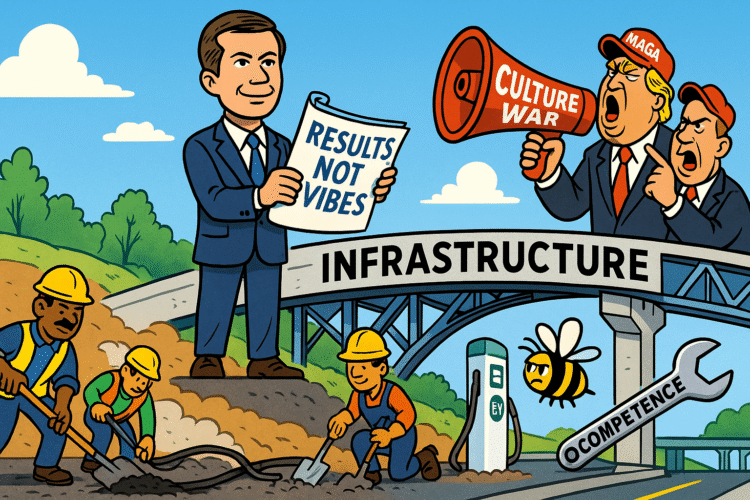
Somewhere in the churning, meme-choked fog of modern politics, competence became uncool. Governing got rebranded as “deep state meddling.” And the people who actually know how to do things—like fix a bridge, regulate a train, or refund a plane ticket—got replaced by men who post.
So maybe it’s time we talk about Pete Buttigieg.
Because while the rest of the political class has been auditioning for cable news therapy hour, he’s been quietly doing the most radical thing imaginable in twenty-first-century America: governing.
The Man Who Actually Fixed Things
Let’s start with the receipts.
As Secretary of Transportation, Pete Buttigieg inherited an agency defined by acronyms and apathy. FAA, FRA, DOT, NHTSA—the alphabet soup of forgotten functions. But under Buttigieg, those bureaucracies started behaving like they belonged to a country that wanted to build again.
The bipartisan infrastructure law wasn’t just passed, it was implemented. Highways got resurfaced, bridges got replaced, ports unclogged, rail lines modernized, and broadband extended to the forgotten corners of the country where buffering has become a form of rural torment.
He didn’t just tweet about supply chains. He fixed them.
While other cabinet members chased headlines, Buttigieg was in the trenches forcing airlines to cough up refunds and post fees upfront. He made “junk fee transparency” a consumer protection issue instead of a punchline. He accelerated EV corridor funding and Buy America supply chains. He pushed new rail safety and hazmat rules into the Federal Register—actual law, not just vibes.
He made sure smaller cities—those eternally shafted by state bureaucracies—could access direct federal grants without groveling through red tape. He cut deals that got local projects moving while others were still scheduling their ribbon-cutting press conferences.
And yes, he’s the guy who took a sleepy department with a C-SPAN camera and turned it into an engine for rebuilding physical and civic infrastructure. You know, the stuff that keeps the country from literally collapsing.
The Mayor Who Never Stopped Being a Mayor
The key to understanding Buttigieg is that he’s still a mayor at heart. South Bend wasn’t New York or Chicago. It was a struggling industrial town that needed someone to modernize it without gentrifying its soul.
He did that the way he’s done everything else: by treating governance like a verb instead of a brand. He learned that progress isn’t about ideology, it’s about delivery.
When you’ve managed a city, the potholes have names. When the trash isn’t picked up, people know where you live.
That mayoral DNA shows in how he runs the Department of Transportation. He’s not a think tank mannequin or a pundit in a government costume. He’s an implementer. He’s the guy who shows up with a spreadsheet and a wrench.
Add to that his service in the Navy Reserve, where he learned logistics from the inside, and you start to see a pattern: Buttigieg doesn’t chase chaos. He manages it.
Which, in a world built on chaos engines, is practically subversive.
The Voter Math That Actually Works
Every cycle, Democrats hold the same therapy session about electability. They invent theories about “broad coalitions” while ignoring the candidate who actually represents one.
Pete Buttigieg is a walking Venn diagram of constituencies that don’t normally overlap.
- Midwestern credibility: He’s from the industrial heartland, not a coastal think tank. That matters in Michigan, Wisconsin, and Pennsylvania, the states that still decide who runs the country.
- Suburban appeal: The college-educated voters who define swing counties see in him a version of liberalism that’s competent, calm, and unembarrassed by homework.
- Generational bridge: Gen Z and Millennials see climate seriousness with jobs attached. Not slogans, not carbon math—actual construction.
- Veteran resonance: A guy who served in uniform, not just in a donor spreadsheet.
- LGBTQ visibility: For millions of queer families, an openly gay president isn’t just symbolic, it’s structural permission to exist fully in public life.
He’s a coalition in a suit—policy fluent, unflappable under fire, and more likely to quote the Clean Water Act than a meme.
If Trump is the chaos id and Biden is the institutional superego, Buttigieg is the functioning executive branch.
The Policy That Writes Itself
The thing about competence is that it sells. You just have to tell people what it looks like.
Buttigieg’s agenda writes itself, and it lands squarely in the sweet spot between vision and pragmatism:
- Climate meets construction: Build EV networks, modernize grids, and create blue-collar jobs that pay union wages in the towns that need them.
- Transit plus housing: Shorter commutes, affordable rents, and walkable cities that work for families, not investors.
- Universal broadband and semiconductor manufacturing: Economic and national security through modern infrastructure.
- Worker protections and apprenticeships: Real pathways to middle-class stability instead of a culture war about who deserves to eat.
- Antitrust enforcement: Actual price relief on groceries and airline tickets by ending decades of corporate consolidation.
- Voting rights modernization: Treat democracy infrastructure with the same urgency as bridges, because both are collapsing under neglect.
That’s a campaign platform you can explain at a town hall and fund through existing programs.
You don’t have to squint to see it. You just have to care enough to look.
The Critiques and the Counterpunch
Of course, every adult in politics carries baggage. The trick is whether they’ve learned from it.
South Bend Policing: Critics cite strained relations between the police department and Black residents during his tenure as mayor. And they’re right—it was fraught. But it’s also where Buttigieg learned the hardest truth of executive office: progress means conflict. His response was to push transparency, introduce bias training, and admit mistakes publicly—something few politicians ever do.
McKinsey Years: Yes, he worked for McKinsey. The firm that trains its consultants to treat empathy like a rounding error. But unlike others, he’s been transparent about the work and the lessons: you can’t spreadsheet your way to justice. You need both data and humanity.
Airline Meltdowns: The winter of cascading cancellations and stranded travelers could’ve sunk him. Instead, it became the crucible for rulemaking that forced airlines to compensate passengers, disclose fees, and modernize systems. It wasn’t performative outrage. It was regulatory follow-through.
East Palestine Train Disaster: He got heat for not showing up faster. Then he wrote the rules that made sure the next derailment wouldn’t be a PR tour, it would be a federal violation. He didn’t just visit the site. He rewrote the manual.
Competence doesn’t mean avoiding crises. It means learning from them.
And that’s the difference between a politician and a leader.
The Politics of Boredom vs. the Politics of Consequence
The biggest challenge for Buttigieg isn’t scandal. It’s narrative.
We live in an age where performance counts more than policy. Trump throws tantrums, DeSantis throws migrants, Vivek throws buzzwords, and the press throws up its hands. Meanwhile, the guy who just quietly built 35,000 EV chargers doesn’t trend.
But maybe that’s the point. Maybe voters are done with spectacle. Maybe the country’s tired of government as a reality show and ready for government as a functioning system.
Buttigieg represents the radical idea that competence is charisma. That steadiness is the new rebellion.
When the bar is subterranean, showing up with a plan is revolutionary.
The Case for Timing
Every politician gets one moment when their skill set matches the national mood. Buttigieg’s might be now.
The Trump-Biden binary has calcified. One is chaos, the other is fatigue. The electorate isn’t craving ideology, it’s craving reliability. Someone who can translate complexity into results. Someone who can actually execute.
Post-shutdown America is desperate for functionality. Bridges, schools, broadband, supply chains, democracy itself—everything needs maintenance. Buttigieg’s entire brand is maintenance with ambition.
He’s not promising miracles. He’s promising competence. And that’s rarer than charisma these days.
The Road to 2028
If he runs, the path is clear. Watch the calendar.
After the 2026 midterms, expect exploratory signals—union roundtables, small donor calls, town hall tours in the Midwest corridor that decides everything. Early endorsements from mayors and veterans’ groups. Quiet meetings with climate tech donors and infrastructure coalitions.
He’ll frame it around results: jobs, roads, fairness, democracy. Not culture wars, not hashtags, not rage click economics. Just results.
That’s the campaign message that works in every diner from Scranton to South Bend.
A government that builds things again.
The Press Test
Of course, the question isn’t whether Buttigieg can deliver. It’s whether the media will notice.
Competence is hard to cover. You can’t reduce a bridge repair to a viral clip. You can’t meme a functioning broadband expansion. So journalists will do what they always do: frame effective governance as boring.
They’ll ask if he’s “too technocratic.” They’ll wonder if he “connects emotionally.” They’ll invite chaos agents to balance panels about bridges.
But you can’t gaslight results. At some point, someone will drive across a bridge he rebuilt or get a refund he forced an airline to pay. And that will be the real campaign ad.
Closing Section: The Competence Rebellion
In a political culture addicted to outrage, Pete Buttigieg is the anti-algorithm.
He’s not loud, he’s effective. He’s not selling fear, he’s selling functionality. And that might be the most subversive campaign of all.
America doesn’t need another savior. It needs an engineer. Someone who can read a bill, balance a budget, and fix a runway without tweeting about it in all caps.
That’s Pete Buttigieg’s pitch: not revolution, but repair.
And maybe, just maybe, the country’s finally ready to admit that competence isn’t boring. It’s survival.
When historians look back at this era, they won’t measure it by how many times we trended. They’ll measure it by who rebuilt the foundations while everyone else was screaming into the void.
If the choice is between noise and function, we know where the smart money should go.
Mayor Pete might just be the last grown-up standing in the room. And at this point, that’s not a slogan. That’s a rescue plan.