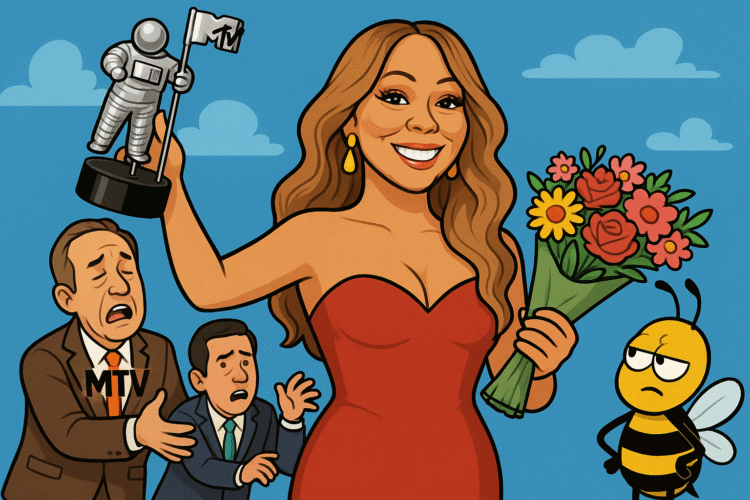
Awards are a strange currency. They aren’t proof of greatness, only proof of consensus—or more often, proof that enough voters remembered to tick the right box after too many cocktails. But every so often, awards act as an accidental confession. That’s what’s happening on September 7, 2025, when the MTV Video Music Awards will finally hand Mariah Carey her first-ever Moon Person. Not for “Best New Artist” in 1991. Not for “Best R&B Video” in the ’90s when she was redefining the genre. Not even in the 2000s when she crawled through the wreckage of Glitter to deliver The Emancipation of Mimi. No. Thirty-five years later, Mariah Carey is finally receiving the Michael Jackson Video Vanguard Award.
The belated coronation will take place at UBS Arena in New York, hosted by LL Cool J—because nothing says “relevant music television” like a network desperate enough to call in rappers from the Reagan era to read cue cards. The show promises a lineup stacked like an overambitious brunch menu: Lady Gaga’s first VMA performance in five years, Doja Cat, Post Malone, J Balvin, and more. But the real event is Mariah: a career-spanning medley and the long-delayed acknowledgement that she was always bigger than this stage.
The Moon Person That Took 35 Years to Land
The irony is structural. Mariah Carey has sold more records than most of the VMA winners combined. She has influenced an entire generation of vocalists, pioneered the hip-hop-pop crossover, and holds Billboard records that will probably survive the next century. And yet, until now, the VMAs pretended she was an opening act.
This is not just oversight—it’s pathology. MTV built its brand on celebrating the visual spectacle of pop, and no one has embodied that more than Mariah. From the windswept balladry of “Vision of Love” to the diamond-butterfly camp of “Heartbreaker,” to the literal snow-globe fantasia of “All I Want for Christmas Is You,” her videography is practically a syllabus in pop aesthetics. But MTV has always been allergic to women it could not diminish. Mariah was too much: too talented, too successful, too unwilling to play the ingénue. So instead of showering her with awards, they left her out of the club.
Now, in 2025, they hand her a Vanguard statue like a guilty parent showing up late to the recital with wilted flowers.
The Vanguard Award as Confession
The Vanguard Award itself has become less about honoring innovation and more about making amends. It’s MTV’s version of back pay. Britney Spears got it in 2011 as a tacit apology for years of exploitation. Rihanna in 2016 as acknowledgment she’d built a dynasty without the network’s help. Beyoncé in 2014 because even MTV understood that pretending she wasn’t the era’s defining visual artist would be malpractice.
Mariah’s turn is just the latest admission: we ignored you for decades, but please let us pretend we always loved you. It’s the award-show equivalent of writing “Happy Birthday” on Facebook three weeks late and hoping no one notices.
A Performance as Vindication
Mariah will perform a medley—her first career-spanning VMA performance. The irony here is that she’s not just promoting her belated award, but also her upcoming album, Here for It All, due September 26. The current single, “Type Dangerous,” is even nominated for Best R&B. It’s as if MTV is trying to cram 35 years of neglect into one night: the award, the performance, the nomination, the promo. It’s desperation disguised as tribute.
But the spectacle will work. Because Mariah Carey doesn’t just perform songs—she inhabits them. When she steps on that stage, wind machine at full blast, whistle register intact, it won’t feel like an apology tour. It’ll feel like victory.
Lady Gaga’s Return and the Shadow of Influence
The night also features Lady Gaga, performing at the VMAs for the first time in five years. Gaga, of course, owes part of her freedom to Mariah. Before Gaga made it acceptable to be unapologetically theatrical, Mariah made it acceptable to be unapologetically Mariah. Not weird. Not avant-garde. Just herself, amplified until it became art. Gaga will dominate headlines, but in a way, her presence is also proof: Mariah’s influence isn’t a footnote—it’s the DNA of the show.
Why It Took So Long
Why did it take this long? The easy answer is sexism. The truer answer is that institutions don’t reward women who outlast them. Awards are given to artists who burn brightly and fade, not to those who keep shining so long they make the award look irrelevant.
Mariah didn’t need the VMAs. She conquered Billboard. She conquered Christmas. She conquered pop itself. MTV needed her, but acknowledging that would mean admitting that their cultural authority died somewhere around the release of the iPhone.
So they ignored her. Until now, when relevance is bleeding out of the VMAs like glitter down a storm drain, and they need someone who can still draw oxygen into the room.
LL Cool J and the Nostalgia Circuit
LL Cool J hosting is itself a commentary on MTV’s desperation. The network hasn’t been relevant to actual music for at least two decades, so it leans on nostalgia. LL Cool J was a pioneer. He was also last chart-relevant before some of tonight’s performers were born. His presence is meant to confer gravitas but instead underlines how deep MTV has fallen into the nostalgia well.
When your award show needs both Mariah Carey and LL Cool J to feel legitimate, what you’re really admitting is that TikTok won the war.
The Haunting Observation
Mariah Carey will walk on that stage September 7 and collect the Vanguard Award. The audience will clap. The medley will trend. Her new album will get the promo boost it deserves. And for a night, it will feel like justice.
But justice delayed is not justice delivered. The truth is, the VMAs didn’t make Mariah Carey. They didn’t crown her. They didn’t even recognize her until it was too embarrassing not to. She made herself. She carried herself. She defined pop without them.
And so the award is not a gift—it’s a confession. A confession that institutions always lag behind artists, that history is written late, and that sometimes the most influential voices are ignored until the silence becomes unbearable.
Mariah Carey doesn’t need this Moon Person. MTV does. Because in the end, the VMAs aren’t honoring her—they’re begging her to honor them.
And that is the joke at the heart of the parade: the artist they ignored for 35 years is the only one left who can save their show.