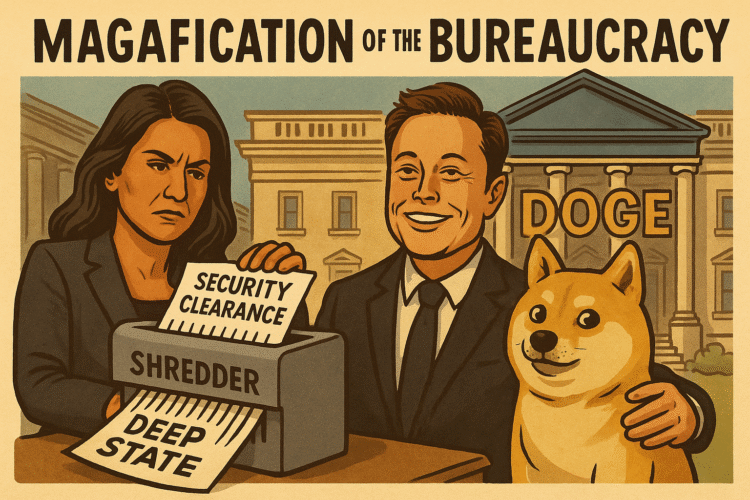
On August 21, 2025, the reporting was clear: the Trump administration is not merely running the federal government; it is remaking it in its own neon-orange image. In place of career expertise, apolitical fact-checking, and that pesky thing called “institutional memory,” we now have a White House governed by loyalty oaths, Silicon Valley imports, and a shiny new bureaucracy called DOGE (yes, that’s the actual acronym, and no, it’s not satire—I checked twice).
This isn’t just a staffing shake-up. It’s an epistemological purge. Knowledge itself, once the currency of governance, has been replaced by vibes, loyalty, and the occasional musings of Elon Musk about “efficiency.” Welcome to the Trump era’s operating system upgrade: Deep State 2.0, now available without the “deep” or the “state.”
Tulsi’s Clearance Bonfire
First up, let’s talk about Director of National Intelligence Tulsi Gabbard’s little summer cleaning project. She revoked 37 security clearances in one fell swoop, claiming the holders had “politicized and manipulated” intelligence. Critics call it a purge. The administration calls it a reset. I call it a bonfire where the kindling is national security expertise and the match is Tulsi’s half-smile.
This wasn’t about catching spies. It was about torching anyone who once admitted—out loud—that Russia did, in fact, interfere in the 2016 election. If you were on the wrong side of that memo, congratulations: your badge now opens the White House gift shop instead of the SCIF.
Airbnb for America
Next up: the White House has tapped Joe Gebbia, co-founder of Airbnb, to run the newly minted National Design Studio. The goal? To “standardize and revamp federal websites.” Because when I think nuclear deterrence and food safety inspections, I think: Wouldn’t it be better if this had a cleaner interface and a star rating system?
Imagine logging on to renew your passport only to be asked whether you’d like a “Superhost” upgrade for $14.99. Or trying to file a FEMA disaster claim and being redirected to a pop-up ad for a glamping yurt in Sedona. This is what governance looks like when you confuse a republic with an app store.
DOGE: Department of Government Efficiency
And then there’s DOGE—the Department of Government Efficiency—championed by none other than Elon Musk. Because apparently, democracy needed rebranding, and nothing says stability like slapping a meme coin on the masthead of the federal bureaucracy.
DOGE’s mandate: cut “waste.” In practice: slash advisory panels, buy out seasoned workers, and consolidate decision-making into the hands of loyalists and contractors. The motto might as well be: Why rely on decades of apolitical expertise when you can crowdsource decisions from a Twitter poll?
We’re told DOGE is about efficiency, but what it really does is strip the government down to its studs, then let Musk scribble slogans on the drywall: “Move Fast, Break Laws.”
The Great Hollowing-Out
The through line here isn’t subtle: reduce expertise, elevate loyalty, import industry hacks. From education to science to public health, advisory committees are being trimmed like hedges in a foreclosure lawn. External scientific input? Curbed. Institutional continuity? Overrated. Civil service protections? Neutered.
This is not a bug; it’s the point. Because when you hollow out the state, you don’t just weaken its ability to enforce rules—you also weaken its ability to resist you. The fewer experts there are, the fewer people left to say, “That’s illegal, sir,” before being escorted out by security.
Supporters vs. Reality
Supporters frame this as “busting deep-state bloat” and “modernizing government.” They talk about trimming fat and cutting costs. What they mean is amputating limbs and calling it a diet.
Yes, bureaucracy can be bloated. Yes, government websites are clunky. But when you replace epidemiologists with loyalty-tested influencers, what you get is not modernization. You get a pandemic response written like a LinkedIn thought-leader post. You get crop subsidy policy designed in a WeWork. You get national security decisions made with fewer footnotes and more emojis.
The Stakes: Facts, Analysis, Competence
The real stakes here aren’t just partisan. They’re existential. Because facts, analysis, and competence don’t just exist in the ether; they require institutions to sustain them. Hollow out the institutions, and you hollow out reality itself.
This is how you get a government that can’t track hurricanes, can’t analyze adversaries, and can’t explain why your child’s classroom is still using asbestos ceiling tiles. But hey, the federal website now has dark mode, so maybe that’s progress.
The Pattern: Loyalty as the Only Credential
Seen together, this is the same playbook over and over:
- Reassignments that sideline career staff into irrelevant posts.
- Advisory-panel cuts that erase inconvenient expertise.
- Structural rewrites that consolidate control in the hands of loyalists.
It’s not about efficiency. It’s about loyalty. In this government, the only credential that matters is your willingness to say “Yes, Mr. President” with a straight face, no matter what fresh hell he just tweeted.
Satire’s Struggle in the Face of Absurdity
It’s hard to parody this because the reality is already absurd. Imagine writing, “The Trump administration replaced intelligence officials with Dogecoin consultants,” and realizing it’s not a joke but a press release. This is what Hannah Arendt meant by the banality of evil—except now it’s the banality of Elon, Tulsi, and a UX team from Airbnb.
Closing Sting
So here we are: a federal government redesigned in the image of a start-up pitch deck. Expertise out, loyalty in. Scientists out, influencers in. Civil service out, DOGE in. And all of it wrapped in the language of “efficiency,” as though what America lacked in 2020 was faster-loading web pages.
The irony, of course, is that hollowing out the government doesn’t make it more efficient. It makes it fragile. And fragility is not strength. It’s the opposite. But in Trump’s America, fragility is the point. Because when the state collapses, all that’s left standing are the loyalists, the billionaires, and the memes.
The rest of us? We’ll be trying to file for disaster relief on a redesigned federal website that crashes halfway through, while a cartoon Shiba Inu tells us: Error 404: Expertise Not Found.