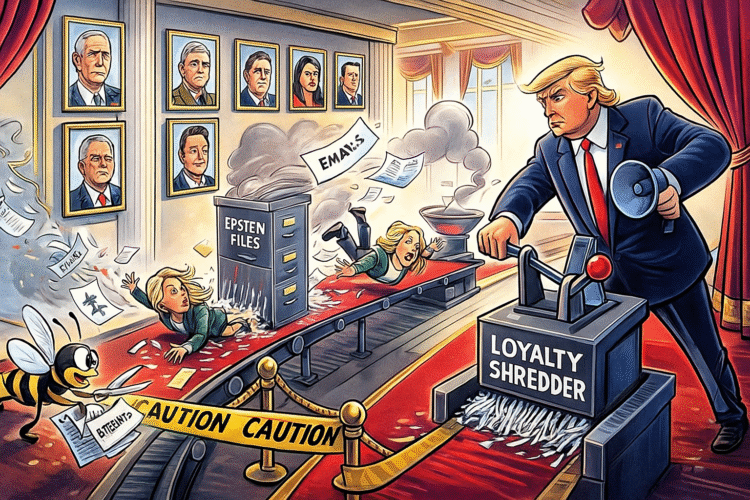
The pattern is not complicated, it is a shredder that activates the second anyone near him grows a conscience, a spine, or an audience of their own.
There is a certain look people get when they realize the room they thought was a team is actually a stage. It is the look of a person hearing the trapdoor unlatch. The lights are still warm, the audience is still clapping, and then, without ceremony, the floor gives way. The drop is not an accident. It is the operating system. Donald Trump has always run his world like a reality show with only one star, and the contract in fine print is the same for everyone who steps into frame. You are useful until you are dangerous, and you become dangerous the moment you show independent power, speak from a conscience, or refuse to serve the next lie on the platter.
We can map the cycle, because it repeats with the steadiness of a metronome. Elevate, flatter, assign loyalty tests, crowd out other sources of legitimacy, and then, when the person insists on their own oxygen, kick the chair. The insults are prewritten, the adjectives recycled, the public humiliation a feature, not a glitch. The purpose is simple. If loyalty runs in only one direction, fear must flow in the other, or the arrangement collapses.
Start with the generals, because that is where the mythology claims Trump assembled gravitas. James Mattis stood for a version of America that carries alliances like vows. He resigned rather than bless a foreign policy built on impulse, spectacle, and grievance. Within hours, the decorated Marine who had been marketed as a living shield became, in Trump’s mouth, the world’s most overrated general. The rewrite was not about history. It was about reminding every other adult in the room that merit is a prop until the moment it is a threat.
Move to Mark Esper, who decided that deploying active duty troops to American streets was not a thing you do to look strong. The decision cost him his job and his dignity inside Trump’s narrative factory. He joined the long line of once indispensable men recast as weak, disloyal, or both. Then Mark Milley, a soldier with a scholar’s mind who chose duty to the Constitution over theater. The retaliation was ugly. Treason, they said, with the volume turned high enough to make even routine security a question. When a leader calls a public servant an enemy, it is not an argument. It is a signal to people who prefer threats to thought.
The civilian bench fared no better. Rex Tillerson walked in with a billionaire’s posture and walked out labeled dumb as a rock and lazy as hell. H. R. McMaster, whose talent is finding the edge where complexity meets action, was boxed into the same corner and discarded when his analysis was inconvenient. John Bolton got the double treatment, fired and then translated into wacko and sick puppy. John Kelly, who tried to impose a chain of command where chaos was the point, became a man who did a bad job and had no temperament, which in this universe means he occasionally said no.
Even the carnival hires could not keep their lanyards. Anthony Scaramucci lasted long enough to pour gasoline on the floor, then discovered that the match was also his exit interview. Eleven days translate into a lifetime in this kind of script, but the ending was familiar. Unstable, said the man who has never once passed a stability test outside the market for attention. Michael Cohen, the fixer who turned law into a hobby of intimidation, earned the label rat and liar the moment he began cooperating with prosecutors. The message is persistent. Loyalty is sacred until it becomes evidence.
The satellite class did not escape the pattern. Nikki Haley and Chris Christie spent years auditioning as reliable messengers. The second they placed distance between their ambitions and Trump’s needs, the names began to stick, disloyal, overrated, ungrateful. Elon Musk learned the lesson in public when an alliance of convenience turned into a clash of egos. He became a bull artist in the vocabulary that substitutes insult for an argument. If the brand does not amplify the star, the brand becomes a target.
This is not a tour of personality for its own sake. It is a map of how power is managed when truth is treated as a coin and conscience as a virus. A leader who cannot tolerate independent legitimacy will punish anyone who tries to grow it. Institutions are supposed to provide ballast in those moments, the guardrails that protect the public from the hunger of a single man. When the institutions are hollowed out, the hunger becomes the policy.
Now place that pattern next to the way Trump has tried to wave away proximity to Jeffrey Epstein. For years, the movement he leads performed a crusade against monsters in other people’s basements. The crusade did not prepare its followers for the day when real receipts would surface that pointed uncomfortably close to home. Emails, banking flags, travel records, photographs, contact lists, quotes. The reaction from Trump world was not outrage at the possibility of harm. It was narrative triage. Hoax. Distraction. Old news. Out of context. Just socializing. Never got a massage. A parade of phrases designed to move eyes away from the ledger and back to the stage.
The record is not a vibe. It is paper. Email lines in which a predator brags that a famous man knew about the girls. Notes about hours spent at a house with a victim whose name is now under black bars. Flight logs with familiar names. Contact materials with birthdays and multiple numbers. Photographs of proximity that were once marketed as glamor and are now excused as coincidence. Civil findings in courtrooms that established liability for sexual abuse and defamation, results that cannot be dismissed with a shrug because they carry a judge’s ink. None of this is a conviction for a different crime. All of it is context that honest people treat as relevant until it is disproved, not as a smear to be wished away.
The pivot from crusader to brand manager would be laughable if it were not so brutal to the survivors who watch the country contort itself around power. If the cause were really about protection, the standard would be simple. Authenticate, publish under protections, demand chain of custody, demand bank access logs with names, demand sworn testimony from custodians and enablers, demand prison logs when whispers of concierge treatment surface. Instead we got a language lesson. Barely legal. It was social. Focus on the border. Move on.
Which brings us to the fresh fracture with Marjorie Taylor Greene, a politician who did more than most to mint Trumpism as a forever brand. She fed the machine. She carried water by the gallon. She made a national career out of amplifying the lies he needed recycled and staffing the outrage he needed warmed. Then she did two unforgivable things at once. She joined a bipartisan push for full release of the Epstein investigative files, and she began talking, however unevenly, about the distance between Trump’s obsessions and the economic pain inside her own base. Healthcare costs, groceries, rent, gas, wages that do not stretch. The reaction was precise and immediate. Wacky. Ranting lunatic. Chronic complainer. The wording is not incidental. It is engineered to degrade and isolate.
The reporting reads like a script we have seen before. Trump showed her polling designed to prove that her ambitions were a mirage without his hand on her shoulder. He refused to bless a next step up the ladder. When she kept pushing on Epstein transparency and the gap between spectacle and groceries, he cut her loose in public and hinted he would help recruit a challenger who would remember their place. She replied with the only weapon that matters in this universe, a fight in the open. She accused him of lying about her record, pressuring Republicans before a key vote on documents that the public deserves to see, proving again that in Trump’s universe no one is a partner, everyone is a mask.
People will argue that Greene does not deserve sympathy, and the impulse is understandable. She participated in building the architecture of harm. But focusing on whether she gets your pity is a distraction from the lesson that matters. If a decorated general, a chief of staff, a secretary of state, a national security adviser, a billionaire ally, multiple governors, multiple ambassadors, a fixer, a social media baron, and an ultra loyal culture warrior can be reduced to trash the second they assert independence, what do you think happens to policy, to law, to norms that guard the body politic from a single man’s appetites. The answer is visible. They get reduced too.
A government run on the shredding of anyone who says no cannot keep promises. It can only keep enemies. That is why the agenda changes shape every week while the grievance stays constant. Real leadership stacks boring wins, the kind you can see at a kitchen table. A politics built on disposal stacks headlines and then lives off the anger that nothing ever changes. The pattern is not a character quirk. It is a way to govern without governing, to turn every failure into proof of sabotage and every betrayal into a loyalty test for the next recruit.
There is another cost, the one the movement pretends not to see. If you call every defection treason, you teach the entire bench to lie or to leave. The competent leave, the silent stay, and the institution becomes a factory for yes men and applause lines. That is how bad policy becomes inevitable. It is not because the leader forgot how to care. It is because he never cared about what caring requires, second opinions, constraints, truth spoken at the wrong time, the dull work of making programs function after the cameras go home.
The moral math gets crueler when you position this pattern next to the children the movement swore to protect. A leader who treats loyalty as a disposable prop will treat truth as one too. The second truth threatens the story, truth is a liar. The second a document threatens the brand, the document is a hoax. The second an ally threatens the grip on narrative, the ally is unstable, weird, wacky. Integrity becomes a costume you take on and off depending on the day’s casting needs. That is not politics as usual. That is corrosion as strategy.
So what is to be done when the shredder is the point. You cannot build a republic around one man’s appetite. You can, however, refuse to let appetite rewrite evidence. When emails say knew about the girls, print the words and demand the chain memos. When flight logs put familiar names in familiar places, publish the logs and ask for sworn explanations. When bank compliance has flagged an ocean of transactions, pull the internal access trails and the committee notes and put them on a table. When a prison transfer looks like concierge justice, request the logs, the authorizations, the camera pulls, and the signatures of the people who said yes. When a politician who built the brand finally says the quiet part about health care costs and grocery bills, do not let the spectacle swallow the substance.
There is also a discipline available to anyone who claims to care about the country more than a man. Stop measuring strength by volume and begin measuring it by whether the people who go to work in the morning can afford the rest of their life. If a leader fires every adult who tells him that his latest fixation will not lower a bill, that leader is not strong. He is loud. If a leader discards a staff that knows how to turn an idea into a program, then blames the deep state when the program fails, that leader is not persecuted. He is incompetent by design.
Marjorie Taylor Greene will find her own path through the wreckage. That part is her business and her voters’ business. The rest of us have different work. We are allowed to hold two thoughts at once. She helped build the machine that hurts people. And, if she chooses to help pry open records that victims have begged the country to read with adult eyes, that pressure is useful. The shredder counts on our cynicism, on our belief that everyone who touches the stage is permanently dirty. Do not let the floor win by staying silent about documents that deserve light.
Watch what happens next, because it is always the same, and knowing the timing helps. First, the insults escalate. Then, the rumor mill about a primary challenger begins to hum. Then, a new mask arrives to say the lines with more enthusiasm. Then, if the poll bumps, the leader says he never cared, never knew, always suspected, and thanks the base for saving him. It is not a story. It is plumbing. Every valve serves the ego, every drain empties into the same tank of grievance.
It would be satisfying to end with a curse. Better to end with a boring sentence about power. A republic survives not because the best men rise, but because even the worst men are constrained. Constraints are not the enemy of strength. They are the proof that strength answers to something other than itself. Any movement that treats constraint as betrayal will produce the same result again and again, loyalty pledges followed by purges, headlines followed by nothing, promises followed by hunger, and a trail of people who thought they were part of something larger discovering they were only costumes in a show that eats its cast.
Receipts, Not Vibes
The pattern is the point. Elevate, demand loyalty, punish conscience, rewrite the past, and call it strength. Mattis, Esper, Milley, Tillerson, McMaster, Bolton, Kelly, Scaramucci, Cohen, Haley, Christie, Musk, and now Greene, each tossed into the pit the second they became inconvenient. Pair that with the attempt to talk away proximity to Epstein in the face of emails, logs, photos, contact lists, and court findings, and the picture sharpens. A leader who treats people as disposable will treat truth the same way. The remedy is not a clever insult. It is sunlight, authentication, sworn testimony, bank access trails, prison logs, and a press that prints what documents say in words a working person can understand. The test for all of us is whether we can keep our eyes on the ledger when the show is screaming for attention. The show ends. The ledger does not.