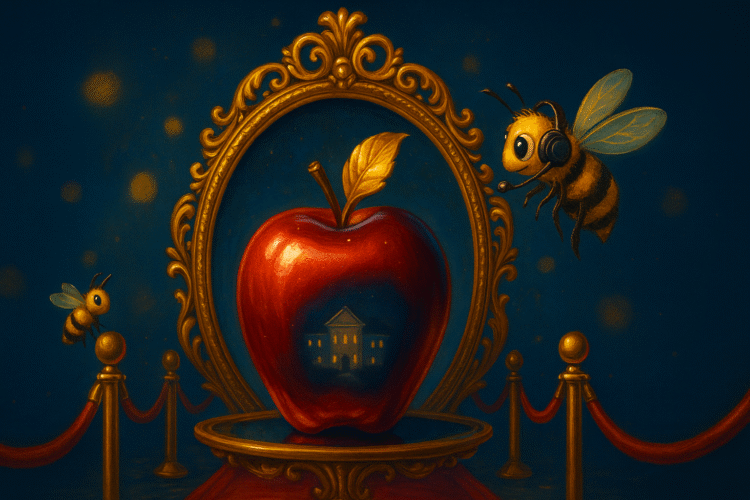
Read Accept This Apple and explore my Amazon author page.
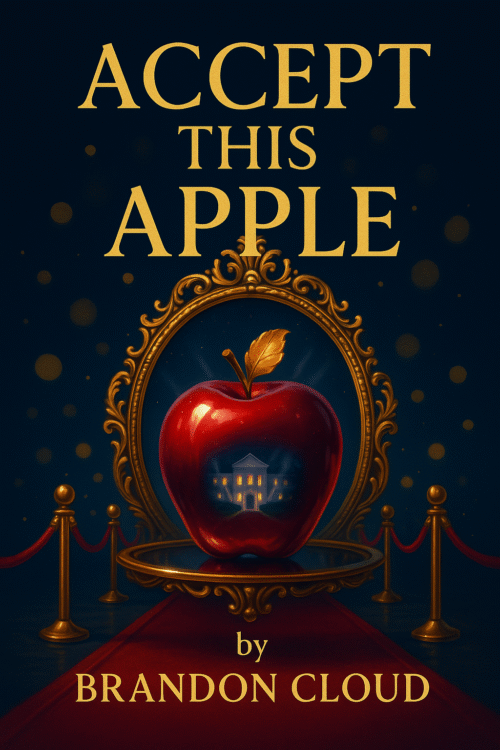
The Faeries Tell series has one unruly mission: keep the shine, fix the wiring, and invite everyone who’s been standing just off-camera to step into the light. Each book reimagines a “problematic” fairy tale through trauma-literate realism, queerness without spectacle, and modern logistics—because real magic is what survives when the cameras cut. In Accept This Apple, Snow White checks into a glossy reality-dating juggernaut where a Prince hands out apples, and discovers the fairy tale he wanted is smaller, steadier, and truer than the edit will ever allow.
This Snow (24, design assistant; observant, wry, accidentally sincere) comes for the crown and stumbles into a kitchen—a literal one at 2 a.m., cinnamon in a pan, where competence is sexier than a spotlight. “I came for a crown and stayed for a kitchen,” he admits later, and you can feel the relief slide into his voice like a chair finally pushed all the way under the table. The show sells romance in big-font moments; this story teaches you to crave the quiet ones: the grounding breath, the steady hand, the “you good?” asked without fanfare. Accept This Apple

The “huntsman” here is Kian “Doc” (27, ER resident; steady, funny, unshowy), a man who models care without performance. His love language? Timing, boundaries, and medically precise calm. “Worst nights don’t need speeches—just someone to keep time,” he says in a pre-season package, and a whole generation of readers raised on grand gestures will understand why Snow’s body hears that before his brain does. Another line repeats in the book like a heartbeat: “In on four, out on six.” It’s first aid for panic and a relationship ethic disguised as a breathing cue.
This is also a book where the Prince (Preston, 29) isn’t a cardboard villain. He’s handsome, practiced, sometimes trapped by his own brand—and he learns to be useful off-camera. The “stepmother”? Vivian, the razor-competent showrunner who believes control equals care until the kids she’s responsible for teach her mercy in real time. And the Seven are not props; they’re fully drawn adults with jobs, coping styles, and their own arcs: Ira the blunt, loyal union electrician; Dani the steel-toe-gentle sound mixer; Remy the night-kitchen heart; Felix the radiant event planner; Noel the soft-voiced archivist; Ari the pragmatic florist; Miles the generous improviser anchored by the world’s calmest transportation coordinator, Jonah. The house they build together runs on labels, room tone, and a shared policy of “abundance via sharing.”
Let’s talk about the original Snow White and why it creaks. There’s the non-consensual kiss (absolutely not in this house), the “fairest of them all” beauty contest (yikes), the stepmother flattened into jealousy with great cheekbones, and seven men who get treated like a punchline instead of people. Accept This Apple doesn’t scold the old story; it rewrites the conditions so those problems never get traction. Apples become choices (stay, date, seed for “later”), the Glass Coffin becomes a “Glass Box” stunt they refuse on live TV, “fairest” is redefined as “most honest in the mirror,” and the kiss belongs to two awake adults who can laugh about it later. (“The kiss belongs to two awake adults who can choose to be silly about it later,” the author promises—a line that lands like a window opening in a room you didn’t know was stuffy.)
Plot without spoilers? Here’s the promise. It’s 2025 Los Angeles: soundstages, a rented “chateau,” apple-blossom arches hiding two-way mirrors, a kitchen wired for challenges, and a control room where magic is plotted in call sheets. Snow arrives on limo night, nails the laugh that trends (“Keep the laugh,” Vivian says in the bay. “He reads kind.”), accepts a flawless red apple…and pockets it. At 2 a.m., in the hum of compressors and craft-services lids, he finds the edges where TV can’t quite script people: Remy feeding grief with pastry, Felix making flow charts feel like affection, Ira turning solidarity into house policy, and Kian tapping a metronome on a stainless table that says, without words, you can breathe now.
As sponsorship weeks and manufactured friction close in, the cast realizes the Prince isn’t that charming and the format is built to break them. Bound by contracts, they bend the show instead. Operation Be Boring might be the funniest revolt in reality-TV fiction: competence so relentless that villainy has nowhere to sit. “Props have a job. So do I,” Snow notes in confession, declining to give the edit a tantrum it can loop. The show expects rivals; what it gets is found family. The network wants triangles; audiences fall for steadiness. Viewers (and readers) begin shipping #SnowAndDoc not because the kiss is cinematic but because watching someone bring water before you realize you’re thirsty is.
The Faeries Tell ethos is baked into every beat. Queerness is ordinary—arguing about mug politics, building “quiet rooms,” and writing house governance rules so kindness survives even when goodwill runs out. Consent is visible behavior, not a lecture: someone steps back from a mic cable and asks “pass?”; “Not tonight” is a whole sentence, and everyone treats it that way. Asexual representation isn’t a Very Special Episode; it’s a hardware-store date where the right wall anchor matters more than performance, and a word that finally fits drops into a life with relief instead of fanfare. When Ira and Dani figure out that “room tone” (a minute of recorded quiet so edits can breathe) is also a love language, it reframes intimacy more powerfully than a dozen fireworks shots.
Stylistically, the book feels like clean glass—bright, quick, irreverent when it needs to be, never allergic to sincerity. There’s comedy (“Carbs before feelings,” Remy deadpans, sliding cinnamon-sugar across the counter) and there’s boundary (“Not tonight,” Snow says to a live “Glass Box” gimmick, and the audience applauds a decision instead of a meltdown). There’s also the kind of micro-practical detail readers of this series love: silicone caps on chair legs, weatherstrip to tame an alley compressor, a “MUST/CAN/NO” card system for house asks. You come for the sparkle; you stay for the logistics, because logistics are what let love be love on a Wednesday when everyone’s tired.
If you’re a reality-TV obsessive, you’ll catch the Easter eggs: trailer misdirects, contract dragons (NDAs as curses you must outsmart), “night ops” addenda, the social team hovering with ship-names. If you hate reality TV, this book might be the spell that breaks your resistance. It’s a love letter to what remains undeniably human inside the machine: nerves, stumbles, freezer-space fights, and a quiet decision to care for one another even when the format begs you to do the opposite. Vivian’s producer brain keeps whispering “pacing, stakes, less beige,” but the season’s heart forms sideways—in kitchens, loading bays, and service corridors mapped for escape instead of spectacle.
Ten reasons you’ll feel this one in your sternum (quietly, because this book respects smallness):
— The moment Snow watches a man take care of someone else and realizes his body has already chosen a compass.
— A seed packet labeled “Later?”—a love letter to slow futures in a culture addicted to Now.
— The house’s collective genius for making competence trend.
— Paper crowns folded from old call sheets, credit redistributed to the crew who actually held the season together.
— A group confessional that goes viral for clarity instead of tears.
— “Breath before pretty,” Ari insists, and it becomes policy for design and feelings.
— Noel’s precision-lethal one-liners that cut through the noise like a scalpel.
— Miles learning to pause, Jonah loving him most at “a calm three out of ten,” and friendship getting the same narrative oxygen as romance.
— A ficus that may or may not live, and why that matters.
— An epilogue with imperfect apples and no cameras—because sometimes the truest happy ending is a Tuesday tart.
Five (okay, more than five) lines you’ll want to underline as you read:
“Keep the laugh. He reads kind.”
“Worst nights don’t need speeches—just someone to keep time.”
“In on four, out on six.”
“Carbs before feelings.”
“Not tonight.”
“Props have a job. So do I.”
“The kiss belongs to two awake adults who can choose to be silly about it later.”
“Breath before pretty.”
Representation isn’t garnish here; it’s the meal plan. The series treats queer joy as ordinary and sustainable—Tuesday dinners, one-clap arrivals, a quiet “I can help” that lands like devotion. It refuses to flatten the stepmother into a cartoon; it lets a prince learn usefulness; it gives an ace character an ending that isn’t loneliness repackaged. And it does all of this without turning characters into tutorials. People argue about coffee lids. They label shelves. They apologize without monologues. They set boundaries and are loved for them.
Readers of The Faeries Tell already know the contract I make with you: I’ll keep the bones of the myth but transpose the power—from spectacle to maintenance, from “fairest” to “most functional together,” from “true love’s kiss” to “true love’s work.” Accept This Apple honors that promise and deepens it. The romantic payoff is real, but so is the collective one: solidarity over management, friendship over rivalry, competence over carnage. When a house refuses the finale’s “final elimination” and crowns the work instead, it’s not a gimmick—it’s a thesis.
If you’re new to the series, start here or anywhere; they’re stand-alones by design. If you’ve been with me since Beau burned, Cinderfella rebelled, and Sleeping Fairy rewrote a curse with neon and braille, you’ll feel the same hum under the pages: ordinary tenderness scaled into a life you can keep. Kitchens are sanctuaries, hallways are escape routes, and love is a system you build together so it still works when everyone is tired and nobody is trying to be magic.
Good to know: the ebook is free for its first 5 days after release, and it remains free to read with Kindle Unlimited. If you’re new to KU, there’s a 3-month free trial, so you can binge the entire Faeries Tell collection and see which retelling steals your sleep. Then come back and tell me which character you adopted against your will. (My money this round is on a sound mixer in steel-toe boots and a union electrician who believes keys should be shared.)
If you’ve ever wanted a fairy tale to stop performing long enough to breathe, I wrote Accept This Apple for you. It’s glossy where it’s fun, gritty where life insists, and tender in the places that usually get cut for time. I can’t give you the ending here—that’s a Tuesday you’ll have to earn—but I can promise the path is built from small, durable choices: a hand hovering until you nod yes, a seed pocketed for later, a drawer where a perfect red apple waits because tonight you needed cinnamon instead.
Thank you for supporting indie authors—and for choosing stories where queerness is everyday, tenderness gets screen time, and the seven aren’t a slur; they’re the group chat you keep unmuted. When you finish, leave a review; it helps other readers find the kitchen at the back of the set. I’ll be there tapping a quiet rhythm on the counter, counting four in and six out, waiting for you to say, Not tonight. Or better: I’m home.