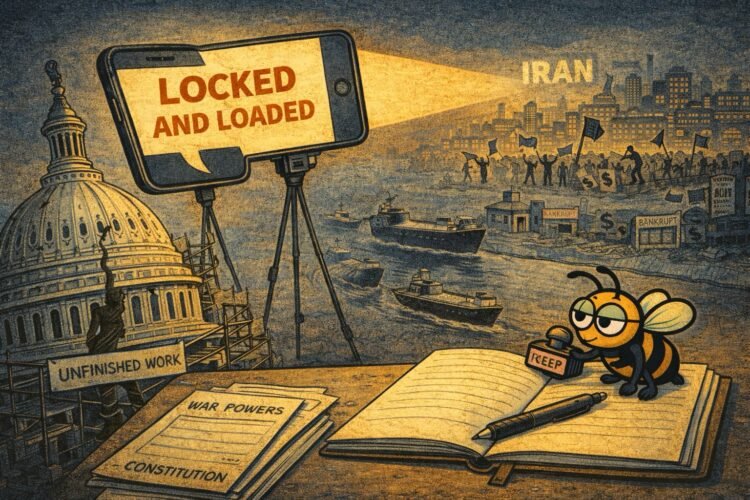
When foreign policy becomes a midnight post and democracy is optional paperwork.
President Donald Trump went to Truth Social and announced that the United States is “locked and loaded and ready to go” if Iranian authorities violently suppress the latest wave of protests spreading across the country. The phrasing was familiar, theatrical, and deliberately vague, the kind of language that sounds decisive until you ask what it commits, who decides, and what happens after the applause dies down.
The protests themselves are real. They have been growing out of an economic crisis that has turned daily life into arithmetic nobody can win. Inflation has surged. The rial has collapsed. Purchasing power has evaporated. Demonstrations have spread from bazaars into Tehran and other cities, pulling in people who are not ideological hobbyists but workers, shopkeepers, families watching livelihoods disappear. Clashes with security forces have already left at least seven people dead, and Iranian officials have warned that any U.S. meddling would cross a red line and provoke serious consequences.
That’s the situation on the ground. It’s complicated, volatile, and tragic in the way economic collapse usually is.
Then there’s the American response, which arrives like a fire alarm pulled by someone who isn’t in the building.
Trump’s threat did not come with a policy paper. It did not come with a briefing to Congress. It did not come with a clear explanation of what “locked and loaded” means in practice, what threshold would trigger action, or how the United States would avoid doing exactly what it claims to oppose, namely escalating violence against civilians. It came as a post, delivered in the rhetorical register of dominance, as if geopolitical restraint is a weakness and deliberation is a delay tactic for cowards.
This flare fits neatly into the broader context of U.S.–Iran relations under Trump. After withdrawing from the Iran nuclear deal, the administration reimposed sweeping sanctions that deepened Iran’s economic isolation and pressure. Those sanctions are not the sole cause of Iran’s crisis, but they are part of the stress system squeezing the country’s economy. Tehran has responded with warnings, crackdowns, and even the appointment of a new central bank governor in an attempt to stabilize the currency and restore confidence. None of it has resolved the underlying problem, which is that a society under economic suffocation eventually pushes back.
These protests are the largest since the Mahsa Amini demonstrations, and they carry that same mix of rage, fear, and exhaustion. They are about dignity as much as dollars. They are about governance as much as groceries. They are not a Hollywood montage where outside intervention reliably produces freedom credits.
Which brings us to the first thing missing from most headline coverage, the thing that should stop any serious country from treating this like an opportunity.
The United States is not a nation flush with solved problems.
We are living through economic anxiety that has turned stability into a luxury. Political polarization has calcified into a permanent condition. Infrastructure gaps are visible every time a bridge fails, a power grid collapses, or a train derails. Climate shocks are no longer seasonal surprises, they are structural stressors. Healthcare remains unstable, expensive, and inaccessible for millions. Social trust is thin. Institutions are brittle. Entire regions feel forgotten. Entire communities feel disposable.
This is not the posture of a country that should be casually threatening military action over another nation’s internal unrest.
Foreign policy bandwidth is not infinite. Strategic focus is not a vibe. Every threat carries costs, even if it never turns into a strike. It hardens positions. It raises risk premiums. It invites miscalculation. It consumes attention that could be spent repairing the systems that are fraying at home. When an American president announces readiness to use force abroad while domestic crises remain unresolved, it does not signal strength. It signals distraction.
The second missing point is constitutional, and it matters whether or not people find it exciting.
Any military strike on Iran, particularly one framed as a response to how Iran treats its own protesters, would require explicit Congressional authorization. The Constitution vests the power to declare war with Congress, not with social media accounts. The War Powers Resolution exists precisely to prevent unilateral executive action from dragging the country into conflict based on impulse, rhetoric, or political convenience.
Posting threats at three in the morning does not meet that standard.
Washington has developed a dangerous habit of treating executive bluster as policy, as if repeated declarations can substitute for democratic oversight. They cannot. They were never meant to. The Founders did not imagine a system where one person could announce readiness for war in a digital forum designed for applause and outrage, then dare the legislature to clean up the mess.
This isn’t about procedural fussiness. It’s about legitimacy. When the executive branch threatens force without Congressional debate or authorization, it erodes the very democratic principles it claims to defend abroad. It turns war into a branding exercise and oversight into an inconvenience.
The third missing point is the one everyone knows and pretends not to see.
This threat is not primarily about protecting freedom of speech in Iran.
If it were, the United States would have a long list of allies to confront first. If it were, consistency would matter. If it were, human rights would not appear selectively when they align with strategic interests.
This is about the dollar, oil chokepoints, and leverage.
Iran sits astride the Strait of Hormuz, a critical artery for global energy flows. Instability there rattles markets. It affects oil prices. It threatens shipping lanes. It sends shockwaves through economies that are already fragile. The region is also deeply entangled with U.S. strategic commitments, including Israel, arms sales, and broader great power posturing.
When American leaders use “rescue” language in this context, it functions as geopolitical cover. It wraps economic and security incentives in moral vocabulary, allowing intervention to sound like altruism rather than strategy. It’s a familiar move, and it has a long track record of producing outcomes that are neither peaceful nor democratic.
Calls for intervention too often masquerade as human rights concern while resting primarily on economic calculations. That doesn’t mean the suffering in Iran is fake or unimportant. It means the U.S. response is not as pure as advertised.
Threatening military action in response to protest suppression does not empower protesters. It gives hardliners a narrative. It allows repression to be framed as defense against foreign aggression. It raises the stakes for civilians who are already at risk. It turns internal dissent into an international confrontation, which is rarely good for the people in the streets.
It also misunderstands how change actually happens.
Economic protests succeed or fail based on internal dynamics, elite fractures, legitimacy, and the balance of fear. Outside military threats tend to unify regimes, not weaken them. They justify crackdowns. They drown out reformers. They make compromise look like surrender.
So what does “locked and loaded” actually accomplish.
It signals to domestic audiences that the president is tough. It reassures certain allies that American muscle remains on standby. It keeps the conversation away from Congressional debate. It creates the illusion of control. And it risks turning a fragile situation into a regional crisis without any democratic mandate.
Meanwhile, at home, Americans are still waiting for a government that feels locked and loaded to fix healthcare, infrastructure, climate resilience, and economic precarity. They are still waiting for political energy to be spent on boring competence instead of cinematic threats.
This is the paradox of American power in this moment. We are eager to posture abroad while avoiding repair at home. We speak the language of freedom while tolerating inequality. We brand intervention as morality while outsourcing the consequences to future news cycles.
Iran’s protests deserve attention, solidarity, and honest reporting. They do not deserve to be turned into a pretext for unilateral military threats that bypass Congress and inflate risk. If the United States wants to support human rights, it has tools that do not involve loaded metaphors and strategic ambiguity. It can amplify voices without drowning them out. It can apply pressure without promising violence. It can respect its own democratic processes while criticizing others.
Or it can keep doing this.
Announcing readiness for war in response to economic unrest is not leadership. It’s noise with consequences. It treats foreign suffering as a stage and American democracy as optional paperwork. It confuses urgency with wisdom and volume with authority.
The world does not need more locked and loaded posts. It needs fewer situations where those posts feel plausible.
Receipt Time: Threats Are Not Policy
When a president reaches for military language to address another country’s internal protests, it says less about compassion and more about priorities. The Constitution still exists. Congress still matters. And human rights are not a branding opportunity. If the United States wants to stand for freedom, it should start by respecting its own processes and fixing its own fractures, instead of using someone else’s crisis as a backdrop for performative toughness.