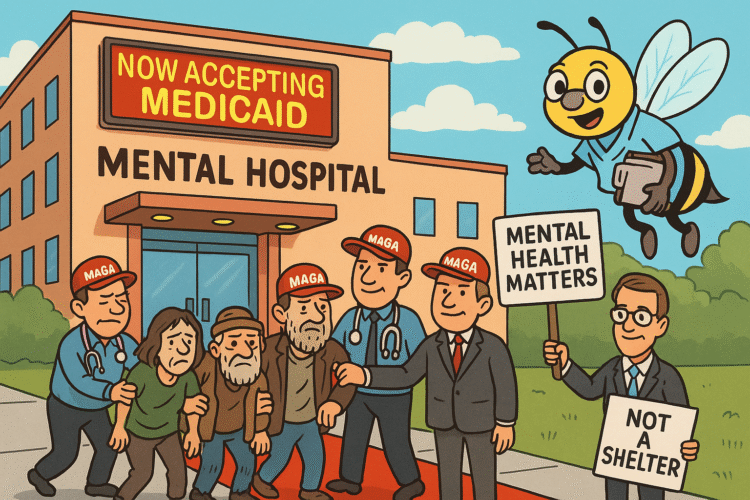
At long last, America’s most beloved political rally cry has returned—not for Hillary, not for Hunter, but for Hannah under the freeway overpass.
Yes, “Lock Her Up” has been dusted off, polished, and rebranded for a new demographic: the unhoused. And it’s all thanks to the latest Trump executive order, which proposes the forcible hospitalization of homeless individuals nationwide.
Some are calling it a mental health initiative. Others, a compassionate intervention. But those of us with working memories might recognize it for what it is: the criminalization of poverty, now with a fresh coat of clinical justification.
Because Nothing Says “Freedom” Like Involuntary Commitment
According to the order, local governments will be empowered (read: pressured) to detain those “displaying signs of mental instability or being a public safety concern.” Translation? If you smell bad, talk to yourself, or exist within two blocks of a Starbucks patio, you might soon find yourself fitted with a paper gown and a 72-hour hold.
And if that sounds extreme, relax—it’s only unconstitutional when poor people don’t get institutionalized.
Supporters argue it’s a bold solution to an ongoing crisis. Critics argue it’s just fascism in a lab coat. But both agree: it polls better than actual affordable housing.
The Return of Reagan-Era Nostalgia, But Make It Meaner
This isn’t America’s first flirtation with medically coded displacement. We’ve been playing psychiatric Whac-A-Mole since the days of trickle-down empathy. Only now, the process has been streamlined: skip the messy social services, slap a DSM diagnosis on the symptoms of poverty, and voila—problem solved.
Because it’s much easier to diagnose “delusions of grandeur” than to admit the delusion might be the country itself.
After all, believing someone deserves a jail cell for refusing to live in a shelter that smells like bleach and broken promises? That’s not mental illness. That’s policy.
The Infrastructure of Incarceration, Just Add Bedrails
What’s most impressive isn’t the cruelty—it’s the efficiency. With ICE vans reportedly on standby and abandoned psych wings quietly being refurbished (call it “vintage institutional chic”), the logistics are already falling into place. You could call it the privatized pipeline from sidewalk to sedation.
And somewhere, a for-profit medical group is refreshing their contracts.
The hospitals? Overwhelmed. The providers? Burnt out. But the goal isn’t treatment. It’s visibility. Or rather, invisibility. The only thing worse than poverty in America… is having to see it.
Meanwhile, at the ER: “We’re a Hospital, Not a Holding Cell”
Hospitals, notably, are not designed to be halfway houses for state-sanctioned displacement. They’re underfunded, understaffed, and already navigating an emergency mental health crisis of their own. Now they’re expected to act as holding facilities, diagnostics labs, detox centers, and containment zones for a government that refuses to invest in actual shelter infrastructure?
Imagine telling a trauma nurse juggling six stroke patients and a fentanyl OD that their new admission is a nonviolent, unhoused man picked up for “acting erratic” near a laundromat. No insurance. No diagnosis. Just a clipboard note that reads: “cleared for psychiatric intake—pending reevaluation.”
This isn’t mental health care. It’s moral outsourcing.
Every time the state punts its poverty problem to the ER, it compromises care for everyone. And it weaponizes the one place meant to offer healing into a proxy for social control.
Hospitals were meant to stabilize the body. Now they’re being asked to disappear the inconvenient.
The Empathy Olympics Are Canceled
There will, of course, be statements. Carefully crafted concern from mayors. Civil rights attorneys dusting off boilerplate language about “due process.” Maybe a tearful segment on late-night television where a celebrity with perfect skin reads a poem about dignity.
But make no mistake: the algorithm already moved on. And soon, so will the bodies.
Because nothing says leadership like legislating human beings into shadows and calling it a solution.
Final Thoughts
This isn’t policy. It’s aesthetic gentrification. It’s the sterilized, scented-candle version of “out of sight, out of mind.” It’s the state deciding that visibility is violence—but only when the person you’re looking at is holding a sign instead of a stock portfolio.
So next time someone in a red hat chants “Lock her up,” ask who they’re pointing at.
It might not be Hillary.
It might just be someone trying to survive.
And the person forced to process them will be wearing scrubs, not a robe.