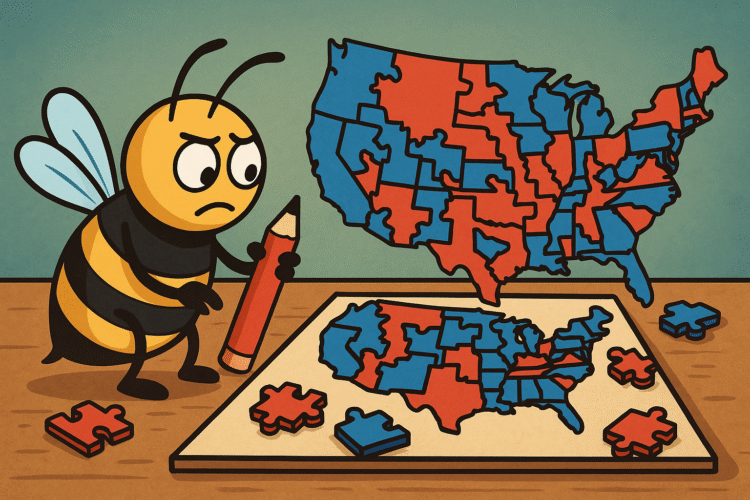
It’s once again that magical time in America when maps are less about geography and more about strategy—where lines aren’t drawn by cartographers but by career politicians with a vengeance kink. This month, the Supreme Court decided to up the ante in Louisiana’s redistricting case, because apparently we haven’t suffered enough slow-moving constitutional erosion for one decade.
At the heart of the case? Whether Louisiana can continue to pretend that the majority of its Black residents are ghosts when drawing political districts. The state currently has six congressional seats and only one—yes, one—is designed to give Black voters a meaningful voice. The other five? Let’s just say they’ve been gerrymandered so precisely, you’d think the GOP outsourced the job to a plastic surgeon with a thing for asymmetry and erasure.
But let’s not pretend this is just about Louisiana. This is about the whole country. This is about the invisible scaffolding of power—the quietly devastating process of redistricting—and how it shapes everything from school funding to climate policy to whether or not you’ll spend 6 hours in line to vote next November.
Redistricting, for the blissfully unaware, is the once-a-decade ritual where elected officials redraw the boundaries of legislative districts to reflect population shifts. That sounds reasonable until you remember this is America, where “reflect” often means “rig for survival.” It’s not about giving every voter a voice—it’s about making sure the right ones get a megaphone while the others are duct-taped in the basement.
And for the last 30 years, Republicans have treated this process like the Super Bowl of disenfranchisement. They don’t just gerrymander—they ghostwrite democracy like it’s a legal thriller with a predictable ending. They’ve perfected the art of drawing districts that look like a spider on meth, all to concentrate their power while diluting everyone else’s. It’s a strategy that would be brilliant if it weren’t also existentially horrifying.
Meanwhile, Democrats continue to show up to a knife fight with a tote bag full of voter registration forms and a Spotify playlist called “Hope & Unity.” While the GOP is hard at work crafting maps that turn blue cities into Swiss cheese, Democrats are busy holding town halls and asking if anyone has a Sharpie. Bless their hearts.
If you want to understand why redistricting matters, just look at Wisconsin. In 2018, Democrats won 53% of the vote for state assembly—and got 36% of the seats. That’s not representation. That’s democracy with the math of a slot machine. Redistricting doesn’t just shift power; it locks it behind a biometric vault, where only certain party IDs are allowed entry.
Which brings us back to the Supreme Court—the nine unelected adults with lifetime appointments who increasingly treat precedent like an optional reading assignment. Their involvement in Louisiana’s case isn’t about fairness. It’s about control. It’s about testing how far they can stretch the definition of “constitutional” before the seams finally split.
If the Court sides with Louisiana, it signals open season for every Republican-controlled state to slice and dice their maps like it’s the Cold War and every Black voter is a threat to national security. It’s not just undemocratic—it’s demographic warfare.
So what can Democrats do? Stop pretending redistricting is beneath them. Stop writing think pieces and start drawing lines. If the game is rigged, learn how to play it better—then change the rules once you’re back in power. Hire the same consultants. Use the same data tools. Show up with knives and maps and the will to win.
Because here’s the truth: fairness doesn’t self-enforce. It has to be fought for, clawed for, and yes—strategized for. The GOP figured that out years ago. They’re not winning because more people like them. They’re winning because they know where to draw the lines.
So while Democrats are still looking for the high road, Republicans are laying concrete on the low one and building a wall with a voter suppression moat. And if you think the courts will save us, I have a congressional district shaped like a question mark to sell you.
Final Thought:
Redistricting isn’t sexy. It doesn’t trend. But it decides who gets heard, who gets erased, and who gets to pretend it’s all just politics. If Democrats don’t start drawing power as well as preaching it, they’ll keep losing—neatly, politely, and permanently.