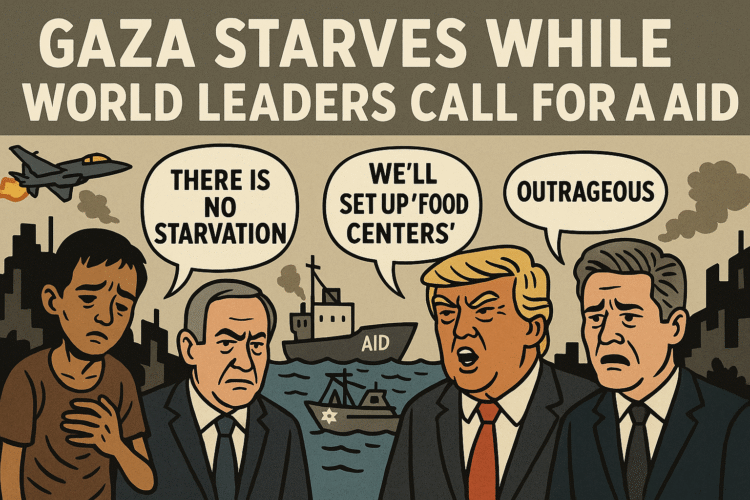
In a powerful show of concern, several world leaders have finally taken a bold, unified stand against the most dangerous enemy in the Gaza conflict: bad press.
After months of airstrikes, blockades, and performative diplomacy, President Donald J. Trump emerged from his golf cart to announce that yes—“real starvation” is happening in Gaza, and yes—it looks terrible on camera. In response, he has proposed a daring plan: the creation of U.S.-sponsored “food centers,” where aid will be distributed alongside flags, branded hashtags, and maybe a commemorative coin if you ask nicely.
“We’ll give them food. The best food. American food. Nobody starves on my watch—unless they’re Democrats or poor.”
The announcement was made moments after Israeli forces reportedly raided a civilian aid ship, seizing humanitarian supplies and detaining the crew, presumably for the high crime of being inconvenient to the official narrative.
Meanwhile, UK Prime Minister Keir Starmer—whose spine has been on sabbatical since taking office—expressed “outrage” at the images of starving children and then immediately returned to his regularly scheduled programming: moderate silence.
Airstrikes Paused, But Only to Catch Their Breath
Despite repeated promises of “pauses” for aid delivery, the Israeli government has continued military operations in Gaza with the same frequency as a cable news rebrand. The term “pause,” it turns out, is doing a lot of heavy lifting—like describing a four-second gap between airstrikes, or the brief moment when a drone operator scratches his nose.
Prime Minister Netanyahu denied that starvation is occurring in Gaza, possibly confusing malnutrition with misinformation, or simply sticking to the doctrine of “If you can’t see the hunger from Tel Aviv, it doesn’t exist.”
When asked about the growing number of Palestinian children dying from lack of food—currently reported at 88—Netanyahu reportedly said, “Hamas is responsible,” because in this geopolitical game of hot potato, accountability is always someone else’s casserole.
Humanitarian Crisis, But Make It Stageworthy
Trump’s proposed food centers will presumably be built in areas previously flattened by American-made bombs, creating a poetic symmetry between cause and cure. Aid, after all, must be earned through appropriate suffering and presented with flair. Picture it: tents labeled “TRUMP MEALS,” each one flanked by military guards and a velvet rope, serving peanut butter packets next to “Keep America Fed Again” hats.
“I’m the best at aid,” Trump declared. “Better than Mother Teresa, okay? She didn’t even have a brand.”
Meanwhile, Starmer’s contribution was to glare sternly at the camera during a press conference, his voice catching just slightly—right before re-endorsing a defense contract. His commitment to justice is unwavering, so long as it doesn’t interfere with re-election.
We’ve Entered the Hunger Games Cinematic Universe
It’s hard to tell whether Gaza is being treated as a battlefield or a marketing opportunity. With headlines framed like studio notes—“Starvation Stuns Leaders,” “Airstrikes Resume Despite Pause Promo”—you’d be forgiven for thinking this was a franchise reboot.
The real tragedy isn’t just the devastation. It’s the choreography.
Aid is delayed, then delivered, then seized. Press conferences express “deep concern,” then pivot to poll numbers. Photos of emaciated children are shared, condemned, then quietly buried under stories about Taylor Swift’s political endorsements. Even the deaths are quantified in press-friendly chunks. “147 starved,” as if suffering becomes more palatable when numerically neat.
Final Thought:
When starvation becomes a branding issue and aid a photo opportunity, the world isn’t responding to a crisis—it’s managing a narrative.
So while Gaza’s children wither under blockade, bombs, and bureaucracy, world leaders adjust their lighting, practice their outrage, and continue to wage the most coordinated campaign of all: plausible deniability in a high-definition age.
Because in 2025, hunger doesn’t make headlines—optics do.