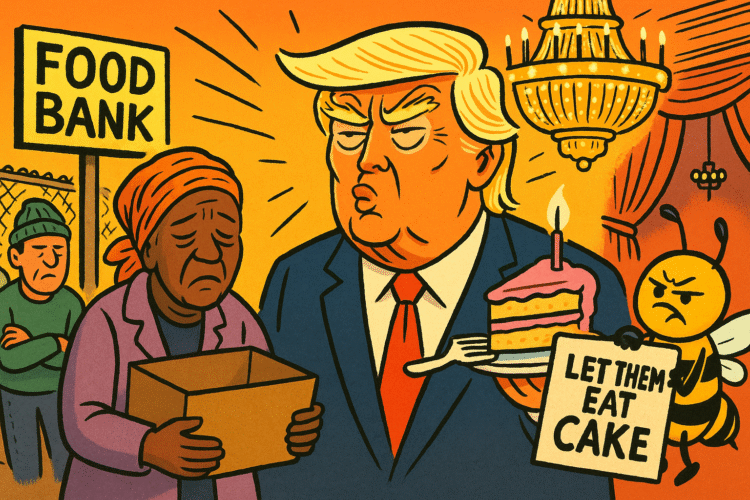
The White House East Wing is gone, ground to powder and carted off in dump trucks so that a privately funded, ninety-thousand-square-foot ballroom can rise in its place. Somewhere between the marble sketches and the gilded drapery orders, the president found time to cut off food aid for over forty million Americans.
Marie Antoinette said “Let them eat cake.” Donald Trump has upgraded that to “Let them eat nothing. My priority is my Epstein Ballroom.”
The Hunger Games, Federal Edition
By November 1, 41 to 42 million SNAP recipients will wake up to find that their benefits have vanished. Not reduced. Vanished.
The USDA has told states that it will not tap its $5 billion contingency fund, will not shift money from other nutrition programs, and will not cover the $9 billion shortfall needed to keep EBT cards working. The explanation? “Legal constraints.”
Translation: We have the money, we just don’t feel like feeding you with it.
Governors are panicking. Food banks are bracing for the surge. Grocers are warning of supply shocks. But at 1600 Pennsylvania Avenue, the cranes are busy. The hunger is someone else’s problem.
Breadlines Meet Ballrooms
Picture it: one side of the city queues at food banks that ran out of canned beans yesterday; the other side toasts champagne under chandeliers so large they have their own ZIP code.
The same week states were told to hold November SNAP disbursements, construction crews were told to accelerate demolition for the ballroom site. Concrete was pouring before contingency funds were.
There’s symbolism so on-the-nose it’s almost performance art: the People’s House loses its public wing while the hungry lose their food. “Let them eat dust,” perhaps.
The Math of Malice
Here’s what $9 billion buys: a month of food for forty-plus million people, many of them children, veterans, and working families. Here’s what $300 million buys: a dance floor the size of a football field and the right to say you helped “modernize” the White House.
Both sums exist. One feeds a nation. The other feeds an ego.
You could fund thirty-three months of SNAP contingency coverage with the same amount being shoveled into limestone and gold leaf. But the administration chose chandeliers over children.
Bureaucratic Hunger Games
The USDA insists its hands are tied. “Without appropriations, contingency funds can’t be used.” This is the kind of legalese that sounds like a rule but reads like an excuse.
During past shutdowns, agencies found ways to issue partial payments, early disbursements, or temporary extensions. This time, they decided not to. The difference isn’t law—it’s will.
Meanwhile, governors—red and blue—are left begging for waivers. Some states are fronting money they may never see back. Others have paused benefits entirely. And in Washington, the message is: “We regret the inconvenience.”
Inconvenience? Tell that to the single mother in Ohio deciding whether to skip meals or gas. Or the veteran in Texas whose local pantry already closed early because demand tripled.
But don’t worry—the East Wing ballroom will have an extra-wide buffet.
Media Neutrality, Starvation Edition
Turn on the television and watch anchors describe mass hunger with the same tone they use for weather updates. “The USDA says 42 million Americans may lose food assistance,” they report, while cutaway graphics show another clip of the First Lady’s construction site glowing at sunset.
It’s almost poetic, if you’re into dystopia.
Cable news will spend more time analyzing the ballroom’s square footage than the number of households going hungry. Pundits will ask, “Could this hurt the president politically?” instead of, “Could this starve people literally?”
We’re so conditioned to treat policy cruelty as campaign strategy that famine sounds like polling data.
Hunger as a Luxury Problem
The defenders say, “We can’t fund everything.” But everything seems to exclude defense contracts, billionaire tax credits, and ballroom blueprints.
Nine billion dollars is less than a rounding error in the defense budget. It’s less than half the cost of one aircraft carrier now steaming toward Venezuela. But somehow, feeding the poor is the extravagance.
When Trump’s aides talk about “tough choices,” they mean the choice between a ceiling medallion and a hungry child. Spoiler: the medallion wins.
Governors at the Gate
In the vacuum of federal empathy, statehouses are scrambling. Some have declared emergencies, others are diverting local funds to stave off the cliff. But states can’t print money, and food banks can’t conjure infinite beans.
Imagine running a state where the federal government tells you to find $200 million in a week or millions of your citizens don’t eat. Then imagine watching a live feed of bulldozers flattening the East Wing.
That’s not policy; it’s mockery.
Bureaucratic Apathy as Political Theater
Every administration inherits crises. This one manufactures them. The SNAP shutdown isn’t an accident—it’s the by-product of a governing style that prizes cruelty’s optics. The hunger itself becomes proof of “fiscal discipline.” The suffering becomes an applause line.
Meanwhile, the same press office that can’t find $9 billion for food somehow found time to brief reporters on ballroom renderings. Marble color palettes, imported fixtures, “event versatility”—as if Versailles had a campaign finance department.
The official justification? “A privately funded modernization.” Privately funded, perhaps, but publicly insulting.
“Contingency Fund” Means What Exactly?
When forty million people are told there’s no contingency for their hunger, you start to question the dictionary. What is a contingency fund for, if not this? Tornadoes? Pandemics? A stray inconvenience that doesn’t involve actual humans?
Apparently, contingency means “until it’s inconvenient.” The USDA’s reserve exists to look prepared, not to be used.
And if you ask why the administration can fast-track military appropriations but not food aid, they’ll tell you, “Different authorities.” Indeed—some authorities get dinner, others get austerity.
The Politics of Starvation
This isn’t new. Starving the poor has always been a bipartisan hobby—Democrats with means testing, Republicans with moral lectures—but this is something darker. This is aesthetic starvation.
It’s not about saving money; it’s about spectacle. It’s about proving that power means never having to justify your abundance.
What better way to signal dominance than to dine in a hall so large it echoes with the hunger of millions? The ballroom itself becomes a metaphor: government as party, citizen as uninvited guest.
What “Let Them Eat Cake” Looks Like in 2025
Marie Antoinette didn’t actually say it. But the myth survives because it feels true—because power always finds poetry in hunger.
Today’s version is subtler. No powdered wigs, just press releases. “We empathize with struggling families,” says the administration, “but legal constraints prevent us from feeding them.”
Let them eat legal constraints. Let them eat process. Let them eat spin.
And when the East Wing ballroom opens—under crystal chandeliers, with place settings engraved for donors and lobbyists—there will be catering invoices larger than entire state food budgets.
The irony will be baked right into the dessert.
The Real Crisis Isn’t the Shutdown—It’s the System
The SNAP shortfall exposes more than bureaucratic failure; it shows a government that views hunger as optional.
Our social contract now depends on whether accountants feel generous. It’s governance by shrug. And if you think this will stop with food aid, wait until housing vouchers or heating assistance fall under the same “constraints.”
Meanwhile, corporate subsidies flow uninterrupted, military spending grows, and the ballroom keeps rising.
The public’s stomach growls while the political class debates chandelier wattage.
Closing Arguments from the Breadline
In a functioning republic, emergencies trigger action. In this one, they trigger press releases. Forty million people face empty fridges, and the official response is “check back next month.”
Every bag of rice not bought, every grocery trip postponed, every child who goes to school hungry is another brick in the wall between government and governed.
And yet, the ballroom expands. It always does. Because hunger doesn’t have lobbyists, but galas do.
So when historians ask how the richest nation on earth let its citizens starve while its president built a monument to himself, the answer will be simple:
We were too busy admiring the chandelier to notice the lights going out.
Postscript: On the Modern Monarchy
The new Versailles doesn’t need a crown—it just needs catering. The old slogan was “Let them eat cake.” The modern one is simpler:
“Let them wait. Dinner’s for the donors.”