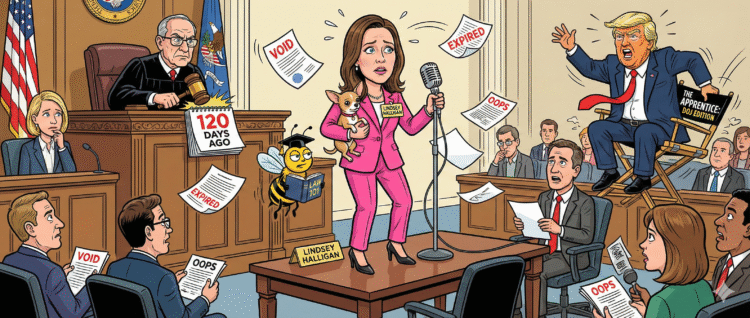
We have spent the last two decades treating the movie Legally Blonde as a lighthearted rom-com, but in the year 2025, it has revealed itself to be a prophetic warning about the dangers of underestimating a woman with a plan. The central thesis of that film, beneath the pink sequins and the scented résumé, was competence. Elle Woods did not win because she had cute shoes. She won because she actually did the reading. She won because she mastered the rule against perpetuities, outworked the Harvard elitists, and understood the mechanics of a perm.
Now, imagine a version of that movie directed by Donald Trump. In this grim reboot, Elle skips the studying, burns the books, spends her time doing hits on Newsmax, and gets handed the biggest case in the country solely because the President thinks she looks the part. There is no montage of hard work. There is no moment of realization. There is just a terrifying slide into authoritarian incompetence.
This is not a screenplay. This is the career trajectory of Lindsey Halligan.
Halligan is the answer to the question “what if we replaced the Department of Justice with a casting call?” A Fort Lauderdale insurance and condo attorney with a résumé that screams “water damage dispute” rather than “federal espionage case,” Halligan was plucked from the relative obscurity of Florida civil litigation and dropped into the cockpit of the United States Attorney’s Office for the Eastern District of Virginia. This is the “Rocket Docket.” This is where the heavy hitters play. It is not a place for beginners.
Her qualification for this role was not her trial record, which was virtually nonexistent in the criminal sphere. Her qualification was her loyalty. She had served as one of Trump’s personal attorneys, a role that in the modern GOP functions as a vetting process for one’s willingness to debase oneself on cable news. She was glamorous. She was combative. She was blonde. In the aesthetic universe of Trumpism, that is a complete CV.
So, Attorney General Pam Bondi, acting on orders from the top, jammed her into the interim U.S. Attorney slot. The mission was clear: execute the revenge fantasies of the President. The targets were high-value. Former FBI Director James Comey. New York Attorney General Letitia James. These were the people Trump wanted in handcuffs, and Halligan was the chosen instrument of his wrath.
The problem, as it turns out, is that federal criminal procedure is not a vibe. You cannot indict someone with a tweet. You cannot secure a conviction with a soundbite. You have to fill out the paperwork.
And Lindsey Halligan, it seems, did not do the reading.
The collapse of her cases this week was total. U.S. District Judge Cameron McGowan Currie did not just dismiss the indictments; she vaporized them. She ruled that Halligan was unlawfully appointed. The Department of Justice, in its arrogance or its ignorance, had allowed Halligan to serve past the statutory limit for an interim attorney. The Federal Vacancies Reform Act gives you one hundred and twenty days. That is the clock. When the clock runs out, the carriage turns back into a pumpkin, and the prosecutor turns back into a random civilian who is trespassing in a federal building.
Because Halligan was essentially a squatter in the U.S. Attorney’s office when she signed the indictments, the judge ruled that every action she took was void. The grand jury presentations? Void. The subpoenas? Void. The indictments against Comey for “false statements” and James for “bank fraud”? Void.
It is a humiliation that defies satire. Trump spent months thumping his chest about “accountability.” He promised a reckoning. He promised that his enemies would pay. Instead, he gave us a civics lesson on the importance of HR compliance. He proved that fascism is actually quite difficult if you cannot figure out how to use a calendar.
The details of Halligan’s tenure read like a carnival of errors. Magistrate Judge William Fitzpatrick had already flagged the Comey probe for “profound investigative missteps.” We learned that the grand jury never even saw the final version of the charging language. This is the legal equivalent of a surgeon operating on the wrong leg while checking their Instagram. It suggests a level of carelessness that is terrifying when you consider the power being wielded.
Halligan was trying to replicate the cinematic moment where the young, underestimated lawyer walks into court and delivers the knockout blow. She wanted the “What, like it’s hard?” moment. But in the real world, when you haven’t done the work, the judge doesn’t gasp in admiration. The judge asks you why you are violating the statute of limitations and then throws your case in the trash.
The contrast with the fictional Elle Woods is instructive. Elle Woods respected the law. She used the law to protect the innocent. Halligan, by contrast, was tasked with weaponizing the law to punish the guilty-by-association. She failed not because the “deep state” conspired against her, but because she fundamentally misunderstood the job. The job of a U.S. Attorney is not to be famous. It is to be precise.
This episode exposes the hollow core of the Trump “revenge tour.” The President wants to be a strongman. He wants to use the Department of Justice as his personal enforcement arm. But he keeps staffing it with people who are chosen for their fealty rather than their ability. He surrounds himself with sycophants who tell him what he wants to hear but cannot navigate the federal code of criminal procedure.
The result is a paradox. The administration is malicious enough to target its enemies, but too incompetent to catch them. James Comey and Letitia James are walking free today not necessarily because of the merits of their defense, but because their prosecutor was legally indistinguishable from a phantom.
There is a temptation to laugh at this. It is funny. Watching the “tough on crime” party fail because they broke the law to hire a lawyer is objectively hilarious. But the laughter should be nervous. Because this was a stress test. The system held this time. The judge read the statute. The appointment was tossed.
But imagine if they had hired someone who knew what they were doing. Imagine if they had found a loyalist who also happened to be a competent lawyer. The guardrails that protected Comey and James were not moral; they were procedural. They were saved by a deadline and a clerical error.
Halligan’s rise and fall is a perfect microcosm of the movement she serves. It is all surface, no depth. It is a movement that believes reality can be bent to the will of the leader, that rules are for other people, and that if you look good on television, the details will sort themselves out.
But the law, specifically the boring, dry, administrative law of federal appointments, is stubborn. It doesn’t care about your follower count. It doesn’t care about your loyalty pledge. It cares about the date on the form.
Lindsey Halligan came to Washington to be a star. She leaves as a footnote, a cautionary tale about the limits of charisma in a courtroom. She wanted to be the face of MAGA justice. Instead, she became the face of MAGA failure. She proved that you can wear the cutest shoes in the world, but if you don’t have standing, you can’t walk into the courtroom.
As the dust settles, we are left with the image of Donald Trump, furious and impotent, screaming at his television while his handpicked avenger packs her bags. He wanted a shark. He hired a goldfish in a shark costume. And when the water got rough, the costume floated away.
Fine Print for Grownups
The dismissal of these cases is not just a funny story about a bad lawyer. It is a reprieve for the rule of law, but a temporary one. The administration has vowed to appeal, blaming “partisan judges” for their own failure to read the Vacancies Reform Act. They will try again. They will learn from this mistake. The next appointee might be Senate-confirmed. The next indictment might be signed by someone who knows where the grand jury room is. We must recognize that incompetence is a defense mechanism for democracy, but it is not a sustainable one. Eventually, the authoritarians might learn how to file the paperwork. And when that happens, we won’t be saved by a Legally Blonde parody; we will need something much stronger than a procedural objection to keep the wolves at bay.