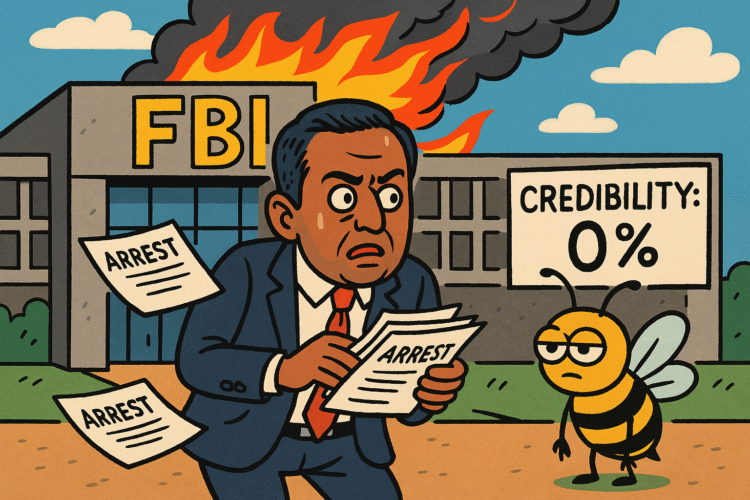
The Worst Week at the Bureau
It only took seven days for Kash Patel to make J. Edgar Hoover look like an Excel spreadsheet. On September 11, Patel stood before cameras and wrongly announced that Charlie Kirk’s assassin was “in custody.” The killer was not, in fact, in custody. By the end of the news cycle, Patel backtracked, leaving the FBI looking less like the nation’s premier law enforcement agency and more like a confused substitute teacher taking attendance.
This would be bad enough on its own, but then came the lawsuits. On September 10, three ousted senior officials sued the bureau, claiming they’d been purged for political reasons to please the White House. Because nothing says “independent law enforcement” like firing career officials until the FBI resembles the cast of The Apprentice: Federal Edition.
Even right-wing influencers—normally happy to turn every FBI misstep into a conspiracy buffet—have begun questioning Patel’s competence. And rank-and-file agents? Let’s just say morale at the Bureau now hovers somewhere between “haunted DMV” and “post-merger HR department.”
When the FBI Director Needs a Babysitter
The FBI director is supposed to be boring. That’s the whole point. You don’t want personality. You want competence so bland it feels like drywall. But Patel? Patel is spice gone rancid.
His policy shifts—away from counterintelligence and toward street crime and immigration enforcement—aren’t subtle. They look like campaign promises cosplaying as strategy. Imagine a referee who suddenly decides touchdowns don’t matter, only cheerleader uniform compliance. That’s Patel.
And when Congress hauls him in for answers, the question won’t just be “Why did you announce the wrong arrest?” It’ll be “Why does the FBI under your watch look like a bad faith parody of itself?”
Independence: A Retro Concept
Remember when the FBI at least pretended to be independent? When the director’s power rested on the myth of neutrality? Those days are gone. Patel’s FBI is less “apolitical investigator” and more “branch office of the campaign.”
The lawsuits from ousted officials spell it out: politically driven purges. Loyalty tests. A bureau that values personal fealty over professional skill. We’ve gone from “Fidelity, Bravery, Integrity” to “Fear, Blunders, Incompetence.”
And the terrifying part? Nobody even pretends otherwise anymore. The director’s job description is no longer independence—it’s obedience.
Competence, Outsourced
Even Trump’s die-hard influencers are unimpressed. These are people who think Bigfoot is a Democrat, who turn weather balloons into communist plots, and they are worried Patel might be in over his head. When the conspiracy crowd starts side-eyeing you, you’ve officially crossed from propaganda into farce.
Meanwhile, inside the Bureau, agents whisper to reporters about morale. It’s not subtle. The FBI is leaking like a colander because nobody trusts the leadership. Agents signed up for law enforcement, not partisan theater. Instead, they’re stuck under a director who mistakes bluster for authority.
The Wrong Arrest
The false announcement on September 11 wasn’t just a slip—it was emblematic. It showed the rot in real time. This wasn’t some obscure policy error buried in bureaucracy. This was the director telling the nation “we got him” when they absolutely did not.
For families watching, it was cruelty masquerading as closure. For agents working the case, it was sabotage disguised as leadership. For everyone else, it was proof that under Patel, the Bureau’s credibility is a currency being burned for short-term optics.
It’s hard to overstate how damaging that is. The FBI doesn’t have tanks or air power. Its capital is credibility. And Patel just torched it.
Politicization as Policy
The AP has noted Patel’s new emphasis on street crime and immigration enforcement. Which sounds noble, until you realize it’s not policy—it’s politics. It’s an attempt to turn the FBI into a prop for campaign ads.
Because what says “law and order” better than arresting desperate migrants while ignoring the larger systemic threats the Bureau is actually designed to face? Forget counterintelligence. Forget cyberattacks. Forget domestic extremism. Patel’s FBI is here to make sure your cousin’s DWI gets maximum press coverage.
This isn’t strategy. It’s pandering.
The Lawsuit Chorus
Three ousted senior officials suing the Bureau might sound like a footnote, but it’s not. It’s the sound of a canary in the coal mine. When people with decades of service say they were tossed out for political loyalty tests, it confirms what everyone already suspects: the FBI isn’t being run as a public trust. It’s being run as a campaign accessory.
And the courts will now get to decide whether “loyalty to the White House” counts as a legitimate job qualification. Spoiler: it doesn’t.
The Rank-and-File Rebellion
Morale isn’t a soft metric. It’s the bloodstream of an agency. Right now, Patel’s FBI is hemorrhaging it. Agents can’t do their jobs when leadership turns investigations into press stunts. They can’t trust their director when he treats false announcements as strategy.
The rebellion isn’t loud—it’s whispers, leaks, and eye rolls. But it’s real. And once morale collapses, credibility follows. Then independence. Then effectiveness. The whole thing crumbles.
Congress Sharpens Its Knives
Patel is about to face Congress, and it won’t be pretty. Democrats will hammer him for politicization. Republicans will use him as a scapegoat for not being partisan enough. Both sides will circle, because in Washington, incompetence is chum.
And Patel will do what he always does: bluster, deflect, and accuse. He’ll name-drop Soros. He’ll ramble about immigration. He’ll pretend mistakes are proof of strength. And in the process, he’ll further erode the Bureau’s credibility.
It’s less testimony, more performance art.
The Future of an Agency in Freefall
The tragedy is that the FBI matters. Independence matters. Credibility matters. When the Bureau loses those, the whole justice system feels the tremor. And Patel is turning the FBI into an institution where chaos isn’t a bug—it’s the operating system.
We’re not watching a one-off mistake. We’re watching a freefall.
Kash Patel: A Case Study in Failing Up
How did we get here? Simple. Patel failed upward. He was a staffer turned talking head turned director, chosen not for skill but for loyalty. Competence was never the point. Compliance was.
And now, America’s top law enforcement agency is run like a flailing start-up. Too many purges. Too much bluster. Not enough actual work. The FBI doesn’t need a hype man. It needs a leader. Instead, it got Patel.
Summary: Chaos at the Bureau
Kash Patel’s first major test as FBI director was a disaster. On September 11, he wrongly declared Charlie Kirk’s killer in custody, then backtracked, shredding credibility in real time. Just a day earlier, three senior officials sued, alleging political purges to please the White House. Meanwhile, Patel’s policy shifts toward street crime and immigration enforcement reek of politicization, while morale inside the Bureau sinks and even right-wing influencers question his competence. Congress is preparing to grill him, but the damage is already done: the FBI’s independence is compromised, its credibility torched, and its director less a guardian of justice than a chaos agent with a press badge.