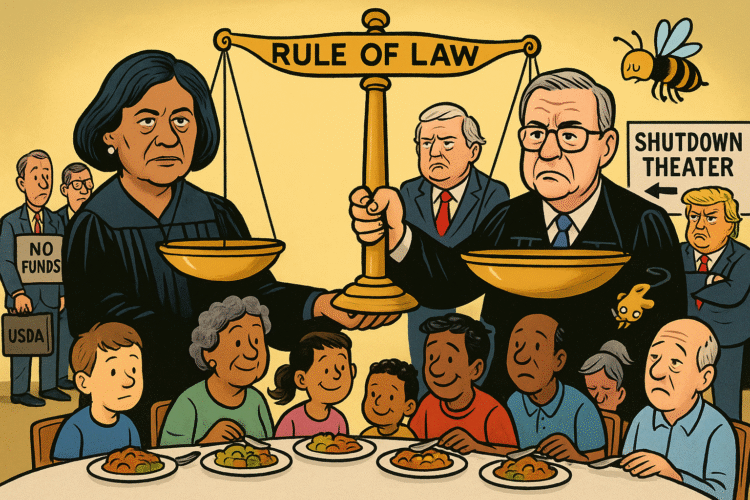
Somewhere between the concept of governance and the art of extortion, the Trump administration decided that feeding 42 million Americans during a shutdown was “optional.” The Department of Agriculture, apparently moonlighting as a nihilist book club, announced it would simply stop issuing SNAP benefits when the clock struck midnight on the first of the month. A bold new entry in the policy genre of “let them eat vibes.”
But today, two federal judges decided otherwise.
In Massachusetts, U.S. District Judge Indira Talwani issued an emergency order requiring USDA to unlock $5.25 billion in contingency funds that the agency had been hoarding like a dragon guarding grain. Hours later, in Rhode Island, Judge John McConnell followed suit, mandating not only that the contingency reserves flow but that USDA identify additional funds to keep benefits going for the 42 million people who use them.
In other words, it took two federal courts to remind the government that starving people during a shutdown is not fiscal discipline. It’s cruelty with a spreadsheet.
The Shutdown Hunger Games
To recap, the administration has spent the past month turning a funding lapse into a constitutional stress test. Troops? Paid. SNAP? Suspended. Infrastructure? Cancelled. But the ballroom project at the White House? Still on schedule.
The USDA, led by Secretary Brooke Rollins, announced two weeks ago that it would halt monthly SNAP disbursements because, it claimed, it had no “appropriated funds” available during the lapse. This was a historic first. Even during the longest shutdowns in U.S. history, benefits had always gone out.
State governments, anti-hunger organizations, and retail groups erupted in panic. Governors warned of “a first-ever food cliff.” Grocery chains braced for chaos. EBT processors scrambled to model what happens when one in eight Americans can no longer buy food.
The department’s reasoning was as simple as it was cynical: the Food and Nutrition Service had $5.25 billion in contingency reserves, but USDA claimed those funds could supplement appropriations, not replace them. Meaning, they could top off an active program, but not sustain it during a lapse.
Today, two judges reminded them that the word “entitlement” has a meaning.
The Law, the Logic, and the Lapse
SNAP isn’t a discretionary handout. It’s an entitlement program created under the Food and Nutrition Act of 2008. Eligible households are entitled to benefits under law. The agency administers it, but it does not control whether it exists.
That’s the difference between a constitutional democracy and a feudal economy.
The court orders rested on three key principles:
- The Food and Nutrition Act: Requires USDA to issue benefits to all eligible households. The government cannot suspend this obligation without a change in law.
- The Administrative Procedure Act: Bars arbitrary and capricious agency action. Declaring “we ran out of money” while sitting on billions qualifies as both arbitrary and capricious, plus a touch of deranged.
- The Antideficiency Act: Limits federal spending without appropriation, but it does not prohibit the use of already-appropriated contingency funds, especially when the purpose is to meet legal obligations.
Judges Talwani and McConnell didn’t just slap wrists—they dismantled the administration’s entire fiscal fairy tale. They ruled that USDA’s “lack of authority” claim was a self-inflicted wound. The department had both the legal tools and the moral duty to prevent a hunger crisis. It simply chose not to.
The Timeline of Manufactured Crisis
Let’s chart how this bureaucratic hunger experiment unfolded:
- October 1: Shutdown begins. USDA releases a “suspension notice” warning states that SNAP benefits will cease at the start of the next month unless funding resumes.
- October 10-15: Governors from Massachusetts, New York, and California lead a coalition of 25 states and D.C. to file multijurisdictional suits in Boston and Providence. The plaintiffs argue the move violates the Food and Nutrition Act and the APA.
- October 19: USDA reiterates its claim that it “cannot legally” issue benefits, prompting states to seek emergency TROs.
- October 25: Oral arguments before Judge Talwani. USDA lawyers defend their interpretation of “appropriation” as though the dictionary is an optional reading.
- October 28: Judge Talwani grants the TRO, requiring immediate use of contingency reserves.
- Later that day: Judge McConnell issues a parallel order, adding language that USDA must identify “additional available funds” and continue distributions until appropriations are restored.
- Next Monday: Both courts require compliance reports confirming EBT processor readiness and a logistical plan for uninterrupted issuance.
That’s what competence looks like when it has to be imposed by subpoena.
The Stakes Beyond Paperwork
Let’s strip the jargon down to its bones. SNAP feeds families who work full-time at wages that no longer buy groceries. It feeds children whose schools depend on those benefits to stabilize attendance. It feeds disabled adults, veterans, and elderly citizens.
It’s not just a poverty program—it’s an anti-collapse program. Every SNAP dollar circulates through the economy about 1.5 times. Retailers rely on it. Distributors rely on it. Local tax revenues rely on it.
When the USDA tried to stop benefits, it wasn’t just pulling food from pantries—it was cutting off an entire segment of consumer spending that sustains rural grocery stores and urban bodegas alike.
This is not just about compassion. It’s about economic math.
The Judges Who Fed the Nation
Judge Indira Talwani has a reputation for methodical precision. Her opinion dismantled USDA’s defense line by line, concluding that the agency’s decision “contravenes statutory command and lacks rational basis.” Translation: you don’t get to rewrite Congress because your boss enjoys shutdown brinkmanship.
Judge John McConnell in Rhode Island went further, noting that USDA’s position would “permit an executive agency to manufacture deprivation” and that the courts were “duty-bound to prevent irreparable harm to millions.”
That’s judicial code for: nice try, but your cruelty is showing.
Both orders cited irreparable harm as the threshold. Without benefits, millions would go hungry immediately. The court recognized that hunger is not a future injury. It’s a daily one.
The rulings also emphasized an important distinction: administrative discretion ends where statutory obligation begins. USDA cannot unilaterally suspend an entitlement because it feels politically convenient.
When the government tried to turn food security into a hostage negotiation, the judiciary said no.
The Administrative Theater of Cruelty
To understand why this even happened, you have to appreciate the Trump administration’s governing style. It’s not policymaking. It’s theater.
The shutdown wasn’t just a funding lapse—it was a stage play designed to showcase “discipline.” The administration paid troops by raiding unrelated accounts, bragged about fiscal control, and refused to tap billions in existing contingency reserves for social programs.
It was a political experiment in selective suffering.
If you build a shutdown to punish your opponents, you have to make sure the pain is visible. Hunger is cinematic. It photographs well. It says, “Look what the Democrats made us do.”
Except now, thanks to a pair of district judges, the photo op has been canceled.
The White House Reacts: Predictably
Within hours of the rulings, a White House spokesperson denounced the decisions as “judicial overreach.” The talking points write themselves: unelected judges interfering with executive authority, courts inventing powers, bureaucrats blocking reform.
But the substance tells a different story. The courts didn’t expand power—they restored it. They reminded the executive branch that rule of law still trumps rule of personality.
Governors praised the decision as “a victory for federalism and common sense.” Anti-hunger advocates called it “the difference between food and famine.” Retailers breathed a sigh of relief as EBT transaction systems were reactivated before mass cancellations could cascade through the supply chain.
In short, two signatures on two orders just stabilized an economy segment the size of a small nation.
Hunger as Policy
The deeper problem isn’t just what USDA tried to do. It’s why they thought they could get away with it.
For years, the administration has reframed empathy as dependency, treating social safety nets as moral hazards. SNAP recipients are no longer families in need—they’re freeloaders in need of discipline.
It’s the same moral logic that calls billionaires “job creators” while calling nurses “entitled.”
Under that worldview, cutting benefits isn’t cruelty. It’s virtue signaling for people who think suffering builds character—other people’s suffering, that is.
The judges’ orders punctured that illusion. They said: compassion isn’t a policy failure. It’s the baseline.
The Bureaucracy That Remembered Humanity
Behind the headlines, the quiet heroes of this week are the state agencies and processors who refused to roll over. From Massachusetts to Arizona, administrators stayed up all night recalibrating EBT systems, printing emergency guidance, and preparing to push payments the moment the injunctions hit.
It was messy, improvisational, and very human. But it worked.
Governors issued joint statements saying they would comply immediately, calling it a “lifeline.” The Food Marketing Institute confirmed that retailers were reactivated by 6 p.m. EST. Anti-hunger groups reported relief lines forming not for food, but for reassurance.
The machine sputtered, but it didn’t break.
The Appeals That Will Follow
Of course, the administration won’t let this stand. USDA lawyers are expected to appeal to the First Circuit early next week. They’ll argue that the courts usurped executive discretion and misinterpreted the Antideficiency Act.
Translation: they’ll try to starve people legally this time.
But appellate panels tend to frown on administrative chaos. Especially chaos that comes with empty grocery shelves.
The likely outcome? Affirmation of the lower courts and a stern warning against weaponizing shutdowns for political leverage.
Because that’s what this was—a manufactured hunger cliff built to extract concessions.
The Real Meaning of “Judicial Activism”
If you listen to the talking heads, you’d think judicial activism means liberal judges rewriting the law. But this week showed what it really looks like: judges refusing to let an administration erase law entirely.
Judge Talwani and Judge McConnell didn’t invent new powers. They enforced old ones. They told a rogue agency that “no funding” doesn’t mean “no accountability.”
That’s not activism. That’s constitutional maintenance.
Closing Section: The Rule of Law Still Eats
For once, the judiciary didn’t just issue words. It delivered calories.
In a shutdown built on cruelty, two judges remembered that hunger isn’t abstract. It’s the sound of a child’s stomach, the panic of a parent in a grocery aisle, the collapse of a corner store when EBT cards stop working.
While the White House played political chess with human lives, the courts reached for something unfashionable: decency.
And so tonight, 42 million Americans will still eat—not because their government cared, but because their courts refused to look away.
It shouldn’t take a TRO to prove the moral worth of feeding your own citizens. But here we are, ruled by slogans, rescued by footnotes.
America has always been a story of what breaks and who repairs it. This week, it was a judge’s gavel that hit the table before the last plate went empty.