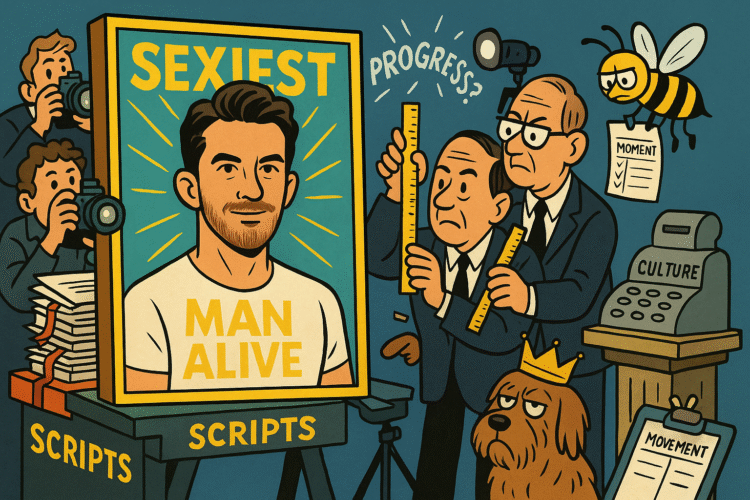
It is both poetic and suspicious that in 2025, the first openly gay man to be named PEOPLE’s Sexiest Man Alive revealed the honor to his dog before anyone else. Jonathan Bailey, a thirty-seven-year-old actor best known for his corset-inducing turn in Bridgerton, his Emmy-nominated heartbreak in Fellow Travelers, and his upcoming high-flying role in Wicked For Good, has now become the glossy-covered proof that visibility can sell as well as smolder. The news cycle called it “historic.” The internet called it “finally.” And his dog, presumably, called it “dinner time.”
To be fair, the moment feels overdue. For decades, the title has been a carefully airbrushed barometer of straight desirability: a heteronormative game of Guess Who where the correct answer was always “someone your mother would trust to unclog a sink shirtless.” Yet here stands Bailey, smiling under soft lighting, a man whose queerness is not whispered away in euphemism but listed in the headline. It’s progress, yes, but the kind that arrives with footnotes.
Bailey’s ascension follows a cinematic résumé that quietly rewrote what leading men can look like. As Anthony Bridgerton, he made Regency repression feel like a slow burn rather than a moral lesson, turning sexual hesitation into foreplay and family duty into foreclosed desire. In Fellow Travelers, he pushed further, embodying the cost of love under political persecution with a performance that was both delicate and devastating. The camera adored him, but it also betrayed him, catching the truth that beauty and shame can share the same cheekbone.
Now, in Wicked For Good, Bailey trades emotional labyrinths for literal ones, diving into blockbuster territory with the kind of franchise spotlight that melts boundaries and budgets alike. The question, inevitably, becomes whether advocacy and stardom can share the same stage without one drowning the other in press junket politeness. Bailey, for his part, seems to understand the choreography. Between filming and promotion, he continues his philanthropic work with The Shameless Fund, which supports LGBTQ+ youth programs, arts initiatives, and housing projects. He walks red carpets and fundraising galas with the same posture: elegant discomfort, like a man aware that every camera flash doubles as an audit.
There is, however, something beautifully absurd about how the mainstream markets this progress. The PEOPLE cover circulates through airports and grocery lines as both souvenir and experiment. Can a glossy magazine, built on hetero fantasy, now hold space for queer desirability without flattening it into novelty? Will readers frame the issue for posterity, or buy it ironically for coffee tables that already display Architectural Digest spreads of “gender-neutral kitchens”? In short, can capitalism love queerness without needing to neuter it?
The metrics, of course, are complicated. Every “historic first” comes with a spreadsheet. Bailey’s cover will be tallied by PR analysts measuring engagement spikes, search trends, and retail conversions. Marketing teams will note how his inclusion impacts brand partnerships, fragrance campaigns, and streaming subscriptions. Representation, in 2025, is not only emotional currency but fiscal policy. The industry’s progress is measured in decimals.
Consider the symbolic math: one gay man equals five cautious phone calls from advertisers asking if it’s “too soon” to pivot their Valentine’s Day campaigns. Meanwhile, another editor somewhere debates whether to use the phrase “trailblazing” or “refreshing” to describe him, both of which are polite synonyms for “We’re trying, please don’t yell at us on Twitter.” The irony is structural, not decorative. We have reached a point where progress and product placement coexist in the same sentence, and it somehow feels like victory.
What makes Bailey’s win more than symbolic is the simultaneity of his visibility and craft. He is not a celebrity created for this moment but one who evolved into it, an artist whose success predates the applause for representation. That distinction matters. Too often, queer recognition arrives posthumously or post-scandal, when the cost of authenticity has already been paid. Bailey, by contrast, is rewarded while still breathing, working, and occasionally singing on set between takes. It suggests, tentatively, that the industry may finally grasp that being out is not a liability but an asset, a reality that neither needs to be hidden nor sold at a premium.
Still, one can’t ignore the choreography of timing. Jurassic World: Rebirth already roared through theaters, offering Bailey his obligatory blockbuster baptism. Wicked For Good now looms as the defining test: can a queer actor lead a global tentpole without the studio’s marketing department treating his sexuality like a fragile vase wrapped in bubble-wrap interviews? The calculus is old but unrelenting: visibility equals risk, risk equals hesitation, hesitation equals “Let’s maybe cast someone safer next time.” Bailey’s very presence challenges that loop, and every frame he appears in becomes data against fear.
The culture machine, of course, loves to call this a “moment.” It is a convenient word that suggests both importance and expiration. A moment is safe because it implies movement without demanding permanence. The real question is whether this cover becomes a movement. Will other queer performers be next? Will male sexuality on magazine covers evolve beyond gym-tanned stoicism? Or will the experiment end once the analytics flatten and the next straight Chris becomes available for a beach shoot?
To understand how slow this shift has been, you have to remember how long the closet dictated aesthetics. For decades, editors knew which stars were gay but refused to gamble their middle-America subscriptions on the truth. Publicists choreographed relationships, posed beach photos, and arranged denials like ritual sacrifices to the altar of box-office faith. The industry’s rule was simple: you can be anything off camera, as long as the camera doesn’t know. Bailey’s cover, then, is not merely progress but punctuation, an exclamation mark at the end of a very quiet sentence.
And yet, even as we celebrate, the euphemisms linger. Articles describe Bailey as “openly charming,” “unexpectedly grounded,” “a man’s man with heart.” These are coded assurances, as if to say, “Don’t worry, he’s still the kind of gay you can invite to Thanksgiving.” The same magazines that refused to print queer love stories now praise him for “bridging audiences,” a polite way of saying “He makes us comfortable.” It’s progress, but it’s still curated comfort.
Fans, meanwhile, have taken ownership of the moment with both irony and sincerity. Social media threads read like group therapy for visibility fatigue: equal parts joy, relief, and suspicion. “He earned it!” one user declares. “Took them long enough,” another sighs. And somewhere, inevitably, a troll comments, “What about representation for straight men?” as if ninety-nine prior covers had vanished into a queer conspiracy. The discourse, like the internet itself, is a perpetual argument about who gets to be seen and who gets to be special.
Talent agents, ever the economists of fame, are already recalculating their rosters. A gay leading man with crossover appeal means new talking points for award campaigns and brand pitches. Authenticity, once a liability, is now a selling point with measurable ROI. It’s not that Hollywood has suddenly become ethical; it’s that sincerity now converts better than denial. Bailey’s success doesn’t erase the industry’s cynicism; it simply proves that honesty, too, can trend.
The deeper irony is that this recognition, while personal to Bailey, functions as collective absolution for the industry. Each headline, each congratulatory tweet, allows studios and magazines to gesture toward inclusion without restructuring their power hierarchies. The ceremony of progress is often easier than the practice of it. The next test will come quietly: who gets the covers next year, who headlines the summer releases, who earns the same paycheck for the same star power. A single cover can open a door, but it can also serve as decoration for a wall that still exists.
And yet, to dismiss it entirely would be too cynical even for satire. The truth is that visibility matters, even when it’s packaged. Somewhere, a queer teenager will see that cover in a waiting room and feel a small pulse of recognition. Somewhere, an actor will reconsider their silence. Somewhere, a studio executive will realize that authenticity didn’t tank the numbers. Progress may be marketable, but it still counts.
The charm of this moment is that Bailey himself doesn’t appear to treat it like a coronation. He joked that he told only his dog because “she’s the only one who wouldn’t leak it.” It’s a perfect deflection: humble, funny, and grounded in the domestic. In that single line, the spectacle deflates into humanity. The Sexiest Man Alive feeds his dog, goes to set, and donates his time. The grandeur melts into ordinariness, which might be the most subversive image of all.
Hollywood has always needed its symbols, and every so often, it accidentally picks a good one. Bailey’s win is less about universal thirst than it is about narrative repair. For once, the story of desirability includes a man who doesn’t have to translate himself. For once, the closet is not a prerequisite for applause. The camera lens, finally, is catching up to real life.
The real test of the cover’s impact will unfold not in headlines but in casting rooms, ad budgets, and writer’s rooms. Representation, after all, is only meaningful when it multiplies. The Sexiest Man Alive cannot remain an exception without turning progress into tokenism. The movement will be measured by repetition: when queerness stops being a qualifier and becomes background noise, when editors stop whispering “firsts,” when fans stop having to ask for proof that visibility sells.
For now, though, it’s worth savoring the absurd beauty of the image: a man once told that authenticity would cost him everything now sits at the top of a list that once excluded him by design. The dog, presumably, still doesn’t care. But the rest of us, watching through the lens of irony and relief, do.
Section Title: The Afterglow Ledger
Bailey’s crown, like all cultural milestones, comes with bookkeeping. Every award season will now reference him as precedent, every casting memo will cite him as data, and every journalist will weigh whether to ask about his advocacy before his abs. It’s a peculiar kind of progress, one that treats humanity as both headline and metric. But somewhere between the spreadsheets and the smiles, a quiet truth hums beneath the surface: visibility works only when it’s allowed to be ordinary.
So we’ll watch the next cover, the next casting choice, the next budget meeting where a producer hesitates and then says, “Actually, why not?” And maybe, one day soon, the title “Sexiest Man Alive” will feel less like a boundary crossed and more like a mirror finally cleaned.