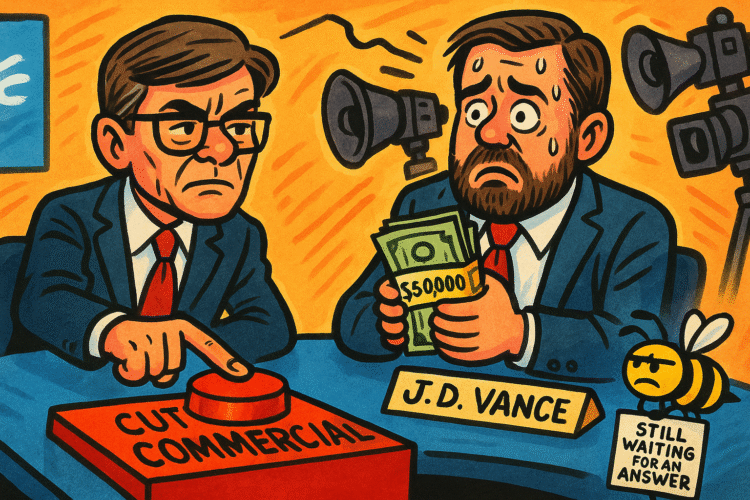
It’s a rare thing to see George Stephanopoulos lose patience. The man has survived a decade of D.C. gaslighting and several hundred Trump surrogates without cracking. But on This Week, the famously unflappable anchor finally snapped. He’d spent five full minutes trying to extract a yes or no answer from Vice President JD Vance about the FBI’s reported $50,000 cash handoff to Border Czar Tom Homan—and when none came, George did what every exhausted American wishes they could do during a political interview: he cut to commercial.
And not the subtle kind, either. No “We’ll circle back.” No “We’re running short on time.” Just the dead-eyed clarity of a man who’s seen the abyss, blinked twice, and decided life’s too short for another pivot to “media bias.”
The Gospel According to JD
The Vice President’s defense of Homan sounded less like a rebuttal and more like a middle-school book report written entirely during lunch. According to Vance, the whole story was a “smear,” an example of the “fake news machine” trying to destroy a good man for doing his job. The problem, of course, is that nobody actually knows what that job is.
Tom Homan—known affectionately among his peers as “the guy who thinks human empathy is a border loophole”—was reportedly caught on tape accepting a $50,000 cash handoff in September 2024. The White House insists the payment was aboveboard and that Homan “wasn’t a public official at the time.” That’s one way to frame it. Another is: the FBI had eyes on a guy handling more cash than a blackjack dealer at a cartel reunion, and the Vice President would rather filibuster than explain why.
When Stephanopoulos pressed, Vance did what every Trumpworld official does when cornered—he attacked the premise of the question itself. It’s a fascinating strategy, really: if you can’t answer, just convince the audience that asking is un-American.
“George, with all due respect, the real story is the liberal media trying to distract from the President’s accomplishments,” Vance said, wearing the expression of a man who just discovered empathy costs extra.
To which George replied, in what will likely be quoted in journalism textbooks for years to come: “You haven’t answered the question.” And then he cut away.
When Silence Becomes Policy
The exchange lasted less than ten minutes, but it told you everything about how this administration governs. The White House’s communication strategy isn’t to deny wrongdoing. It’s to make accountability sound elitist.
Why answer when you can condescend? Why clarify when you can claim persecution? Why provide evidence when you can pivot to the shutdown or immigration or whatever today’s culture-war piñata happens to be?
The brilliance of this approach is its efficiency. It’s cheaper than spin, faster than fact-checking, and infinitely more marketable. You don’t have to know anything—you just have to sound offended that anyone asked.
The 50,000-Dollar Question
The alleged cash handoff, according to leaked FBI notes, happened in a parking lot in September 2024. The tape reportedly shows an unidentified man passing an envelope to Homan, who pockets it before the two shake hands and part ways. The White House insists that “nothing illegal occurred,” and the Department of Justice, now under Pam Bondi’s “Fairness Restoration” initiative, says the investigation was “closed without findings.”
Of course it was. Every probe now ends the same way: inconclusive but deeply patriotic.
It’s hard not to notice the pattern. Whenever a scandal hits this administration, the defense is never “that didn’t happen.” It’s always “you’re the problem for noticing.”
The Theater of Refusal
There’s a strange theatricality to JD Vance’s stonewalling. He performs denial the way an actor performs sincerity—loudly, emotionally, and with complete disregard for the script. His sentences come pre-loaded with culture-war disclaimers: “Let me just say…” and “With all due respect…” and the perennial favorite, “The American people are tired of this.”
You can practically hear the base cheering at home. Not because they believe him, but because he’s giving the illusion of victory—talking over the questioner, framing scrutiny as oppression.
Stephanopoulos’s interruption, then, wasn’t just a TV moment. It was a rupture in the performance. A reminder that journalism, at its best, isn’t about decorum. It’s about saying, “No, actually, you don’t get to monologue your way out of this.”
Deflection as Governance
This wasn’t just any Sunday show spat. It happened during a shutdown, amid mass federal layoffs, National Guard deployments, and open court challenges over constitutional limits. And yet, somehow, the Vice President was still able to pretend the real threat to democracy was “mean questions.”
It’s the governing philosophy of Trump’s America: if you can’t solve it, redefine it. If you can’t explain it, attack whoever asked. Accountability is for losers, transparency is for traitors, and truth is whatever survives the 24-hour news cycle.
The White House Response
Within hours of the interview, the White House press shop released a statement accusing ABC of “agenda-driven ambush tactics.” It praised Vance for “remaining calm under fire” and reminded reporters that “the administration’s focus remains on securing the border and revitalizing American manufacturing.”
Translation: they have no idea what to say, so they’re hoping we’ll forget by Tuesday.
Meanwhile, conservative influencers turned Vance’s non-answer into a badge of honor. “JD stood up to the fake news!” one MAGA account posted, complete with an AI-generated image of Vance wearing boxing gloves. Others began demanding ABC release the “uncut” tape of the interview—as if the network secretly edited out a coherent answer.
Enter the Counteroffensive
Within hours, #FireStephanopoulos began trending on X, boosted by accounts with usernames that look suspiciously like license plates. The playbook is predictable by now: when reality doesn’t cooperate, make outrage the headline.
Illinois Governor J. B. Pritzker appeared on the same program later, calling Vance’s performance “a masterclass in avoiding reality.” Predictably, Trump’s surrogates pounced, declaring Pritzker part of a “coastal elite conspiracy.”
It’s all so numbing, this endless noise machine. The point isn’t to convince anyone of anything. It’s to make the truth feel optional.
Selective Transparency, the Sequel
The real scandal isn’t the alleged envelope. It’s how easily the system absorbs scandal now. A Vice President can dodge a bribery question, get cut off on live television, and still emerge as the hero of his own base. Accountability is no longer about facts—it’s about vibes.
This is what selective transparency looks like in practice: a government that answers only when it wants to, framed by a media landscape that’s been gaslit into thinking neutrality means letting both sides lie unchallenged.
The White House doesn’t need to win the argument. It just needs to convince enough people that arguments are pointless.
The Death of the Follow-Up
There was a time when being cut off on live TV was a humiliation. Now it’s a fundraising opportunity. Within an hour of the interview, the Vance 2028 PAC was already sending emails: “JD won’t be silenced by the fake news!” The email included a donation link, of course.
In the new media ecosystem, even embarrassment is monetizable. Every scandal is a subscription drive, every tough question an excuse to post “We fight for you” on Truth Social.
And so, the stakes get higher, the lies get bigger, and the audience gets smaller.
The ABCs of Autocracy
There’s an old saying in journalism: sunlight is the best disinfectant. But what happens when the administration builds a dome? When every beam of light is branded fake, every journalist an “enemy of the people”?
That’s not paranoia—it’s policy. The White House’s ongoing war with the press isn’t about optics. It’s about infrastructure. You can’t dismantle accountability all at once; you have to chip away at it, one “biased reporter” at a time.
Stephanopoulos’s decision to cut away wasn’t just frustration. It was resistance. A refusal to give another politician a platform to launder lies. And for that, he’ll be vilified by the same crowd that chants “freedom of speech” while suing newspapers for quoting them accurately.
The Cost of Apathy
Maybe the saddest part is how normalized all this has become. A Vice President dodges a bribery question, and half the country shrugs. Another half cheers. The rest change the channel.
This is how democracy erodes—not with coups or decrees, but with commercials. With everyone quietly agreeing to look away when things get uncomfortable.
The administration’s calculation is simple: people are too tired to care. Too exhausted by years of disinformation, crisis, and culture war to distinguish fact from performance.
Cut to the Chase
We’re not watching politics anymore. We’re watching improv theater in which the stakes are real and the actors can’t break character. JD Vance plays the loyal lieutenant. Stephanopoulos plays the weary truth-teller. The audience plays along until the next headline scrolls by.
When Stephanopoulos cut to commercial, it wasn’t just a programming decision—it was a metaphor. For journalism trying to survive in a world that rewards deception. For a country where truth has to wait until after the break.
Because in this America, every answer is a performance, every scandal a rerun, and every questioner eventually gets cut off.