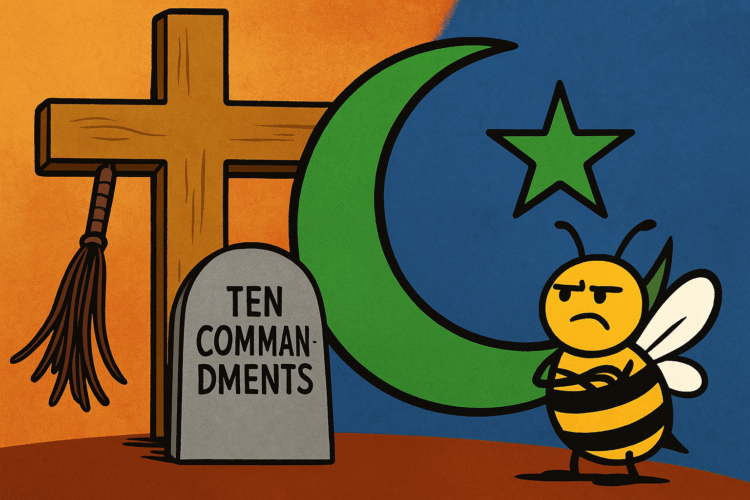
THE GOSPEL OF SELECTIVE OUTRAGE AND OTHER HOLY TRADITIONS WE PRETEND NOT TO NOTICE
Religious superiority is the type of moral panic that spreads through America like pollen in spring, coating every surface, irritating every conversation, and triggering sneezes of self righteousness that echo for miles. The current strain is Islamophobia, a recycled political contagion that resurfaces whenever the nation needs a convenient villain to distract from the theological mess in its own living room. You can almost set a clock by it. Every time the country stumbles into a crisis, someone resurrects the deep cultural fantasy that Islam is uniquely violent, uniquely oppressive, uniquely cruel. As though Christianity did not spend centuries auditioning for those exact roles with a commitment level method actors would envy.
And here we are again, forced to listen to pundits lament the barbarism of Muslims while clutching books that contain instructions for stoning adulterers, expelling women during menstruation, executing unruly children, and purging cities with fire for the crime of insufficient obedience. It is astonishing. It is stunning. It is almost impressive in its acrobatic ability to ignore its own fine print. Americans have perfected the art of reading scripture like a menu, selecting only the palatable parts while pretending the rest are seasonal specials no longer in rotation.
What makes this moment particularly surreal is that everyone knows, intellectually, that violence, misogyny, homophobia, and fear are not unique to Islam. They are endemic to every organized religion that grew up in a tribal world where patriarchs made the rules and gods were fashioned in their image. If you peel back the poetry, scripture is basically a highlight reel of Bronze Age power consolidation. Religion is humanity’s first political party, complete with bylaws, enforcement mechanisms, and a marketing department. Yet somehow the country behaves as though this messy inheritance belongs only to the people who pray in Arabic rather than English.
The hypocrisy would be funny if it were not so predictable. Christians love to act scandalized at the idea that Islamic texts contain violent verses. Meanwhile, Leviticus sits on their shelves like a horror anthology with footnotes. They accuse Islam of fostering misogyny while belonging to denominations that still cannot imagine a woman behind a pulpit. They gasp at stories of conservative Muslim parents rejecting their LGBTQ children while quietly lobbying state legislatures to criminalize gender affirming care and ban rainbow displays in public schools. They howl that Islam is incompatible with democracy as they call for Christian nationalism, Bible based lawmaking, and government sponsored purity codes that would make Cotton Mather blush.
This is not to say that Islam has no extremists. It does. So does Christianity. So does Judaism. So does Hinduism, which now produces enough hard line violence to light its own authoritarian solar farm. Buddhism has had militant factions. Sikhs have had militant factions. Even Scientology has a reputation for retaliatory theatrics that feel like a rejected subplot from a spy novel. The universal truth is that any belief system can become extreme when wielded by people who interpret metaphor as mandate and myth as military order.
So why is Islam singled out? Why is the rhetoric so charged, so persistent, so dripping with condescension and performative fear? Part of it is ignorance. Part of it is racism dressed as spiritual anxiety. But most of it is projection, plain and simple. It is easier to condemn the violence in another faith tradition than to confront your own. It is easier to blame “their” beliefs for extremism than to admit that extremism is an equal opportunity employer. And it is infinitely easier to scream about Sharia law than to admit that the loudest threats to American pluralism come from Christians who would remake this country into a theocratic HOA with no appeal process and mandatory worship hours.
Whenever a Christian nationalist rants about Islam’s supposed commitment to medieval punishments, you can practically see the cognitive dissonance glowing behind their eyes as they ignore entire chunks of their own holy text. The stoning. The sacrifices. The forced marriages. The subjugation of women. The rules about hair, fabric, food, reproduction, and obedience. The entire book of Deuteronomy, which reads less like divine revelation and more like a community handbook drafted by a committee of men who feared women, nature, and the possibility of being wrong. The idea that modern Christianity is inherently peaceful is not a theological fact. It is an act of collective amnesia.
But religion is not the problem. Power is the problem. It always has been. People pick and choose which parts of their religion to practice based on what makes them feel righteous and what helps them control other people. The cafeteria Christians who ignore the Sermon on the Mount while treating Leviticus like a policy manual. The conservative imams who selectively enforce hadiths that align with patriarchy while ignoring those that emphasize mercy. The rabbis and clerics and pastors who elevate their own status by choosing the harshest interpretations and selling them as unshakeable truth.
People show you their priorities in the doctrines they enforce. If modesty policing is top of mind, misogyny is the animating spirit. If sexuality is the obsession, the goal is control. If violence is excused as divine justice, then cruelty is the core value. And if the state becomes the enforcement arm of religious doctrine, then theocracy is the destination. It does not matter which religion is being weaponized. The result is the same. When religion and government become indistinguishable, human rights become negotiable.
This is why the Founders, imperfect as they were, understood that the only sustainable democracy is one that protects freedom of religion by ensuring religion cannot control the government. That line is delicate. It takes discipline to maintain. And we are failing it spectacularly. Christians scream that Islam is dangerous while promoting laws based on their own scripture. They accuse Muslims of wanting to reshape the country while lobbying to impose Christian prayer in schools, Christian history in textbooks, Christian morality in bathrooms, Christian doctrine in medical decisions, and Christian nationalism at the ballot box.
The Islamophobia we are witnessing now is not about terrorism. If it were, Christian extremists who bomb clinics and threaten school boards would be treated with equal scrutiny. It is not about human rights. If it were, the loudest critics would be fighting the criminalization of drag shows, the surveillance of pregnant women, the book bans, the forced birth mandates, the violent anti LGBTQ legislation, and the rise in white Christian militia groups. It is not even about religion. It is about maintaining cultural dominance by casting a minority faith as inherently violent, inherently foreign, inherently dangerous. It is a mirror trick, a magic act performed for an audience that is desperate to believe they are on the side of civility while ignoring the violence carried out in their own name.
But the myth is thinning. Younger Americans see the hypocrisy. They see the rise in hate crimes. They see the fear mongering. They see politicians confecting moral outrage to distract from their own corruption. And they are not impressed. When they hear accusations that Islam is incompatible with American values, they see projection. When they hear that Muslims are dangerous, they notice that most acts of domestic terrorism come from white men radicalized by Christian nationalism. When they hear politicians rail against Sharia law, they ask why those same politicians are trying to impose Christianity in public policy. The disconnect is glaring. The hypocrisy is blinding.
Freedom of religion does not mean freedom to weaponize religion. It does not mean the right to force other people to live according to your sacred text. It does not mean twisting public policy to align with your doctrine. It does not mean treating your religious beliefs as universal truth. And it definitely does not mean using one religion’s extremists as a smokescreen to hide your own.
The truth is that extremism grows wherever people stop being accountable to shared law and start demanding deference based on divine authority. That is true in Tehran, in Jerusalem, in Rome, in Salt Lake City, in megachurches in Tennessee, and in Capitol offices where legislators quietly fantasize about biblical governance. A religion is only as dangerous as the people who interpret it. And every faith tradition has its zealots who insist that God wants them to dominate public life. The only difference is which extremists have access to power.
So what do we do with this? We start by telling the truth plainly. Misogyny, homophobia, hatred, fear, and violence are not Islamic traits. They are human traits. Religion is merely the vessel people use to justify them. Every faith contains beauty, and every faith contains cruelty. Every faith has peaceful adherents, and every faith has extremists who weaponize doctrine for power. The question is not which religion is violent. The question is which practitioners are using their religion to excuse violence and which institutions are enabling it.
We need to stop pretending the problem is Islam. The problem is religious supremacy. The problem is the belief that your faith grants you moral license to govern other people’s lives. The problem is the political movement that uses scripture as a cudgel and fear as a currency. The problem is a country that refuses to look inward because outrage is easier when the target speaks another language or prays in another direction.
You can practice your religion. You can believe whatever you want. You can pray, meditate, fast, chant, celebrate, worship, and observe however your conscience leads you. That is your right. What you cannot do is force your faith onto other people. You cannot legislate your doctrine into their medical care. You cannot police their bodies through your commandments. You cannot decide their rights based on your mythology. You cannot demand the government reflect your theology. The First Amendment protects your freedom to believe. It does not empower you to rule.
If you want to live in a world where your religion governs every aspect of life, you are free to find a theocracy that suits your tastes. But do not pretend that theocratic impulses are unique to Islam. And do not pretend that a Christian led theocracy would be kinder. History has receipts. So does the present. And the receipts show that extremism is a human failing long before it is a religious one.
We will not defeat Islamophobia by insisting Islam is perfect. We will defeat it by telling the truth about all religion. The violence is not in the scripture. It is in the interpretation. The danger is not in the faith. It is in the fusion of faith with power. And the only antidote is a government that represents everyone, not one sect disguised as a national identity.
Practice your religion. Believe what you believe. But stop pretending it gives you authority over anyone else. The rest of us have our own gods (or none) to answer to, our own lives to live, and our own rights to defend. Faith is personal. Freedom is collective. And the country cannot survive if one disguises itself as the other.