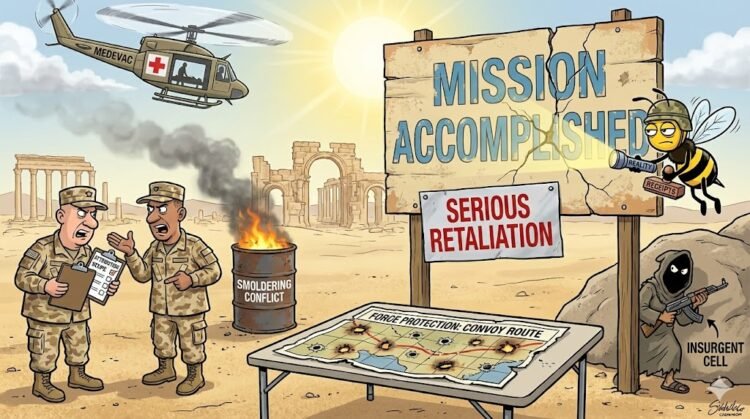
Three Americans dead near Palmyra, serious retaliation promised, and the same old lie that a victory lap is the same as an ending.
An ISIS-linked ambush near Palmyra in central Syria hit a joint U.S. and Syrian partner movement and killed two U.S. service members and an American civilian interpreter. Three additional U.S. troops were wounded, along with multiple Syrian personnel. The reports describe a lone gunman opening fire during what was framed as an anti-ISIS engagement, with U.S. helicopters evacuating wounded personnel and partner forces eventually killing the attacker after a firefight. President Trump promised “serious retaliation.” Pentagon leaders framed the attack as proof ISIS remains operational and able to exploit gaps in local security forces, partner coordination, and route protection.
There is a particular kind of American political habit that needs to be dragged into the sunlight by the collar: the habit of calling something “defeated” when you mean “it no longer holds a piece of land we can point to on a map.” Trump did this repeatedly in his first term. He declared ISIS defeated, claimed the U.S. had defeated 100 percent of the ISIS caliphate, and announced “We have defeated ISIS in Syria.” He treated a territorial collapse as total elimination, as if the war on a network ends when the network loses its real estate. It was a victory-lap narrative written for television, not for the kind of conflict that actually exists in the dirt and heat outside Palmyra.
Now three Americans are dead in central Syria, and the gap between the headline and the reality is not an academic matter. It is a body bag. It is a helicopter evacuation. It is the quiet, brutal reminder that insurgent cells do not dissolve because a president declares a percentage.
This is what happens when leadership sells closure instead of telling the truth about the kind of war we are in. The public is promised an ending. The mission keeps smoldering. The casualties keep arriving. And every time it happens, Washington reacts like it’s shocked, as if the last announcement was not recorded, replayed, and used as a political prop.
The “Defeated” Myth and the Smoldering Reality
ISIS lost territory. That mattered. It disrupted the caliphate’s ability to govern openly and recruit with the credibility of a functioning state-like entity. But insurgencies are not primarily territorial. They are cellular. They are opportunistic. They feed on vacuum, grievance, and weak governance. They survive by embedding, waiting, and striking when the conditions are right.
Trump’s messaging treated the caliphate’s territorial collapse as the end of the story because “end of the story” is a compelling narrative and “the story continues” is harder to campaign on. “We have defeated ISIS” fits in a rally chant. “ISIS is degraded but still capable of insurgent violence, and our partners’ security capacity varies across routes and checkpoints and local power dynamics” does not.
The Pentagon’s framing now, that the attack proves ISIS remains operational and can exploit gaps in security forces, coordination, and route protection, is the adult sentence. It’s the sentence that should have been front and center years ago. But adult sentences don’t sell like victory laps, and victory laps don’t require follow-through. Victory laps are speeches. Follow-through is a long, exhausting commitment to a mission that voters were told had already ended.
That contradiction is the bitter context for this ambush. It is not that ISIS “came back.” ISIS never left in the way politicians implied. The organization mutated, dispersed, and adapted. The language of total defeat was always a lie of convenience.
The Ambush and the Fragile Mechanics of Partnered Operations
The incident described involves a joint U.S. and Syrian partner movement during an anti-ISIS engagement, with a lone gunman opening fire. That detail matters because it raises a question Washington hates to answer out loud: how porous are the lines between “partner,” “local security,” and “threat.”
Partnered operations are necessary in Syria because U.S. forces are not trying to occupy large swaths of terrain. They operate with local partners, share intelligence, coordinate movements, and rely on local knowledge and access. That collaboration can be effective. It can also be vulnerable.
A lone gunman is the kind of threat that turns routine movement into catastrophe. It’s low-tech and high-impact. It’s the kind of attack that exploits the human layers of a mission: trust, proximity, and the assumption that an engagement zone has been controlled.
When U.S. helicopters have to evacuate wounded personnel, you’re seeing the mission’s logistical muscle in action, and also the reality that even a small attack can create a cascading emergency. Evacuation is competence. It’s also evidence of how fast things go wrong.
Partner forces ultimately killed the attacker after a firefight. That suggests coordination did function in the end. But the initial breach is what matters most. How did the gunman get close enough to open fire. Was this an infiltration. Was this an insider. Was this a security failure along a route. Was it a local sympathizer acting alone. Was it a gap in screening. Was it a predictable vulnerability that was tolerated because the mission has been running on the assumption that “defeated” means “manageable.”
All of those questions become urgent now, not because Washington suddenly discovered risk, but because Americans died and the mission must justify itself again.
Serious Retaliation and the American Love of the Clean Punchline
Trump promised “serious retaliation.” That phrase is familiar, and it is designed for maximum emotional satisfaction. Serious retaliation is the promise that something will happen to restore a sense of control. It’s the promise that violence can be answered with violence in a way that feels like closure.
But retaliation in Syria is rarely clean. It can mean airstrikes against ISIS networks and facilitators. It can mean raids. It can mean intensified intelligence operations. It can mean new force protection measures that change how convoys move, where they stop, who is allowed near them. It can also mean a broader escalation in posture that increases exposure, because the act of “getting serious” often involves doing more things in places where things can go wrong.
Retaliation also has a political function. It allows leaders to appear decisive. It can shift headlines from “Americans killed” to “America responds.” It can reassure domestic audiences that the government is not passive. The danger is that the response becomes more about optics than strategy. The response can become a gesture designed to show power rather than a plan designed to reduce risk.
And once again, the temptation will be to sell the public a clean headline. Mission accomplished, again. ISIS crushed, again. Threat eliminated, again. The conflict keeps smoldering, again.
Force Protection and the Unsexy Work That Actually Saves Lives
The immediate next steps will likely include force protection changes. That means route security, overwatch, screening procedures, movement timing, and rules about proximity in engagement zones. It means reviewing how partner forces coordinate and who controls what. It means asking uncomfortable questions about whether local security services are reliable and whether any part of the partner structure is compromised.
If there is suspicion of insider access or extremist sympathies, cooperation with Syria’s security services becomes more complicated. Trust becomes a tactical risk. Vetting becomes a priority. That can slow operations, create friction, and increase the burden on U.S. forces.
Force protection is the part of the war that is boring until it fails. It is the set of routines that keep people alive. It will now be under a microscope, because a lone gunman exploited something. That something will be hunted through after-action reports and intelligence assessments, and the mission will adjust.
The adjustment will not be glamorous. It will not be televised. It will not fit into a slogan. It will also matter more than any presidential statement.
The Pressure Cooker: Escalate or Reduce Exposure
This attack will intensify political pressure on Washington in two opposite directions. One direction is escalation. If ISIS can kill Americans, then the mission must get tougher, more aggressive, more muscular. That is the logic of retaliation and deterrence.
The other direction is reduction of exposure. If Americans are dying years after the mission was declared complete, what are we doing there. What is the end state. How long does “degraded but still present” last. How many more names will be added to the list before someone admits the public was sold a simplified story.
This is the core tension of modern counterterrorism. Leaving can create vacuum. Staying creates risk. Staying also creates political fatigue. Leaving creates political liability when something goes wrong. The mission becomes a treadmill where the public is told it’s finished while the operators know it’s not.
And the operators are the ones paying for the political fiction.
Attribution, Scope, and the Temptation to Overpromise
Near-term decision points will revolve around attribution confidence and retaliation scope. How sure is the U.S. that the attacker was ISIS-linked. Was the gunman a direct ISIS operative, a sympathizer, or someone acting under a broader extremist influence. How deep does the network go. Is there a facilitator chain. Is there a local cell. Are there insiders.
Those distinctions matter because they shape the response. A response aimed at an ISIS network is different than a response aimed at deterring local infiltration. A response aimed at a broad network can escalate quickly. A response aimed narrowly can feel insufficient politically, even if it’s smarter tactically.
There will also be decisions about coalition posture. What does this mean for U.S. cooperation with Syrian partners. What does it mean for the rules of engagement. What does it mean for base security and movement patterns.
And there will be decisions about messaging, which is where America often fails itself. Messaging is where leaders are tempted to sell certainty. It is easier to promise a clean end than to explain a messy reality. It is easier to claim ISIS is defeated than to admit we are in a long war against networks that adapt.
This is where the bitter context comes back. Trump declared victory in his first term. He claimed 100 percent defeat. He said the words that made people want to stop thinking about Syria. Now Americans are dead near Palmyra, and the lesson is not just that ISIS persists. The lesson is that declarations do not kill insurgencies. Declarations only numb the public, and a numb public is easier to manage until the next casualty reminds everyone that the war never cared about the speech.
Receipt Time The Smoke Keeps Rising
An ISIS-linked ambush near Palmyra killed two U.S. service members and an American civilian interpreter and wounded three additional U.S. troops plus multiple Syrian personnel after a lone gunman opened fire during an anti-ISIS engagement, forcing helicopter evacuations and ending with partner forces killing the attacker, as Trump promised serious retaliation and the Pentagon emphasized the incident proves ISIS remains operational and able to exploit gaps in local security coordination and route protection, a grim contrast to Trump’s first-term victory-lap declarations that ISIS was defeated and that 100 percent of the caliphate had been eliminated, with immediate next steps likely including tightened force protection, follow-on raids or airstrikes against ISIS networks and facilitators, heightened scrutiny of partner cooperation if insider access played a role, and near-term decision points around attribution confidence, retaliation scope, coalition posture, and whether Washington again tries to sell the public a clean headline while the conflict keeps smoldering and producing American casualties.