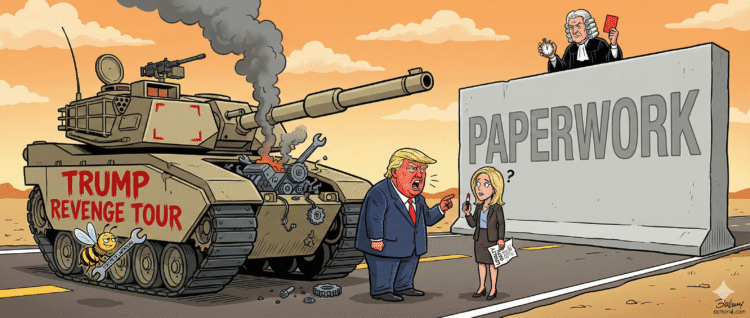
The central tragedy of the modern authoritarian is that eventually, someone has to fill out a form. You can stand on a podium and scream about retribution until your voice gives out. You can promise to rain fire and fury on your enemies. You can draft lists of traitors and fantasize about televised tribunals. But at the end of the day, the machinery of the state is not powered by rage. It is powered by paperwork. And on a quiet Tuesday in a federal courthouse, Donald Trump’s dream of a revenge sequel to “Lock Her Up” didn’t die in a blaze of glory. It died because his administration couldn’t figure out how to read a calendar.
The collapse of the criminal cases against former FBI Director James Comey and New York Attorney General Letitia James is not just a legal setback. It is a humiliation that should be taught in civics classes under the heading “Why Fascism Is Harder Than It Looks.” U.S. District Judge Cameron McGowan Currie did not acquit these defendants because they were innocent, though the charges were laughable on their face. She tossed the cases because the prosecutor who brought them, Lindsey Halligan, was legally indistinguishable from a random person who wandered in off the street and started shouting objections.
Judge Currie found that Halligan, a Trump loyalist and former personal attorney whose criminal trial experience could arguably be described as “scant,” was unlawfully appointed. This ruling turns months of administration chest-thumping about “accountability” into a very expensive lesson on the Vacancies Reform Act. It reveals that the great MAGA purge, the promised cleansing of the deep state, has stalled not because of a secret cabal of resistors, but because the people in charge are incapable of performing the basic administrative functions of a human resources department.
The Interim Problem
To understand the depth of this failure, one must look at how Lindsey Halligan ended up in the Eastern District of Virginia in the first place. She was not there because she rose through the ranks of the Department of Justice, earning the respect of her peers through years of grueling trial work. She was there because she was available and she was loyal.
The administration had a problem. The career prosecutors in the Eastern District, actual professionals who view the law as something other than a weapon for the President’s mood swings, had reportedly refused to bring the charges against Comey and James. Erik Siebert, the previous U.S. Attorney, apparently looked at the file, looked at the law, and decided he preferred to keep his law license. When the professionals say no, a normal administration reconsiders the case. The Trump administration, however, simply shops for a new prosecutor.
They jammed Halligan in as the “interim” U.S. Attorney. This is a standard maneuver for administrations that want to bypass the pesky requirement of Senate confirmation, a process that tends to filter out people whose primary qualification is “willingness to indict the President’s enemies on thin evidence.” But there is a catch. The law, specifically the Federal Vacancies Reform Act, puts a clock on these appointments. You get one hundred and twenty days. That is four months to get a permanent nominee to the Senate.
The Trump DOJ, led by Attorney General Pam Bondi, apparently decided that statutes are for losers. They let the clock run. They let it run past the deadline. They let it run past the grace period. They treated the statutory limit on interim appointments with the same casual disregard they treat the Emoluments Clause. They seemed to believe that if they just didn’t acknowledge the expiration date, the milk wouldn’t spoil.
Judge Currie disagreed. In a ruling that stripped the veneer of legitimacy off the entire operation, she noted that once that statutory clock ran out, the power to appoint a replacement shifted from the Attorney General to the courts. Pam Bondi could not simply extend Halligan’s tenure by sheer force of will. By keeping Halligan in the seat past the legal limit, every single action she took became void ab initio.
This is the legal equivalent of realizing the pilot of your plane doesn’t have a license. It doesn’t matter how well they landed; the flight was illegal from the moment the wheels left the tarmac.
The Fruit of the Poisonous Tree
The consequences of this administrative faceplant are total. Every indictment signed by Halligan is void. Every grand jury presentation she oversaw is a nullity. Every filing with her signature is worth less than the paper it is printed on. The case against James Comey, which alleged false statements and obstruction in a narrative so convoluted it required a flow chart to follow, has evaporated. The bank fraud case against Letitia James, widely seen as a tit-for-tat reprisal for her civil fraud victory against the Trump Organization, has dissolved.
The administration cannot simply refile the papers tomorrow. The grand jury process has to start over, but it has to start over under a lawfully appointed U.S. Attorney. And that brings us to the second problem: the timeline.
The statute of limitations is not a suggestion. It is a hard wall. In their rush to manufacture these cases, the administration was already scraping the edges of the allowable timeframe. By fumbling the appointment of the prosecutor, they have likely allowed the clock to run out on the underlying conduct. James Comey is not walking free because a jury found him innocent. He is walking free because the people trying to frame him were too incompetent to check the expiration date on their own prosecutor.
This outcome creates a distinct flavor of irony. Donald Trump spent years screaming about “technicalities” letting criminals go. He has now created the ultimate technicality. He has engineered a situation where his “enemies” are immune from prosecution not because of their virtue, but because of his own administration’s ineptitude. He has immunized the people he hates by trying to prosecute them with a lawyer who wasn’t allowed to be there.
The Process was the Punishment
But the unlawful appointment was just the final nail in a coffin that was already shoddily constructed. Before Judge Currie nuked the cases from orbit, Magistrate Judge William Fitzpatrick had already signaled that the prosecution was a disaster. Fitzpatrick found “profound” procedural irregularities and misconduct in the Comey probe.
We learned that the full grand jury never even saw the final version of the indictment. This is a detail that suggests the Justice Department has moved past “aggressive prosecution” and into “Soviet show trial” territory. The grand jury is supposed to be a check on government power, a group of citizens who decide if there is enough evidence to proceed. In the world of Pam Bondi’s DOJ, the grand jury appears to be a rubber stamp that you don’t even have to bother inking before you press it.
Former special counsel Jack Smith, who knows a thing or two about high-stakes prosecutions, had issued public warnings about this very scenario. He noted that drafting a brand new, untested prosecutor on a “day’s notice” to beat a statute of limitations clock “reeks of lack of process.” It turns out that when you treat the Department of Justice like a DoorDash order, trying to get a conviction delivered in thirty minutes or less, the quality suffers.
The rush was palpable. The administration needed these indictments. They needed the headline “Comey Indicted” to feed the beast of their base. They needed the image of Letitia James in the dock to satisfy the President’s thirst for vengeance. They cared deeply about the announcement of the charges. They cared very little about the validity of the charges. They operated on the assumption that the sheer weight of the presidency could crush any procedural objections.
They forgot that federal judges, even conservative ones, tend to be sticklers for the rules. They forgot that the law is a system of interlocking statutes, not a series of tweets.
The Enemies List Meets Reality
This collapse must be situated in the broader context of the second term’s “retribution” agenda. Donald Trump did not hide his intentions. He openly promised to go after his “enemies list.” He named names. Comey. Letitia James. Fani Willis. Jack Smith. Adam Schiff. John Bolton. Mark Milley. He threatened prosecutions. He mused about show trials. He engaged in death penalty talk on Truth Social that would get a normal citizen visited by the Secret Service.
The base was promised a purge. They were promised that the “deep state” traitors would be marched out in handcuffs. They were sold a fantasy of total, unchecked executive power where the President’s enemies would be crushed by the righteous fist of the law.
What they got instead was a masterclass in bureaucratic failure.
The gap between the rhetoric and the reality is becoming the defining feature of this administration. Trump can bully the Justice Department into opening investigations. He can install loyalists like Pam Bondi to oversee the purge. He can force career prosecutors to resign. But he cannot force a judge to ignore the fact that the prosecutor isn’t legally employed. He cannot force a statute of limitations to pause just because he is angry.
We are seeing the limits of “vibes-based” governance. You can run a campaign on vibes. You can run a social media platform on vibes. You cannot run a federal criminal prosecution on vibes. The legal system, for all its flaws, still requires evidence, procedure, and authorized personnel.
The collapse of the Comey and James cases casts a long shadow over the rest of the list. If they couldn’t get Comey, a man who is hardly a beloved figure in either party, how are they going to get Mark Milley? If they couldn’t navigate the paperwork to indict a state Attorney General, how are they going to build a treason case against a former National Security Advisor?
The administration is learning that the “deep state” is often just a scary name for “people who know how to read the regulations.” By purging the experts and replacing them with loyalists, Trump has lobotomized his own enforcement arm. He has surrounded himself with people who are willing to do anything he asks, but who are incapable of doing it correctly.
The Furious Spin
The reaction from the White House has been predictable. Pam Bondi and the press office are furiously vowing to appeal. They are blaming “partisan judges,” a charge that rings hollow when you consider the specific, technical nature of the ruling. They are trying to spin this as a temporary setback, a minor hurdle on the road to justice.
But the legal reality is stark. The statute of limitations for Comey is likely gone. The conduct in question occurred years ago. Unless they can find a way to toll the statute—which usually requires proving the defendant fled the jurisdiction or hid evidence, neither of which applies here—the case is dead.
For Letitia James, the situation is slightly different but equally bleak. She could, in theory, be recharged. But that would require a lawfully appointed U.S. Attorney to review the file and decide there is actually a case. A Senate-confirmed U.S. Attorney, even a conservative one, is unlikely to sign their name to a bank fraud theory that has already been laughed out of court once. The process of confirmation brings scrutiny. It brings questions from Senators. It forces the administration to defend the merits of the case in public.
The “interim” trick was designed to avoid exactly that scrutiny. By failing to execute the trick correctly, they have forced themselves back into the very process they tried to subvert.
The Syllabus of Limits
Ultimately, Judge Currie’s opinion reads like a syllabus on the limits of presidential revenge. It is a reminder that the American system, however battered, however strained, still has a few guardrails left. Those guardrails are not made of high-minded ideals or soaring rhetoric. They are made of boring, dry statutes. They are made of appointment clauses and time limits. They are made of the bureaucratic red tape that authoritarians despise because it applies to them, too.
The danger of a second Trump term was always framed as the danger of an unleashed strongman using the machinery of the state to destroy his opponents. That danger is real. But we are discovering that the machinery of the state is complicated. It has gears and levers and safety switches. If you put a person in the driver’s seat who doesn’t know how to drive, they don’t turn the machine into a tank. They just strip the gears.
Lindsey Halligan was supposed to be the angel of vengeance. Instead, she became the patron saint of unforced errors. She stands as a testament to the fact that loyalty is not a substitute for competence. You can hire the lawyer who defended you on cable news to run a federal prosecutor’s office, but you cannot make her a federal prosecutor just by wishing it so.
The “revenge tour” has hit a wall, and the wall is made of paper. It is made of the forms they didn’t file and the dates they didn’t check. It is a satisfying, if precarious, victory for the rule of law. We are safe, for the moment, not because the system is strong, but because the people trying to break it are incompetent.
The Fragile Shield
We should not, however, take too much comfort in this incompetence. The administration will learn. They will find lawyers who can read a calendar. They will find appointees who can pass a Senate confirmation, or at least find ways to manipulate the process more skillfully. The intent to weaponize the Justice Department remains. The desire to criminalize opposition remains.
The dismissal of these cases is a reprieve, not a permanent pardon. It gives the system breathing room. It gives the targets of the President’s ire a moment to regroup. But it also serves as a warning. The guardrails held this time because the attack was clumsy. The next attack might be smarter. The next prosecutor might be lawfully appointed.
But for now, we can savor the absurdity. We can look at the collapse of the “Lock Her Up” sequel and appreciate the specific, dry humor of a procedural dismissal. Donald Trump wanted a show trial. He wanted a spectacle. He wanted to see his enemies broken on the wheel of justice. instead, he got a lecture on the Vacancies Reform Act and a voided docket.
It turns out that being a dictator requires a surprising amount of administrative overhead. You have to file the paperwork. You have to watch the clock. You have to follow the rules of the road, even if your ultimate goal is to drive off a cliff. The Trump administration failed the DMV test of tyranny. They couldn’t even get the learner’s permit for their fascism.
And in the annals of history, that might be the most damning verdict of all. They weren’t just malicious; they were bad at it. They were the gang that couldn’t shoot straight because they forgot to load the gun, and when they finally pulled the trigger, they realized the gun was actually a banana they brought for lunch. The republic survives, not because of its virtue, but because its enemies couldn’t figure out how to fill out the HR forms.
Fine Print for Grownups
The most critical takeaway from this saga is the importance of the “boring” parts of government. We often focus on the speeches, the rallies, and the executive orders. But the real power of the state lives in the statutes that govern procedure. The Federal Vacancies Reform Act is not a glamorous piece of legislation. It does not have a fan club. But this week, it did more to protect the rule of law than a thousand op-eds. It prevented an illegitimate prosecutor from wielding the power of the federal government. It reminded us that process is liberty. When we allow the process to erode, when we stop caring about who is appointed and how, we open the door to abuse. The administration’s failure to navigate this process is a joke today, but it is a warning for tomorrow. The next time, they might check the date.