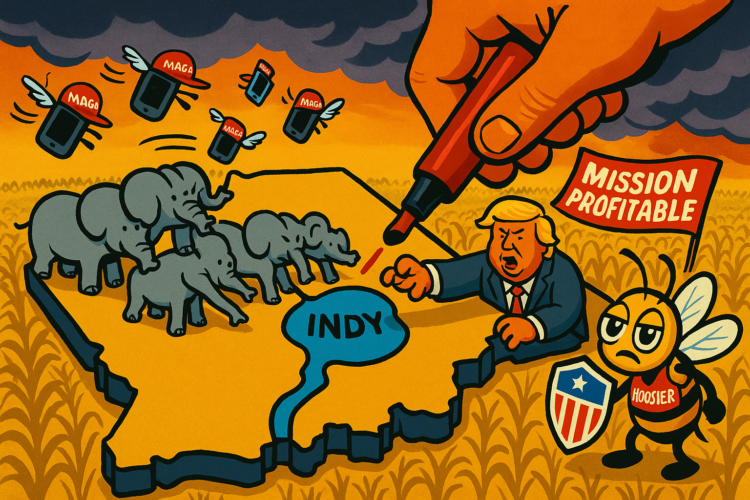
A rare intraparty “no” lands in the middle of the national gerrymander arms race, and suddenly everyone is pretending they just love local control again.
Indiana’s Statehouse spent this week acting like a polite Midwestern family hosting a reunion while a brawl happens behind the deviled eggs. The fight was over House Bill 1032, a mid-cycle congressional remap sold as basic maintenance for the Republican brand, the political equivalent of rotating the tires so the U.S. House majority does not wobble off the highway in the next midterm. The pitch was blunt even by modern standards: take Indiana’s current 7-2 Republican delegation and redraw it into a 9-0 sweep by cracking the two Democratic districts, including Indianapolis-centered seats, and redistributing those voters across multiple Republican districts until they dissolve into the statewide wallpaper.
It was not subtle. It was not shy. It was not pretending to be anything but a seat-harvesting project with a nice, safe label slapped on the front like a jar of homemade pickles. And then, in a moment that felt like a glitch in the national script, the Indiana Senate delivered a rare intraparty rebuke to President Donald Trump and killed the plan anyway, 31-19, even though Republicans hold a supermajority in that chamber. The bill did not just lose, it failed to win even a majority of the forty Republican senators who could have passed it by sheer arithmetic, which is usually how these things work when leadership wants them to work.
So the map stayed put, at least for now. The pressure cooker did not explode, it just screamed, rattled, and then got shoved back into the cabinet, still hot, still humming, still waiting for someone to claim it is “not over” and start looking for a different legislative vehicle.
The Emergency Gerrymander
The argument for HB 1032 was framed as urgency, a word that has become the all-purpose cologne of modern power. Spray it on anything and suddenly it looks like a crisis response. Supporters described the redraw as a necessary partisan maneuver to protect a slim U.S. House edge, because the national party has decided that the only legitimate majority is one that cannot be threatened by voters getting moody. In this worldview, elections are not a test of public consent, they are a weather event, and maps are the levees.
The mechanics were the point. Take the two Democratic-held seats, pull them apart, and splice their neighborhoods into multiple Republican districts so each piece becomes a minority fragment in someone else’s district. “Cracking” is a brutal word for a brutal practice, and the fact that it is said casually in legislative hallways tells you everything about the moral weather system inside American redistricting. It sounds like something you do to crab legs, which is also a kind of extraction.
The state House, doing what state Houses do when leadership has decided the train is leaving with or without everyone’s luggage, advanced the bill 57-41. A bloc of Republicans joined Democrats against it, which should have been the first sign that this wasn’t going to be a clean party-line march. When your own members are willing to take a “no” vote on a map designed to guarantee their party more power, it usually means the pressure is coming from somewhere they resent more than they fear losing. That somewhere, in this case, was not subtle either.
Local Control Unless It Disagrees
If you want to watch a political party do interpretive dance with its own slogans, you could not ask for a better stage than this one. Republicans have spent decades preaching federalism, local control, states’ rights, and the sacred wisdom of letting communities govern themselves, right up until the moment a community makes a decision they dislike. Then the sermon shifts. Suddenly it is time for national discipline, coordinated strategy, and consequences for disobedience, because democracy is only charming when it does not interrupt the plan.
This bill became a nationalized pressure test after Trump personally lobbied lawmakers, including reports of calls to swing senators. Vice President JD Vance amplified the push, and outside groups like Turning Point Action and Heritage Action leaned in, treating Indiana as a test case for how hard the White House can squeeze a state legislature before the legislature either complies or snaps. Gov. Mike Braun aligned himself with the White House effort, warning of political consequences and explicitly signaling support for primary challenges against Republican holdouts, as if the state’s elected senators were interns who forgot to bring the boss coffee.
That is the part that Indiana senators, especially the holdouts, kept circling back to. Not the map lines in isolation, but the spectacle of coercion, the overt threat of punishment, the idea that a mid-decade redraw was being demanded not because Hoosier voters asked for it, but because national power brokers saw two extra seats and decided those seats belonged to them by birthright.
In debate, opponents argued voters did not authorize a mid-cycle power grab. They objected to heavy-handed federal and party coercion and the sheer ugliness of punitive leverage over state legislators. They talked about representation, institutional legitimacy, and public trust, which in this decade sounds almost quaint, like someone pulling out a pocket watch and asking the room to respect time.
One Republican senator, quoted in coverage, framed his “no” as loyalty to constituents over national pressure, the kind of sentence that used to be routine and now reads like a threat to the modern party machine. Another Republican criticized the proposal as corrosive to public trust, which is a polite way of saying, “If we do this, nobody will believe any of us ever again, and they will not be wrong.”
Threats as Whip Count
Here is where the story stops being merely cynical and starts smelling like something scorched. The run-up to the vote included reports of escalating intimidation tactics. Lawmakers faced threats. Some reported swatting-style hoax emergency calls, the kind designed to provoke an armed police response at a person’s home, because nothing says “healthy democracy” like weaponizing emergency services to terrorize elected officials into voting the right way. There were also reports of bomb threats and other harassment, plus the general fog of online pressure campaigns that treat dissent as treason and politics as a contact sport with no referees.
One of the clearest, most stomach-turning details in reporting was the timing: a Republican senator who was publicly criticized by Trump over redistricting was later targeted by a swatting incident, according to local authorities, with law enforcement responding to a hoax report at his home. Even if you cannot prove a direct chain of command from rhetoric to action, the atmosphere is the message. When national leaders flirt with punishment talk, and outside groups promise retribution, and then threats start arriving, the holdouts are not imagining the point. The point is to make “no” feel unsafe.
This is the strange new civics lesson: the same movement that sells itself as anti-elite and anti-bully has turned political bullying into its most consistent organizing strategy. It is grievance politics with a whip, and the whip is not theoretical. It lands on people’s lives, their families, their front doors, and the way they sleep at night.
And yet, in the middle of all that, enough Republican senators voted “no” anyway. Not a narrow scrape, not a single heroic holdout, but a majority of the GOP caucus in that chamber. Which means either their principles suddenly grew a spine, or their institutional pride did, or they decided that being threatened into a gerrymander was one humiliation too many. Pick your explanation, and then remember that all three can be true at once.
The Party of Consequences
The most revealing part of this episode is not that Trump wanted the map. Of course he did. The national parties now treat state legislatures like toolboxes. If a lever exists, pull it. If a boundary line can be bent, bend it. If a court will tolerate it, do it. The revealing part is the willingness to say the quiet part loud, to make the threats public, to treat primaries as a discipline system for lawmakers who fail to obey.
Turning Point Action signaled it would spend big to target Republicans opposing the redraw. Heritage Action amplified pressure. Other aligned groups pushed the narrative that Indiana was a make-or-break test, a place where the party could either demonstrate unity or become an example of what happens when it doesn’t. Gov. Braun reportedly warned of consequences and suggested primary challenges, adding the state-level stamp of approval to the idea that dissent should be punished.
This is how you turn a legislature into a vending machine. Put in pressure, shake it hard, threaten to break the glass, and demand that the product drop. If it does not drop, kick the machine, blame the machine, and then promise to replace the machine with one that works.
The senators who opposed the bill kept pointing to something that gets overlooked in national chessboard talk: legitimacy is a resource. When you burn it, you cannot always buy it back. A mid-decade gerrymander might deliver two extra seats, but it also broadcasts to the public that the rules are optional for those with enough muscle, and that the state’s institutions exist to serve partisan strategy instead of civic stability. Even if you do not care about the moral argument, you should care about the backlash argument, because a democracy that is openly rigged starts producing citizens who act like nothing matters except force.
Indiana’s Senate, in this case, looked at the cost and decided the juice wasn’t worth the squeeze, or maybe they decided they didn’t want to be seen as a colony governed by remote control. Either way, the “no” vote landed like a rare weather event in the current climate.
The Redistricting Arms Race
Supporters framed the bill as a response to a broader redistricting arms race, which is not wrong. Mid-decade redistricting has become more common in this cycle because both parties see the House majority as a knife edge, and they are treating maps the way corporations treat tax loopholes. If you can exploit it, you are expected to exploit it, and if you do not exploit it, you are branded naïve, or disloyal, or both.
Trump’s broader strategy has been to push GOP-controlled states to redraw maps to squeeze out more safe seats ahead of the next midterm, and other states have been pulled into the same logic. Democrats, not known for refusing power when offered, have floated or pursued their own map maneuvers in response. The result is a national posture where both parties act like the game is already rigged, so rigging it further becomes self-defense. That is the emotional logic of escalation, and it is how you end up normalizing tactics that would have been scandalous in any previous era.
Indiana’s episode mattered because it was supposed to be easy. The state is deeply Republican at the statewide level. The legislature is overwhelmingly Republican. The bill was designed to protect Republicans. The White House wanted it. National groups wanted it. The governor wanted it. The state House passed it. If this could fail here, it could fail anywhere, which is exactly why so much national pressure was poured into it.
And it still failed.
That is why the vote is being read as a referendum on Trump’s influence, but it is also a referendum on the limits of threat politics when it collides with local institutions that still have some memory of being institutions. The Senate did not just reject a map. It rejected the idea that a state legislature should be treated as a subsidiary of the national party. That is a meaningful line to draw, even if it was drawn for messy reasons.
What Happens Now When the Map Stays Still
The immediate consequence is straightforward: Indiana’s current congressional lines stay in place for the next cycle, unless leaders revive the effort through a new legislative vehicle, a procedural maneuver, or some kind of special-session remix designed to rerun the fight with different pressure points. The governor has already signaled the issue may not be settled, which is political code for, “We are going to keep poking this until someone flinches.” Meanwhile, the party apparatus will do what it always does after losing a public power play: look for someone to punish.
The near-term fallout shifts to retaliation dynamics, primary recruiting, donor spending, endorsements, and the quiet reshuffling of internal leadership relationships. If you are an Indiana Republican senator who voted “no,” you are now a character in a national story you did not audition for, and you may find your next campaign season includes attack ads funded by people who do not live in your district but feel entitled to run your political life anyway.
If you are a Republican senator who voted “yes,” you have the awkward task of explaining to your constituents why you wanted to redraw a congressional map mid-cycle. You can dress it up as strategy, defense, and fairness, but most voters hear the subtext. They hear power protecting itself. And the “yes” voters also get to live with the possibility that the bill’s defeat makes them look like the ones who tried to rig the field and failed, which is never a flattering headline.
If you are Gov. Braun, you have aligned yourself with the White House and chosen the side of punishment talk. That might help in certain national circles, but it also creates a record that your opponents can replay: when a legislature did not do what the governor wanted, the governor talked like a political enforcer instead of a state executive. For a state that values the theater of independence, that is not nothing.
And if you are Trump, you now have a public loss in a state that is supposed to be friendly territory. That is not catastrophic, but it is instructive. Influence is not the same as obedience. Threats do not always produce compliance. Sometimes they produce resentment, and resentment is a strong fuel, especially in a legislature full of people who did not run for office to become extras in someone else’s national drama.
The Real Problem With the “It’s Just Politics” Defense
There is a defense that always shows up in these moments, usually wearing a shrug. Gerrymandering is politics, they say. Both sides do it, they say. Voters do not care, they say. They say it with the calm voice of a person explaining gravity, as if the moral content of a tactic disappears when it becomes common.
The Indiana fight exposes why that defense is lazy. The “both sides” line is often used as a sedative, but the consequences are real and uneven. When a district is cracked, communities lose coherence. Representation becomes performative. Voters become pieces in a math problem rather than citizens in a place. When a map is redrawn mid-cycle for partisan gain, it tells people that the electoral contract is flexible for those in power. That message does not stay inside one bill. It bleeds into everything.
The deeper issue is the conversion of democracy into a permanent emergency. The argument for constant map manipulation rests on the idea that the next election is always too important to risk, so the rules must always be optimized. That logic does not stop at district lines. It spreads to voting laws, election administration, court fights, intimidation, and the steady erosion of civic restraint. If politics becomes total war, then anything becomes permissible, and the people who get hurt first are the ones who do not have donors, lawyers, or a national megaphone.
Indiana’s Senate opponents were, in their own way, pointing to this. They were saying that even if you can do it, you should think about what you are training the system to tolerate. They were saying that legitimacy matters, not as a sentimental value, but as a practical ingredient for governance. You cannot govern a public that believes you are cheating them, not without escalating force, and force is a bad substitute for consent.
The Strange Comfort of Watching Power Hit a Limit
It is tempting to treat this as a redemption story for the Indiana GOP, but that is too clean. Many of the same lawmakers who voted “no” this week have supported plenty of other power plays, and the party has not suddenly converted to fairness. What happened here looks less like a moral awakening and more like a collision between two appetites for control: the national appetite and the local appetite.
State legislators, especially in supermajority states, are used to being the biggest fish in their pond. They like their pond. They like their committee chairs, their donor networks, their local alliances, their quiet authority. When the White House treats them like a group chat to be managed, it pokes at their pride. When outside groups threaten to buy their primaries, it pokes at their autonomy. When intimidation escalates into swatting and threats, it pokes at their safety.
At some point, enough poking turns into resistance.
That resistance is not pure. It is not heroism. It is not a halo moment. It is still useful. It is still a sign that even in a political era built on fear and discipline, there are limits to what people will swallow, especially when the coercion becomes embarrassing and public. Politics is still made of humans, and humans hate being humiliated, even when they are complicit in humiliating others.
So the bill died. The map stayed. The national apparatus recalculated. And Indiana, for a brief moment, reminded everyone that even a supermajority can flinch when it is asked to kneel.
Receipt Time The Map That Refused to Blink
A bill came to the floor with the math on its side, the governor on its side, the president on its side, the megaphones on its side, and the threat machine warmed up and ready, and it still lost because enough lawmakers decided they would rather absorb the backlash than accept the premise that they exist to be disciplined. That is not a fairy tale. It is not a cleansing moment. It is just a small, stubborn refusal, the kind that does not fix the system but does reveal its seams. And in a country where the lines on paper keep getting treated like weapons, it matters when the people holding the pen, for once, put it down.