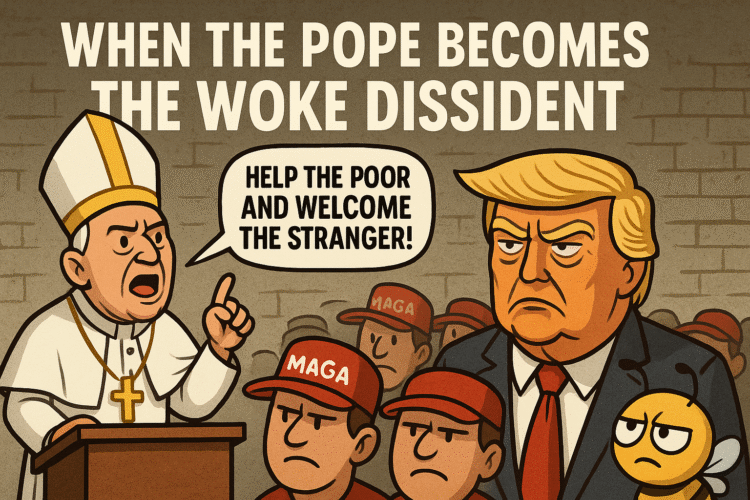
Picture this: the White House is stressed, Chicago is festering under federal patrols, Republicans are fighting over funding bills, and in strolls Pope Leo XIV—America’s first pontiff—to disrupt the script. His declaration is simple and seismic: being “pro-life” cannot exempt cruelty toward immigrants. To sanction inhumane migration policy, he says, is to undercut life itself. It’s not just a slogan. It’s a theological red line, thrown down in the middle of a shutdown week.
What shook the moment was not just the message—but the mess behind it: Cardinal Cupich’s attempt to honor Senator Durbin, the conservative backlash, Durbin’s swift recusal, the White House’s snarky pushback, and Catholics caught between doctrine and political portfolios. The Pope’s remark reframes “pro-life” into a crucible of morality. It forces MAGA’s favorite label—“life”—to answer for its absences. And suddenly a liberal Jesus rises as the most scandalous figure in American politics.
So let’s walk through the timeline, the people, the theological stakes—and the delicious absurdity of MAGA meeting a pope who sounds like one of their worst nightmares.
The Timeline: Chicago, Durbin, and the Vatican Intervention
Early September 2025
Cardinal Blase Cupich announces a plan: the Archdiocese will honor Senator Dick Durbin with an award for his work on immigrant rights, despite the senator’s pro-choice record. The idea: to signal that pro-life ethics cannot be reduced to abortion alone. The decision leaks. Conservative Catholic commentators and pro-life organizations push back, accusing Cupich of heresy, betrayal, and ideological drift.
September 29–30
Backlash intensifies. On social media, Catholic pundits call the pairing insane, Durbin “not really pro-life.” Inside the Vatican, the announcement lands like a bomb. The Pope, already meeting with migrant rights advocates, observes the U.S. controversy, texts his inner circle, and asks: can the American Church remain silence on this?
October 1, 2025 — The NPR Moment
In a rare English-language address, Pope Leo XIV intervenes. He says that supporting the “inhuman treatment of immigrants in the United States” is fundamentally incompatible with being “pro-life.” He refuses the narrow bracket that limits life ethics to the unborn; he expands it to the dispossessed, the deported, the border-crossing poor. He explicitly says: “If one omits human dignity in migration, one has amputated what it means to be pro-life.” He frames the issue not as politics but as ecclesial conscience.
Hours later, in reaction, Senator Durbin declines the Cupich award. He claims he doesn’t want to become a battleground for the Church’s internal fight. He praises the intention, but bows out to moderate tension. Conservative Catholic voices exult: the Pope’s intervention is improper political meddling, they say.
Same day — White House response
Press Secretary Karoline Leavitt condemns the Pope’s remarks as “politically loaded and unfair.” She defends federal immigration policy as lawful, responsible, and rooted in national sovereignty. She rejects the term “inhumane,” saying it’s a weaponized narrative. She accuses leftist quarters in the Church of wanting to “turn the United States into an open border sanctuary.”
In Washington, aides scramble: with federal raids currently underway in downtown Chicago, with talk of deploying Guard troops, the Pope’s excoriation becomes a political grenade. Will they push back against the Church—or accept the sermon and avoid a showdown?
The Theological and Political Clash
The core line the Pope dropped was lethal: “What are we defending in the name of life if we destroy life elsewhere?” The implication is straightforward and devastating to political identity: you cannot call yourself pro-life while endorsing policies that rip families apart or let children perish in detention or deportation. The line forces a redefinition: pro-life cannot be a single-issue slogan. It must be a cross-cutting ethic of human dignity.
Of course, the MAGA right recoils. The pope who helped unions, who fed the hungry, who hung out with the marginalized—they accuse him of being “woke pope.” They say: this is not his place. Yet Jesus, in the Gospels, spent far more time preaching about the poor, the immigrant, the lost sheep, than about doctrinal purity or ritual. He overturned tables, welcomed prostitutes, embraced the lepers. He criticized organized religion when heartlessness masked as piety. He loved the immigrant. He demanded mercy. He hated exclusion. So in a sense, a pope voicing this is just echoing theology.
Still, to MAGA ears, it sounds blasphemy. They expect a pope who preaches chastity, opposing abortion, opposing liberal theology—but not one who names cruelty as the greatest heresy. They expect a Vatican that is the moral arm of their politics. This Leo XIV does not comply.
Inside the Church, bishops divide. Some buffeted by local politics, they tread softly—calling for dialogue, nuance. Others bolster the Pope’s argument, citing the Catechism’s consistent teaching on migrants and capital punishment. They say the life ethic must include the stranger, not just the embryo.
At the same time, conservative Catholic groups wring hands: this will fracture the pro-life coalition. If abortion no longer anchors every policy, many who rallied around that banner will find their apologetics unraveling. The political calculation is brutal: if you concede this expansion of “life,” how many votes slip away?
Policy Collision: Migrant Enforcement Meets Moral Demand
Pope Leo’s words land at the precise moment Washington is engaging in a sweeping enforcement surge. Storms of raids in Chicago, talk of National Guard deployment, frozen funds, and possible deportations: the machinery of policy is whirling. The Pope’s statement doesn’t just critique — it changes the moral frame.
He doesn’t propose specifics, but he forces the question: in domestic policy, which life counts? The forced migration, family separation, detention abuses — those debates now sit in full view. He turns a policy choice into a moral test.
If those enforcing the laws are deemed guilty of diminishing life, then what? Are federal officers now subject to ecclesial censure? Will bishops demand oversight? Do sanctuaries become theological obligations? The Church’s moral firewall now stands between sovereignty claims and constitutional claims.
This equivalent shift alters how the public sees immigration enforcement. The liberal frame isn’t “open borders,” but “human dignity vs. cruelty.” Conservatives who weaponized pro-life as shorthand for anti-abortion will now find themselves scrambling to justify how deportations or harsh detention conditions align with life ethic.
The Sad Irony of MAGA Meeting Jesus
If there’s cosmic irony in the moment, it’s this: the identity most terrified of a “woke pope” is forced to reckon with the Jesus they claim to love. The one who hugged children, healed the sick, welcomed outcasts, spoke with empathy to the foreigner. They imagine their Jesus as conservative, exclusionary. But the real Jesus would have marched with immigrants, challenged the powerful. That pope is closer to Jesus than the political one they worship.
Imagine the horror for MAGA when their pet pope starts sounding like one of their worst theological nightmares: a cleric who cares about the border wall and the human cost of the wall. A pontiff who cares about the womb and the refugee. The MAGA cult expected silence or praise. Instead they got a critique from the pulpit they allowed too little weight.
Ripples Through 2026, Church, Country
What happens next? Several trajectories are already visible. If the Pope’s moral frame holds, then “pro-life” politics must either expand or fracture. Candidates in 2026 who claim pro-life credentials will be asked not only about abortion but about migrants, deaths in custody, family separation. The moral bar shifts upward.
Within American Catholicism, the intervention draws factions into open competition: the doctrinal maximalists vs. the political minimalists. Parishioners read op-eds, discuss bishops’ letters, take sides. Into the parishes come pressure, politics, moral anxiety.
On the secular front, the White House is forced to decide: respond to the Pope or stonewall him. If they retaliate, they risk alienating millions of Catholic voters—especially in swing states. If they limp, they appear weak. The timing, in a shutdown week and amid Chicago deployment drama, could make the Pope’s words the political headline of October.
Across American institutions, the Pope’s line changes how we talk about life. It demands that immigration policy, criminal justice, housing, health care be judged not by securitization alone but by human dignity. To live is more than breathing. To be pro-life is not just adopting one banner. It is choosing a worldview that includes mercy, border crossers, criminals, sinners, all God’s children.