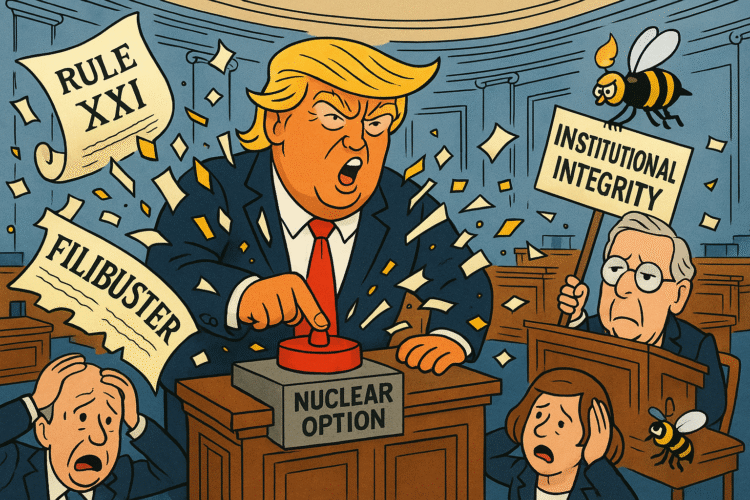
When Donald Trump takes to Truth Social to explain constitutional procedure, it’s like watching a raccoon perform heart surgery. The confidence is unmatched, the tools are wrong, and yet somehow half the country insists he’s reinventing medicine.
This week, Trump posted what might be his most nakedly authoritarian policy demand to date: “Republicans must use the nuclear option! Scrap the filibuster! No mail-in, no early voting, no fraud, no nonsense!” That’s right. The man who once thought Article II gave him “the right to do whatever I want as president” now wants to blow up a Senate rule that’s survived two world wars, a depression, and the invention of reality television—all because he can’t count to sixty.
For context: the filibuster isn’t in the Constitution. It’s a Senate tradition, much like marble floors, procedural hypocrisy, and old men quoting Cicero. But Trump’s call to “use the nuclear option” isn’t just a tantrum about gridlock—it’s a playbook for turning minority rule into permanent power.
The Rule They Pretend Is Sacred
Let’s rewind to Rule XXII, born in 1917 when Woodrow Wilson was losing his patience with isolationists filibustering wartime bills. Back then, it took a two-thirds vote of senators present to cut off debate. In 1975, after too many all-nighters in a chamber that smells like coffee and compromise, the Senate reduced it to three-fifths of sworn members—that’s sixty votes if everyone’s alive and pretending to work.
In other words, the filibuster has always been a moving target. You can almost hear the ghost of James Madison sighing, “I told you to write it down, you idiots.”
Fast-forward to 2013, when then–Majority Leader Harry Reid detonated what became known as the Democratic nuclear option. He lowered the cloture threshold to a simple majority for executive branch and lower court nominees. Mitch McConnell, always one to store outrage for later resale, declared, “You’ll regret this.”
He was right.
Because in 2017, McConnell expanded that same nuclear option to Supreme Court confirmations, clearing the way for Neil Gorsuch, followed by Brett Kavanaugh, followed by the last shreds of irony.
Now Trump wants to finish the job: no more filibuster for legislation. He calls it “getting things done.” Historians will call it “the prequel to one-party rule.”
The Nuclear Option: It’s Not Just a Metaphor
The name “nuclear option” sounds dramatic because it is. It describes what happens when the majority reinterprets Senate rules on the fly. Here’s how it works:
- A senator—let’s say the Vice President or a loyalist in the chair—rules that cloture now means fifty-one votes instead of sixty.
- Someone appeals.
- The majority votes to uphold the ruling.
- Presto: new precedent.
It’s not magic, just math—and precedent sticks like gum under the chamber’s antique desks.
Article I, Section 5 of the Constitution gives each chamber the right to determine its own rules. So when Trump says “use the nuclear option,” he’s not calling for a law, he’s calling for a reinterpretation of procedure. It’s the political equivalent of saying, “Just say the quiet part louder and call it governing.”
Why the Filibuster Matters (and Why It Doesn’t)
The filibuster was once a tool for protecting debate. In practice, it’s now a procedural chokehold that kills everything from voting rights to labor law before a floor vote ever happens.
Want to raise the minimum wage? Filibustered.
Want to pass gun background checks? Filibustered.
Want to codify Roe v. Wade after Dobbs? Filibustered and forgotten.
But when it comes to tax cuts or spending bills, the Senate already has a loophole: budget reconciliation. Under the Byrd Rule (named after Robert Byrd, the Senate’s unofficial historian and former Klansman turned procedural saint), budget measures can pass with a simple majority. That’s how Trump’s 2017 Tax Cuts and Jobs Act made it through with fifty-one votes and a prayer.
So yes, the filibuster stops progress—but only for issues that help people, not corporations.
Democrats Had the Shot and Missed
Let’s be honest: Democrats could have ended the filibuster years ago when they controlled the White House and both chambers. They didn’t. They called it “preserving norms.”
Those norms cost them the Freedom to Vote Act, the John R. Lewis Voting Rights Advancement Act, and a permanent child tax credit that lifted millions of kids out of poverty.
They also failed to codify Roe, expand court ethics, or grant DC statehood—because apparently nothing says “governing” like letting Joe Manchin play gatekeeper while pretending Kyrsten Sinema is deep.
Now Trump is seizing the moral high ground of procedural nihilism. He’s packaging it as patriotism: “End the obstruction! Get things done!”
Translation: “Let me rule without rules.”
The Accountability Paradox
Here’s the kicker: eliminating the filibuster might actually be good—for democracy.
When majorities can pass laws with fifty-one votes, voters can finally hold them accountable. You break it, you bought it. No more blaming “process” when promises die in committee.
Republicans would own their agenda: the tax cuts, the abortion bans, the immigration crackdowns. Democrats would have to deliver or die trying. The Senate would be visible again—less myth, more math.
The problem isn’t majority rule. It’s bad faith. The filibuster has become a smoke screen for cowardice. It’s a procedural boogeyman that lets senators perform outrage while keeping their donors comfortable.
If you want real accountability, make every law a majority decision. Then watch how quickly everyone stops pretending to be powerless.
The Minority Rights Mirage
Filibuster defenders like to frame themselves as guardians of minority rights. They quote Madison, whisper “deliberation,” and clutch their lapels like powdered wigs are back in style.
But in practice, the filibuster hasn’t protected minority rights—it’s protected minority rule.
Historically, it’s been a segregation tool. Southern senators used it to block anti-lynching bills, civil rights legislation, and voting protections. When progressives call it a “Jim Crow relic,” that’s not rhetoric—it’s lineage.
Mitch McConnell, the Senate’s self-styled institutionalist, once warned that ending the filibuster would “turn the Senate into the House.” The horror! Imagine a chamber where laws actually pass.
He said that right before detonating the filibuster for Supreme Court confirmations. That’s McConnellism in a nutshell: principles are sacred until they block your appointee.
Trump’s Filibuster Pitch: The Authoritarian Remix
Trump’s pitch isn’t about democracy—it’s about domination.
He’s not invoking the nuclear option to empower voters. He’s invoking it to crush oversight. With no filibuster, a bare majority could:
- Nationalize voter ID laws.
- Defund agencies investigating him.
- Rewrite immigration and asylum statutes by whim.
- Privatize everything that isn’t nailed down.
He frames it as populism. It’s really procedural autocracy.
The man who once said “Article II lets me do whatever I want” is now asking Congress to codify that same energy into law. It’s less governing, more revenge fan fiction.
The Math of Power
Here’s where it gets real.
A simple majority can set a new precedent at any time. The vice president, as presiding officer, rules from the chair. A senator objects. The majority votes to uphold. Done.
So if Trump wins back the White House and Republicans hold fifty-one Senate seats, they could erase the filibuster in one afternoon.
Democrats could too—but only if they stop treating the rulebook like the Ten Commandments.
Because the Constitution doesn’t mention filibusters. It doesn’t require sixty votes for anything. It just says each chamber sets its own rules. The rest is ceremony and fear.
The Chamber of Shrinking Workload
Governance scholars point out that the Senate now passes fewer bills than at any point since the 1950s. It spends more time confirming judges and naming post offices than debating policy.
Without real legislative flow, the body’s relevance has shrunk to spectacle: hearings, investigations, grandstanding. The filibuster didn’t preserve deliberation—it preserved dysfunction.
Ending it won’t cure everything, but it will expose who’s actually governing and who’s hiding behind “process.”
The Current Moment: Test Cases and Talking Points
Trump’s Truth Social post set off a flurry of quiet panic. Leadership aides have confirmed huddles to “review procedural options.” Whip counts are being floated, hypotheticals modeled.
So far, no live motion to change Rule XXII has surfaced—but the chatter is there. Think of it as a dress rehearsal for the next unified government.
Some Republicans, including a few “institutionalists,” are reportedly considering a test vote on a noncontroversial measure just to see if the precedent holds. Once that happens, the sixty-vote rule becomes history.
Meanwhile, Democrats are debating whether to push a standing order to carve out narrow exceptions—like for voting rights or reproductive access—before Trump gets the chance to nuke the entire system.
It’s procedural chess. Only one side plays like it’s a knife fight.
The Press and the Myth of “Both Sides”
If this unfolds the way Trump wants, expect the usual media coverage: “Republicans Consider Ending Filibuster, Critics Divided.”
Divided, of course, between those who want democracy to function and those who think governing should feel like a haunted house.
The press will call it “controversial.” They won’t call it what it is: an acceleration toward naked majoritarian rule, engineered by a man allergic to process and immune to shame.
The Next Steps
- Watch for a test vote. If a majority votes to reinterpret cloture, precedent is born.
- Watch the parliamentarian. If overruled in the chair, we’re officially in new territory.
- Watch Democrats. They might finally act on narrow carve-outs—or watch the ladder burn from a safe distance.
- Watch the press. See whether they keep calling a Senate habit “constitutional.”
Closing Section: The Myth of Sacred Rules
Every time America faces a structural choice, someone clutches a rulebook like it’s divine law. But the filibuster is not scripture. It’s a self-inflicted wound with a nostalgia complex.
Ending it won’t end democracy. It might finally start it.
Because real accountability doesn’t come from process—it comes from power exposed to daylight. A fifty-one vote Senate might finally show voters what’s broken.
If it’s chaos, good. Let the public see the cost of the people they elected. If it’s progress, even better. Maybe democracy works when it’s allowed to.
The filibuster was born in 1917, retooled in 1975, weaponized in 2013, and exploited in 2017. If Trump gets his way, it’ll die in 2025.
The tragedy isn’t that he’s wrong about the rule. It’s that he’s right for all the wrong reasons.
And when the Senate finally lights that procedural fuse, the only thing left to ask will be whether the explosion clears the air—or buries the country in smoke.