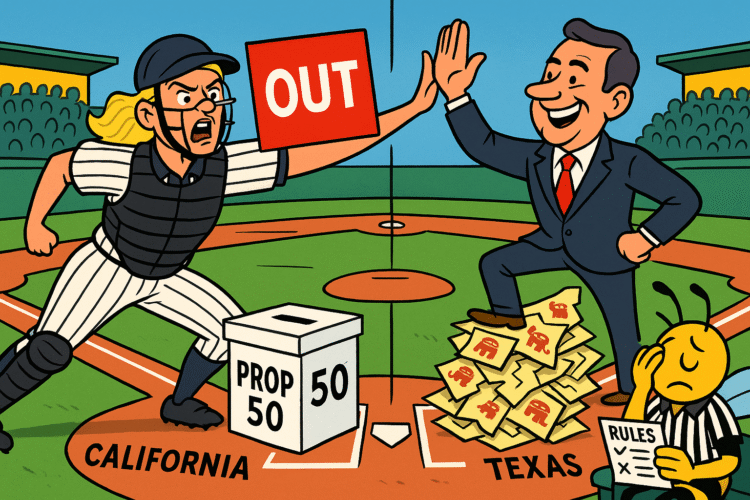
The moment the scoreboard tilts the wrong way, some teams tighten their laces and others make a beeline for the referee’s locker room. The Trump administration has opted for the latter, this time hauling the Justice Department along to pound on the door. In California, voters just approved a new congressional map under Proposition 50 that could flip up to five seats. Within hours, California Republicans sued. And now the federal government has flung itself into that lawsuit, calling the map a race driven “power grab.” Meanwhile, in Texas, where GOP leaders spent the summer redrawing lines after direct nudges from Mar a Lago, the same DOJ is quietly studying its cuticles, offering no comparable lawsuit despite civil rights challenges stacking up like unpaid parking tickets.
Start with California’s plot twist. Prop 50 was pitched as a defensive maneuver, a mid cycle counterweight to red states already slicing open their maps to lock in new partisan edges. Instead of leaving an independent commission in place while other states raced ahead, California voters suspended that commission and empowered the legislature to draw a fresh congressional map for the next three cycles. The new lines tilt toward Latino heavy districts in the Central Valley and Los Angeles, and Democrats did not bother to whisper about the goal: claw back several GOP held seats. Voters read the ballot summary, shrugged, and passed it with ease.
Republicans, newly allergic to voter directed map making, filed a federal lawsuit before sunrise the next morning. The plaintiffs include elected officials and conservative voters represented by the Dhillon Law Group, the firm founded by Harmeet Dhillon, who now holds the Trump administration’s top civil rights job but is officially recused from the matter. Their theory is simple: California abandoned its independent commission, infused the map with racial motives, and violated Equal Protection by leaning heavily on Latino identity when sketching new district lines.
Cue the federal entrance music. The Justice Department filed its own complaint in the Los Angeles federal court, choosing not only to intervene but to attach its own set of alarms about race based districting. Attorney General Pam Bondi barnstormed across conservative media, calling the map a “brazen scheme” and a “naked racial power grab.” The DOJ’s argument leans on the Shaw line of cases, insisting the map uses race as the predominant sorting tool without the narrow tailoring the Constitution requires. That this constitutional emergency materialized only after Democrats pointed out that the map could flip up to five congressional seats is, of course, pure coincidence.
California Democrats are not pretending this was accidental. Governor Gavin Newsom and the legislature framed Prop 50 as a direct response to Texas and other GOP led states ripping open their maps without updated census data and padding Republican margins in the process. If red states could exploit the timing gap for advantage, the argument went, California voters had every right to respond in kind. Their defense is that they still respected traditional mapping criteria, that Latino voters were historically underrepresented, and that countering years of dilution in other states is not the same as staging an original sin of racial engineering. In their telling, Prop 50 is a mirror, not a mugging.
Bondi and DOJ tell a different story. California, they argue, used race as a proxy for partisanship, supercharging Latino influence to secure Democratic gains while invoking the Voting Rights Act as camouflage. If that argument holds, then any attempt to push back on Republican maps that squeeze minority voters becomes unconstitutional the moment Democrats say out loud what Republicans usually imply: they want more seats. The legal logic is an ouroboros chewing its own tail.
Now rotate east. In Texas, civil rights groups are still litigating the mid decade remap that sliced up Black and Latino communities and boosted Republican prospects. The redraw was not exactly subtle. Trump publicly demanded more GOP seats, and state leaders dutifully produced a map that packs and cracks minority voters with surgical precision. Plaintiffs argue it violates both the Equal Protection Clause and Section 2 of the Voting Rights Act. Texas officials, in the familiar dance, insist the map is about politics, not race, even though the voters who lose the most power happen to be Black and Latino.
Notice the missing name on the Texas docket. The Justice Department is not a plaintiff there. It may sprinkle in amicus briefs or statements of interest, a kind of politely worded restaurant review written while the kitchen is actively on fire, but it has not sued Texas the way it has sued California. The disparity is the point, not the footnote.
This is where the civics lesson becomes a Rorschach test. Under the Shaw doctrine, a map fails if race predominates without a compelling, narrowly tailored justification. Under Section 2 of the Voting Rights Act, however, states sometimes must consider race to ensure minority voters have a fair chance to elect their choice candidates, especially when racially polarized voting is entrenched. In one framework, race is forbidden fruit. In the other, race is a necessary ingredient. Courts have navigated that tension for decades. Selective enforcement transforms the tension from a puzzle into a partisan cudgel.
California’s argument is that voters themselves, not backroom politicians, chose a course correction. Section 2 and demographic realities suggested Latinos were historically underpowered. Prop 50 tried to align representation with population realities while responding to overt partisan map surgery in other states. If the Voting Rights Act exists to prevent dilution, they argue, then refusing to act while red states dilute freely is the bigger violation.
DOJ’s argument is that both sides cannot play the same game unless they use the same motivations. California saying the quiet part out loud, in this logic, is worse than Texas quietly doing the same thing but calling it “purely partisan.” One state is punished for candor. The other is rewarded for euphemism.
Election lawyers in both states are now living inside increasingly frantic group chats. In Los Angeles, judges must decide whether to fast track the California case, which could freeze candidate filing and toss county election offices into panic. In Texas, three judge panels juggle Section 2 trials, preliminary injunction bids, and the relentless election calendar. Appellate courts may get sucked in multiple times before anyone knows what map the state will use. If chaos were a performance metric, both states would qualify for federal grants.
Behind the procedural haze is a deeper question about motive. When Republicans in Texas say openly they want more Republican seats, commentators nod approvingly as if honesty about power is refreshing. When California Democrats admit they designed Prop 50 to counter GOP engineered dilution in red states, that honesty is rebranded as constitutional evidence of misconduct. The principle becomes not “do not seek partisan advantage” but “do not confess to it.”
There is also the matter of who counts as the real sovereign. California’s statewide electorate voted on Prop 50 directly. The Trump administration now argues that this popular expression must bow to federal judges interpreting Equal Protection. In Texas, where demographic change threatens to reduce Republican dominance, the enacted map itself is treated as the truer expression of voter will than the actual voters who are losing influence. The through line is not constitutional theory. It is partisan convenience.
This is how neutral map rules decay into a menu of exceptions. When the Justice Department roars in California while whispering in Texas, it signals to state lawmakers that the true umpire wears a campaign hat. Draw lines that please the president, and the federal government calls your maneuver “purely political” and stays out. Draw lines that displease him, and those same lawyers appear in court claiming the republic is under threat. The Constitution becomes a customer service manual, updated depending on who is calling from Florida.
Democrats warn that the asymmetry will incentivize a new era of maps drawn not for voters but for executive praise. Voting rights groups say selective enforcement invites forum shopping by the federal government itself, turning redistricting into an audition for presidential approval. Republican leaders, meanwhile, celebrate the California suit as a triumph of principle while praising Texas for achieving the same objectives by decree instead of referendum. In one breath, they condemn a Democratic map as racial manipulation. In the next, they call their own map a patriotic obligation.
Umpires In Campaign Hats
Over the next several weeks, a few checkpoints will reveal whether the rulebook still matters. Watch whether the court in Los Angeles freezes candidate filing and races toward a rushed ruling that could decide the fate of multiple House seats. Watch whether the Justice Department articulates any standard that could, even theoretically, reach Texas, or whether it leans on adjectives that magically apply only to blue states. Watch whether appellate courts in Texas accelerate Section 2 cases enough to collide with the mid decade redraw. And watch whether any national outlet is willing to say plainly that the White House is suing blue California for doing in public and by referendum what it encouraged red Texas to do behind closed doors and by fiat, turning the redistricting process into a choose your own umpire contest where the only unforgivable act is losing.