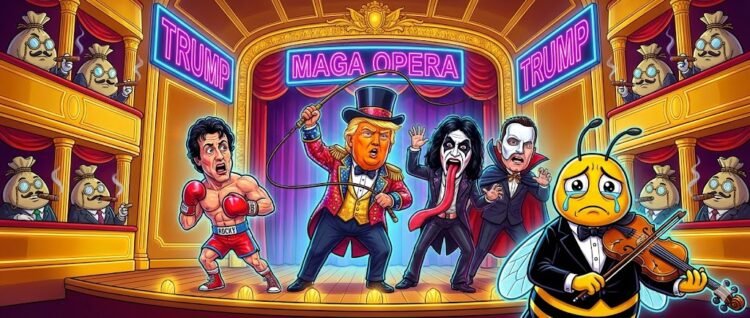
The nation’s premier cultural institution has been rebranded as a Atlantic City lounge act, and the price of admission is your dignity.
The John F. Kennedy Center for the Performing Arts was designed as a living memorial to a slain president, a marble temple on the Potomac intended to elevate the American spirit through the transcendent power of culture. For decades, it stood as a demilitarized zone in the culture wars, a place where Republicans and Democrats could sit in a velvet-lined box, wear tuxedos that smelled of mothballs, and politely applaud a ballerina or a jazz pianist without trying to arrest them. It was stuffy. It was self-important. But it was ours. It belonged to the civic trust.
That era ended on December 7, 2025. It did not end with a bang, but with the opening riff of a Kiss song and the sight of President Donald J. Trump standing center stage, microphone in hand, acting not as the solemn head of state but as the emcee of his own reality show.
In a spectacle that felt less like a celebration of the arts and more like a hostile takeover of a library by a monster truck rally, Trump personally hosted the 48th Kennedy Center Honors. He is the first president to do so. This distinction is important. Past presidents were content to sit in the balcony, wave once, and let the artists shine. They understood that the night was about the honorees. But in the Trump cosmology, there is no room for a spotlight that does not illuminate the leader. He didn’t just attend the party. He crashed the stage, grabbed the aux cord, and turned the nation’s highest cultural honor into a captive audience for his own stream of consciousness.
The roster of honorees reads like a playlist curated by a man whose cultural reference points calcified sometime around 1986. We had Sylvester Stallone, the avatar of American muscle and mumbled resilience. We had Kiss, the band that taught the world that merchandise is more important than music. We had George Strait, the safe harbor of country music. We had Michael Crawford, the original Phantom, a fitting choice for an administration that operates largely in the shadows and occasionally drops chandeliers on its enemies. And we had Gloria Gaynor, whose anthem “I Will Survive” was likely played without a shred of irony regarding the institutions currently trying to survive the man clapping in the front row.
This was not a collection of artists chosen for their contribution to the avant-garde or the depth of their human insight. This was a lineup chosen for their vibes. It was a lineup of winners, of tough guys, of people who understand branding. It was the aesthetic of a gold-plated elevator translated into performance art.
The atmosphere inside the Opera House was reportedly surreal. The “Hollywood turnout” was thin, a polite way of saying that the actual cultural elite of the country—the people who make the movies, write the songs, and win the real awards—staged a boycott. The red carpet was devoid of the usual A-list liberal glitterati. In their place sat the new court. Defense Secretary Pete Hegseth was there, presumably checking the structural integrity of the balcony. Governor Glenn Youngkin, Kari Lake, and Dr. Mehmet Oz filled the seats, a tableau of political ambition masquerading as patronage. It looked less like a gala and more like the green room at CPAC, but with better upholstery.
Richard Grenell, the center’s president and Trump’s loyalist enforcer, was quick to spin the boycott as a victory. He trumpeted that the event raised a record twenty-three million dollars, nearly double the previous year’s take. He credited Trump with securing about two hundred and fifty million dollars in congressional funding for the venue. This is the transactional language of the new regime. Art is not measured in beauty. It is measured in receipts. The boycott didn’t matter because the donors showed up. The critics didn’t matter because the check cleared.
This crystallizes the institutional politicization that critics warned about when Trump purged the board earlier this year and installed his loyalists. The Kennedy Center is no longer a neutral ground. It is a trophy. It is a spoil of war. By flooding the board with his people and turning the fundraising into a MAGA flex, Trump has effectively privatized a national monument. He has turned it into another Trump Hotel, just with better acoustics and a federal subsidy.
The hands-on curation was the tell. Trump didn’t just approve the list; he introduced them. He used prerecorded videos to frame the artists’ careers through the lens of his own admiration. This reshapes the narrative of the Honors entirely. It is no longer “America honors these artists.” It is “The President likes these guys.” The Rainbow Ribbon, once a symbol of artistic lifetime achievement, has been converted into a badge of loyalty. It is the Medal of Freedom for people who kept the President entertained during the lean years.
Consider the optics of the Oval Office medal ceremony. This intimate ritual, usually a moment of quiet respect, was transformed into a photo op for the new cultural hierarchy. Stallone and Trump, two septuagenarians who have built empires on the myth of the underdog while living in palaces, standing shoulder to shoulder. It is a powerful image, but it is not an image of artistic appreciation. It is an image of consolidation. It says that culture, like the Justice Department and the civil service, must bend the knee.
The presence of figures like Pete Hegseth in the audience adds a layer of menacing absurdity. Here is a Defense Secretary who has advocated for war crimes and the “kinetic” solution to drug policy, sitting in a tuxedo applauding the disco hits of the 70s. It normalizes the extremism. It wraps the radicalism of the administration in the soft focus of a gala. It tells the viewer at home that these people are civilized, that they appreciate the Phantom of the Opera, so surely they can’t be dismantling the constitution. It is the banality of evil wearing a cummerbund.
The friction with the broadcast partners, CBS and Paramount Skydance, must be palpable. They are contractually obligated to air this spectacle on December 23. They have to edit around the empty seats. They have to decide how much of the President’s monologue to keep. They are trapped in a partnership with a center that has gone rogue. If they air it as is, they are broadcasting state propaganda. If they edit it, they are “censoring” the President. It is a lose-lose scenario engineered by a man who thrives on placing institutions in impossible binds.
This event sets up immediate cultural and ethical flashpoints. Can a national arts institution remain “national” if half the nation’s artists refuse to step foot in it? Can it claim to represent American culture if it only celebrates the culture that the President enjoys? The answer, obviously, is no. The Kennedy Center is becoming the Trump Center in all but name. It is shrinking. It is becoming a regional theater for the grievance politics of the right, funded by the taxes of the people it excludes.
The “record fundraising” that Grenell brags about is not a sign of health. It is a sign of capture. It means that the donor class sees the Kennedy Center not as a charity, but as an investment. You donate to the Center to get close to the President. You buy a table to show your fealty. The art is just the background noise for the transaction. The twenty-three million dollars didn’t come from lovers of opera; it came from lovers of access.
We are watching the “Orbanization” of American culture. In Hungary, Viktor Orban didn’t just take over the courts and the press; he took over the opera houses and the museums. He understood that to control a nation, you have to control its stories. You have to define what is “good” art and what is “degenerate” or “woke” art. Trump is following the playbook. By elevating Stallone and Kiss, he is elevating a specific vision of America: loud, violent, nostalgic, and commercial. He is saying that this is the official culture, and everything else is suspect.
The “thin” turnout from Hollywood is framed by the right as elitist snobbery, but it is actually an act of civic hygiene. To attend would be to collaborate. To smile for the cameras would be to normalize the man who has spent the last year burning down the civil service and threatening his political opponents. The artists who stayed away were not being petty; they were drawing a line. They were refusing to be props in a dictator’s talent show.
But the show went on. That is the tragedy of it. The lights went down, the music played, and the President beamed. He loves the applause. He loves the gold. He loves the idea that he owns the stage. For one night, he wasn’t just the President; he was the producer, the director, and the star. He turned the Kennedy Center Honors into a celebration of himself, reflected in the mirrored sunglasses of Gene Simmons.
The near-term consequences are bleak. We can expect expanded fundraising and programming tied exclusively to Trump’s tastes. Next year, expect the honorees to be Kid Rock, the guy who draws the Pepe cartoons, and the CEO of UFC. Expect the “civic trust” to evaporate completely. Expect the Kennedy Center to become just another venue for the MAGA roadshow, a place where the cultural war is fought with fundraising dinners and black-tie insults.
There is a profound sadness in seeing the Kennedy Center reduced to this. It was imperfect, yes. It was elitist, sure. But it aspired to something higher. It aspired to the idea that art transcends politics. Trump has smashed that aspiration. He has dragged the art down into the muck with him. He has proven that nothing is sacred, nothing is off-limits, and everything, eventually, can be branded.
The irony of honoring Michael Crawford, the Phantom, is the most biting detail of all. The Phantom was a disfigured genius who lived in the sewers beneath the opera, obsessed with a beauty he could not possess, eventually destroying the thing he claimed to love because it wouldn’t submit to him. Trump didn’t need to wear the mask. The metaphor was wearing a tuxedo and standing at the podium.
Receipt Time
The invoice for this evening of “cultural enrichment” is being sent to the American taxpayer, who is now subsidizing a $250 million venue for the President’s personal amusement. The cost includes the dignity of the institution, which has been sold off for parts. It includes the integrity of the Rainbow Ribbon, which is now just a party favor for loyalists. And it includes the silence of the empty seats, where the artists used to sit before they were told that their only role was to clap for the King. The receipt shows a record profit in dollars and a total bankruptcy in soul.