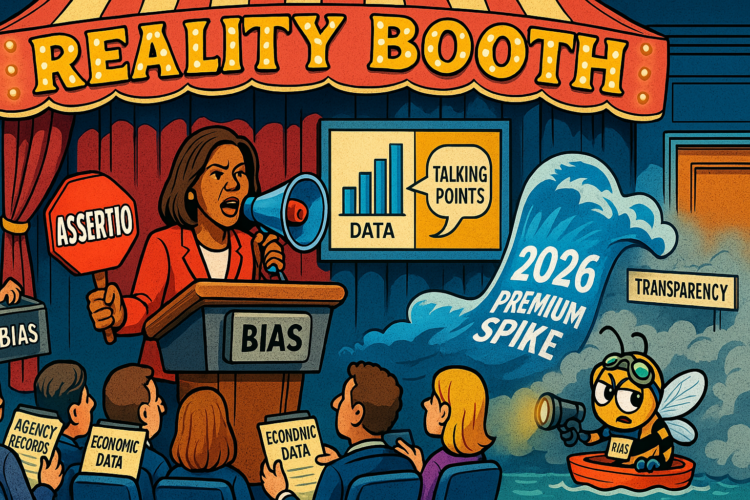
The press asks for information, the podium offers vibes, and the real product is confusion with a patriotic label.
There are two ways to look at a White House press briefing. The old way is as a daily information exchange, flawed but functional, where reporters ask questions and the government, at least in theory, answers them in a way tethered to records, data, and basic reality. The newer way is as a live-action stress test for the concept of “verifiable,” where the administration shows up with a script, a glare, and the confidence of someone who thinks facts are optional when you say them with enough force.
Karoline Leavitt has leaned into the second model so aggressively that the briefing room now feels like an escape room designed by a cable news producer. The clues are scattered, the rules change mid-sentence, and the only way out is to stop expecting the door to exist. Her escalating confrontations with reporters are being framed as press-versus-White House drama, but that’s the surface story. The deeper story is that the fights are not with journalists. They’re with reality itself, and reality keeps refusing to cooperate by remaining observable.
The pattern is consistent. Leavitt fields questions about immigration enforcement outcomes, economic indicators, court rulings, foreign policy actions, and the other unglamorous items that come with governing. Then she deflects, contradicts established evidence, attacks the questioner as biased or dishonest, and swaps in talking points that orbit the question without ever landing on it. The routine exchange breaks down in real time. The room becomes less “here’s what happened” and more “here’s what we want you to repeat.”
That may sound like a small shift. It isn’t. A press secretary doesn’t just communicate policy. A press secretary signals whether the government believes it owes the public an honest accounting. When the podium treats basic facts as debatable, the administration is not just dodging reporters. It’s trying to rewrite the contract between power and accountability.
The Podium as a Fog Machine
The Trump-era communication strategy has always relied on assertion rather than proof. Say it confidently. Repeat it. Treat follow-ups as insults. Attack the messenger. Fill the air with so much argument that the audience stops trying to track what’s true and instead picks a side based on tribal loyalty. Leavitt’s confrontations fit neatly into that model, not as personal temperament, but as job performance. She’s not losing control of the room. She’s using the room as a stage where control looks like defiance.
Defiance plays well on camera. It feels strong. It feels like someone is standing up to an annoying elite. It also serves a more practical function: it muddies accountability. If the briefing produces confusion instead of information, then responsibility gets harder to pin down. Agencies, markets, and courts are left to reconcile statements that do not match records, filings, or data. The administration can always claim it was misunderstood. It can always accuse the press of distortion. It can always insist the real scandal is the question itself.
This is governance by fog. If you can’t see clearly, you can’t aim clearly. If you can’t aim clearly, you can’t hold anyone responsible.
The funniest part, in the bleakest way, is how often the fog is sold as transparency. “We’re telling it like it is,” they insist, while actively refusing to describe what is. It’s like watching someone smash a window and claim it improved visibility because there’s more air now.
Immigration: Numbers as Costume Jewelry
Immigration questions are a perfect arena for this strategy because the issue already comes with fear, misinformation, and emotionally loaded imagery. When reporters ask about enforcement outcomes, removals, detentions, or operational metrics, the answers often come back as slogans. “We’re enforcing the law.” “We’re securing the border.” “We’re finally taking this seriously.” Those lines are designed to satisfy an audience that wants a mood more than a ledger.
But the mood does not replace the facts. Outcomes are measurable. Court orders exist. Records exist. If a reporter cites a documented discrepancy, the response is frequently not to address it but to question the reporter’s motives. Bias becomes the argument. Tone becomes the weapon. The administration doesn’t have to win on evidence if it can win by turning every question into a character attack.
It’s an old con, dressed up for a modern audience. If you can’t dispute the numbers, dispute the person holding the spreadsheet.
The Economy: “Strong” Is Not a Statistic
Economic indicators are another common flashpoint. Reporters ask about inflation, jobs, growth, prices, markets, wages, and the gap between what people hear and what they feel in their bills. Leavitt’s style in these exchanges, as described in the analysis, follows the same choreography: contradict or gloss over established indicators, swap in talking points, accuse the questioner of dishonesty, and keep moving.
This works politically because the economy is both data-driven and emotionally experienced. People are stressed. People are angry. People want someone to blame. When the White House insists everything is great or insists the problem is someone else, the goal is not to provide a faithful snapshot. The goal is to plant a flag. The flag can be waved long after the receipts come in.
The irony is that markets and agencies cannot govern with flags. They govern with numbers, filings, and forecasts. A press secretary can declare a reality, but investors, employers, and households still have to live in the one where prices exist.
Courts: When “We Won” Means “We Didn’t Like the Question”
Court rulings are where reality-denial gets particularly dangerous. Courts produce orders, opinions, deadlines, and legal constraints. When the briefing room treats those constraints as negotiable, it signals something bigger than spin. It signals a power posture that sees the law as an obstacle course rather than a boundary.
In the described pattern, Leavitt is confronted with court-related questions and responds by deflecting, disputing established information, or attacking the reporter. The result is a visible breakdown in the normal information exchange. Instead of clarifying how the administration will comply, she turns the conversation into conflict.
That might thrill the audience that enjoys watching institutions get punched. It’s a problem for anyone who remembers why institutions exist. Courts aren’t there to be entertained. Courts are there to impose limits, especially when power gets too comfortable.
When the press briefing refuses to acknowledge those limits plainly, the press room becomes less a communication channel and more an audition for contempt.
Foreign Policy: Certainty as a Substitute for Coherence
Foreign policy briefings are often where administrations try to project clarity, strength, and consistency. Under this style, clarity becomes a performance instead of a reflection of actual strategy. When asked about documented actions, outcomes, or contradictions, the press secretary pivots to assertion and offense. The questioning itself becomes the enemy.
This is a terrible way to communicate in a world where other governments are also watching. Allies and adversaries don’t just hear the words, they examine the gap between the words and the record. When the U.S. briefing room behaves as if facts are flexible, it signals unpredictability. Unpredictability can be mistaken for strength in domestic politics. Internationally, it can read as instability.
And it creates a second irony: the administration talks about strength while showing that it can’t tolerate basic verification. If you’re confident in your actions, you don’t need to scream at the person asking what you did.
The Press Secretary as a Content Creator
One reason this tactic persists is that it’s optimized for attention. Leavitt’s confrontations generate clips. Clips travel. Clips rally loyal audiences. The drama becomes the story. The reporter becomes the villain. The administration gets to claim persecution. The base gets to feel righteous.
The briefing room becomes content, and content has different incentives than governance. Content rewards conflict. Content rewards certainty. Content rewards insults that fit into a shareable rectangle. It does not reward nuance, caveats, or the boring sentence that starts with “We don’t know yet.”
So the system selects for the most combative performance. Even the questions change in response. Reporters who want answers have to harden follow-ups, bring documents, cite records, and make the evasions visible. That’s what the analysis suggests is happening, and it’s the only rational adaptation left. If the podium won’t supply verifiable information, journalists have to force verification into the room.
That creates a new loop. The harder the verification, the more defensive the administration becomes. The more defensive the administration becomes, the more it attacks the press. The more it attacks the press, the more the base cheers. The more the base cheers, the more the White House sees the strategy as successful. Meanwhile, the country loses the one boring civic habit that made accountability possible: the ability to agree on basic facts.
Governing by Assertion Leaves a Mess for Everyone Else
The administration can perform reality-denial in the briefing room, but it can’t live there permanently. Agencies still have to file documents. Courts still issue rulings. Markets still react. Foreign governments still interpret actions. The bureaucracy is forced to translate the performance into something operational. That translation is where chaos breeds.
If statements don’t match the record, someone has to reconcile them. If the press secretary claims one thing and the filing says another, the filing wins. If the podium insists on a narrative that contradicts data, the data still shapes outcomes. That means the briefing becomes less a source of information and more a source of noise.
Noise has consequences. It erodes trust. It increases cynicism. It makes people assume everyone is lying. It makes it harder for the public to know what to believe, which is convenient for an administration that prefers reduced scrutiny. If the public gives up on truth as a shared standard, power moves more freely.
This is why the real fight isn’t between Leavitt and reporters. It’s between accountability and performance. And performance is currently winning on points because it’s louder.
What Comes Next: The Briefing Room as a Testing Ground
The near-term consequence is an erosion of trust that turns routine briefings into performance conflicts. Fact-finding shifts to adversarial verification outside the White House. Journalists face a decision point: adapt by hardening documentation demands, or accept the new model where questions become props and answers become slogans.
The administration also faces a decision point, though it won’t phrase it that way. It can keep treating the podium as a reality-bending device, or it can return to the old expectation that words should match records. The first option energizes the base and pressures media outlets. The second option restores some democratic norms and lowers the temperature.
There’s a reason the first option is attractive. It makes accountability harder. It’s the politics of denial with a microphone.
And it’s contagious. If the White House can treat facts as negotiable, governors and lawmakers will do it too. If they do it too, the public’s ability to demand evidence collapses. Once that collapses, the only thing left is power and narrative, and narrative is usually written by whoever can afford the loudest amplifier.
Reality Check Receipt
Karoline Leavitt’s escalating confrontations with reporters reflect a broader strategy that treats press briefings less as information exchanges and more as live performances built around disputing verifiable facts, with repeated moments where questions about immigration outcomes, economic indicators, court rulings, and foreign policy actions are met with deflections, contradictions, and attacks on questioners rather than documented answers, producing visible breakdowns in transparency and shifting fact-finding into adversarial verification outside the White House, while the near-term stakes center on whether journalists respond with harder follow-ups and receipts-driven questioning or whether the administration’s assertion-first posture further corrodes trust and normalizes governance that expects the public to accept narrative over record.