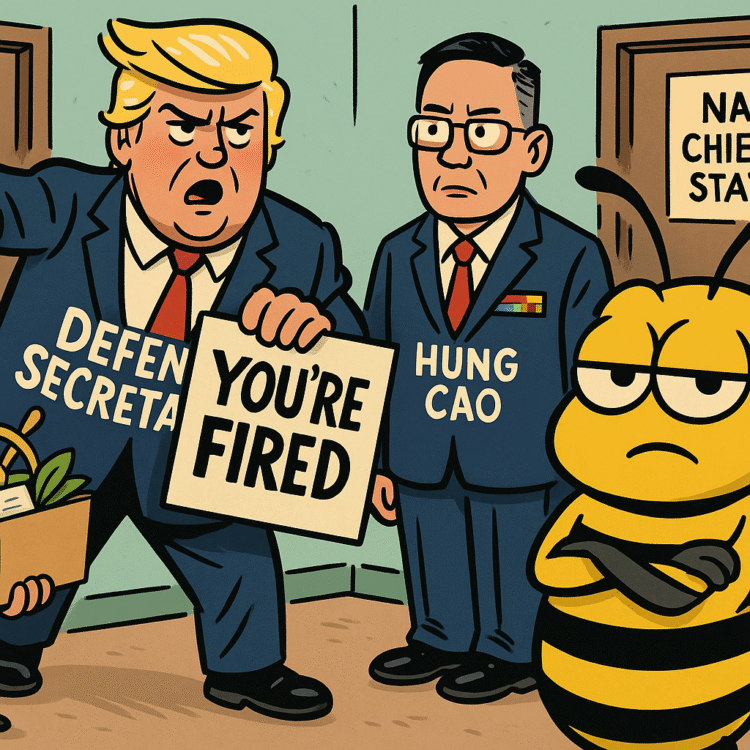
In Washington these days, firing people has become the dress code. Public purges signaling ideological loyalty rather than competence is the new CV, and the latest victim is Jon Harrison, Navy secretary John Phelan’s chief of staff. On October 3, 2025, Defense Secretary Pete Hegseth abruptly cut Harrison loose—only hours after the Senate confirmed Hung Cao as Undersecretary of the Navy. Harrison’s ouster was scarcely confidential: the Pentagon issued a one-line, no-explanation memo. Harrison declined comment. The gears of this purge, however, reveal more than internal squabbling. They expose what happens when the culture war overtakes national defense.
The Cast & Timing
Let’s assemble the cast. Jon Harrison had become more than a behind-the-scenes aide. Under Phelan and Harrison, the Navy’s policy and budgeting offices had been centralized, gatekeeping staff flows and redirecting lines of authority. Sources allege Harrison and Phelan reassigned or “froze” aides intended to assist Cao, ensuring that decision-making stayed under their umbrella. Cao, confirmed earlier that week, arrived with a staff roster in limbo.
Then came the moment. On October 3, Hegseth, having already overseen a string of firings across the Pentagon, exercised his kick. The Pentagon’s terse public notice read: “He will no longer serve as Chief of Staff to the Secretary of the Navy. We are grateful for his service to the Department.” Harrison offered no public rebuttal or defense. The signal was clear: authority in the Navy office now answers more to Hegseth than to Phelan or any incoming undersecretary.
This move followed days after Hegseth’s Quantico summit (September 30), where he publicly announced sweeping cultural reforms in the military: reimposed male benchmark fitness standards, tighter grooming rules, merit tests, and leadership shakeups. Concurrently, rules began rolling out that critics say weaken Pentagon inspectors general, limit whistleblower protections, and invert internal oversight. Harrison, in effect, was caught in the crosshairs of the culture reset.
Why He Had to Go
Harrison’s removal is not a personnel shake-up. It is a lesson. He had been behaving like a center of gravity in the Navy bureaucracy—determining hires, adjudicating access, and structuring workflows. Analysts say he had already diminished the role of undersecretary aides by reassigning them, and attempted to interview future military assistants to make sure their loyalties aligned with his vision. In short: he was building a machine inside the Navy that looked like a mini-Phelan empire—and not a Cao-friendly one.
Once Cao was confirmed, the balance of power threatened to shift. Harrison’s hold over staffing, information flow, and gate access was incompatible with a new undersecretary trying to reenter the game. Hegseth’s purge simply cleared that obstacle. Harrison, once central, became too central—a rival node in a network that Hegseth wants to be the brain.
Purge as Policy
To see Harrison’s firing as isolated is to misunderstand the method. This is purge logic. Earlier in 2025, Hegseth ousted the Chair of the Joint Chiefs (Gen. Charles Brown), dismissed the Navy’s top uniformed leader (Adm. Lisa Franchetti), and removed leaders across the Air Force, Coast Guard, and intelligence ranks. He has fired aides in his own Pentagon office: his former chief of staff Joe Kasper resigned amid leaks, and other aides (Dan Caldwell, Darin Selnick, Colin Carroll) were removed under the cloak of internal investigations. New York Post+3The Washington Post+3The Guardian+3
At Quantico, his message was not subtle: loyalty, toughness, ideological conformity—not institutional judgment. The new backdrop is a command climate where dissent or even ambiguity may become disqualifying. Harrison’s failure lay not in competence but in encroachment—he had to go so that no one else believes they can build bureaucratic weight independent of the Hegseth axis.
Operational Strain in a War-Wounded Navy
Imagine being a Navy operator trying to push submarine building timelines, manage shipyard bottlenecks, or stabilize contractor pipelines. Now imagine your civilian leadership is shifting every few weeks, and internal gatekeepers are being replaced not by technocrats but by political loyalists.
The Navy already lags in productivity compared to China. Programs are delayed, surface and subsystems are late, supply chains strained. Civilian leadership instability makes it harder to sustain any institutional discipline, continuity, or long-term planning. The price gets paid in delayed vessels, cost overruns, and lost strategic credibility with allies.
If Cao cannot rebuild a working front office—if he can’t get trusted deputies, restore staffing flow, and rebuild bureaucratic trust—then the office will limp. Control over billets, promotions, and access will tilt toward whoever controls H-ring lines to Hegseth. Even departmental secretaries (like Phelan) may find their power hollowed.
What Happens Next
- Cao must either acquiesce or rebuild. If he refuses to play along, his undersecretary role becomes a façade; his aides marginalized, his orders rerouted through new gatekeepers.
- Billet control, personnel flows, and front-office influence shift into the E-Ring (the Defense Secretary’s inner sanctum), not down the departmental mesh.
- Other services see how crossing Hegseth looks: get purged, removed, ignored. That chilling effect will quiet dissent.
- Congress, industry, and allies will watch contracting decisions, shipbuilding program reviews, and congressional oversight hearings more acutely—where will budget authority lie? Who signs off on major decisions?
- If disruption continues, some programs may be canceled or derailed, contracts renegotiated, promotions delayed. Allies watching militaries under strain may lose confidence.
The Irony and Dystopia
The irony is thick. Harrison, who centralized power inside the Navy to improve control, is himself ejected in the name of discipline and warfighter ethos. The rhetoric of meritocracy becomes cover for political restructuring. The message: your value is not technical, not institutional—it is loyal, ideological, conforming.
In this model, technical dissent or bureaucratic friction is rebranded as disloyalty. Complexity, caution, expertise—all become liabilities. Efficiency becomes ideological purity.
What Congress & Allies Should Demand
Congress must demand transparency: what criteria was used to fire Harrison? What internal memos reflect performance assessments? How is Cao’s office being rebuilt? What does chain-of-command mapping now show? And allies who rely on naval assurance should ask: who now signs decisions? What chain of legitimacy backs them?
They should refuse to fund or authorize programs where civilian control is overtaken by political purges. They should push for inspector general investigations—not just inside the Pentagon, but with independent auditors seeing whether purges undermine readiness.
Harrison is gone. But the firing tells us more than his biography ever could. It shows that the battlefield in 2025 is not only at sea or in skies—but inside government offices. The war for institutional control is underway, and the Navy’s front offices are now just another territory.