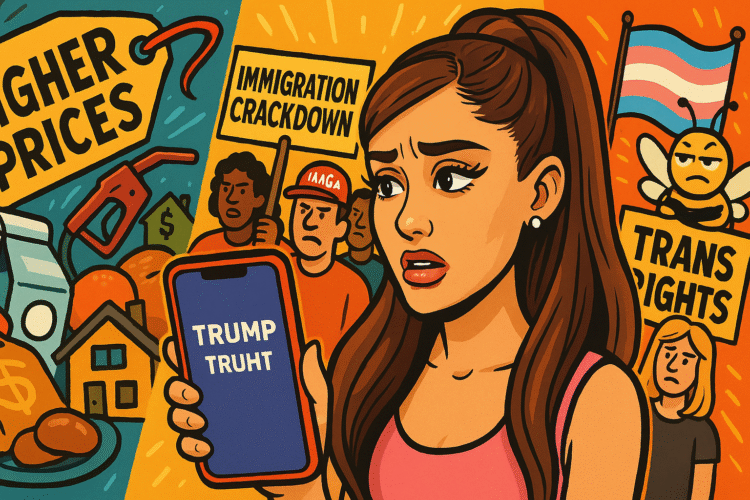
She’s been seen on stages and screens, warbling “thank you, next” and hitting falsettos. But this time, Ariana Grande raised her voice in a different key: political reckoning. Using Instagram Stories and a reshared post, she looked straight into the camera and asked: what did Trump voters actually get? Did promised relief for rent, groceries, gas, insurance ever arrive? And if not, was the moral cost—crackdowns on immigrants, queer people, speech—worth the trade?
This moment is a rare one: a celebrity, mid-career, forcing a constituency to answer their own deal. It’s not a tweet. It’s a spotlight. And the reactions it unleashed tell you everything about our moment: algorithms are battlegrounds, celebrities are lightning rods, and what was once art has become confrontation.
The Sequence: Story Tiles, Reshares, Amplification
Ariana’s post appeared in her Story feed early in the day. The first tile read something like: “I want to check in with Trump voters.” A second tile listed broken promises: lower grocery costs, rent relief, falling gas or energy bills, lower insurance premiums. Then she pivoted: “Do you see any of that? Has any of it become your life?” The final swipe asked: “Are these supposed gains worth the suppression of immigrants, trans people, and speech?”
She then reshared a post (itself cropped and reposted by fan accounts) framing her message as “an overdue check-in, not a lecture.” Soon TMZ ran the story under a headline: “Ariana Grande Calls Out Trump Supporters: Are the Promises Worth It?” Fan accounts exploded: screenshot stacks, replays, commentary breakdowns.
Within hours, the “check in with Trump voters” meme was everywhere. Conservative influencers denounced her. Calls for boycott, for censorship, even for deportation escalated. Supportive voices called her brave, called it harm reduction, a moral nudge, a wake-up call. The split was immediate and sharp.
The Cultural Footing Behind the Salvo
This isn’t the first time Ariana has leaned political. Over the past year she’s reshared calls to impeach, spoken up about ICE and deportation, and engaged publicly with trans and immigrant rights. But this moment feels different. She’s not commenting on policy abstractly—she’s asking people who believed in economic promises to face an alternate ledger: profit in their wallets vs pain in others’ lives.
It helps that she’s not just a singer. She’s been riding a speculative wave of cultural momentum in 2025: Wicked Part Two trailers, streaming spikes for Eternal Sunshine tracks, whispers of a new tour. She carries attention. Her voice is translatable. So when she speaks as a political actor, it echoes beyond fandom into public life.
That gives her the power to serve not just as entertainer, but as arbiter—authoring a narrative frame: Winners don’t ask for favors. They demand accountability. And she positioned herself as the one nudging both sides.
Backlash, Support, and the Wound She Ripped Open
From the moment she posted: MAGA influencers warned her that fans would turn. They accused her of virtue signaling, of alienating half the country. Some fringe voices floated the idea that if she’s so concerned about speech, maybe she’d leave. (Yes, that old chestnut.) Others claimed she was abandonee from political relevance, a pop star who forgot the rules.
On the flip side, progressive circles embraced her. She became a hashtag. She became evidence that celebrities can still exercise moral voice. She became a proof point: in a moment of silence, someone must speak. Her critics said she was tone-deaf; her defenders said she was bearing witness.
What she provoked was more than social media heat. She forced a question: when the promises don’t land, what do you owe your fellow citizen? When the cost is lived, what has your vote become?
Why This Moves the Needle
Celebrity speech in punitive climates is both powerful and dangerous. She doesn’t have the privilege of quiet neutrality. Every public line is scanned, weaponized, and crossed. In a world where social media is the civic square and algorithmic amplification is the loudspeaker, a few Story cards can become national flashpoints.
Also: her attack reframes economic policy as moral ledger. She put emergency rent, gas, groceries on the same page as civil-rights rollbacks. She collapsed the binary: it’s not economy versus rights. It’s economy plus rights. If one side fails, the burden falls on the other.
And finally: the timing matters. We’re in an election-proximate cycle. She turned a celebrity post into a political moment. A narrative moment. She primed others to talk about tradeoffs. She pushed the conversation off “who’s offending whom” into “what was promised, and what was taken.”
The Stakes: Voice, Accountability, Political Accountability
When celebrities ask these hard questions, they risk backlash. But silence is complicity. Ariana’s post reminds us that political legitimacy isn’t just policy—it’s trust. And trust dissolves when promises are ghosts.
If the public stops believing that voting yields change, they stop voting. If people conclude the moral cost is inevitable, they give up the language of resistance. That’s the real danger.
She also reminds us that power is performative. Lawmakers can ignore protesters, but they can’t ignore a pulse of online outrage. Celebrities harness attention currency. They shape narrative arbitrage. And when they break silence, they shatter comfortable silences.
This wasn’t pop stardom. It was confrontation. A young woman calling out the bargains voters made, and asking: do you believe in it harder than you believe in each other? In a time of fracture, that’s more than a tweet. It’s a protest. She didn’t ask for applause—she asked for accountability.