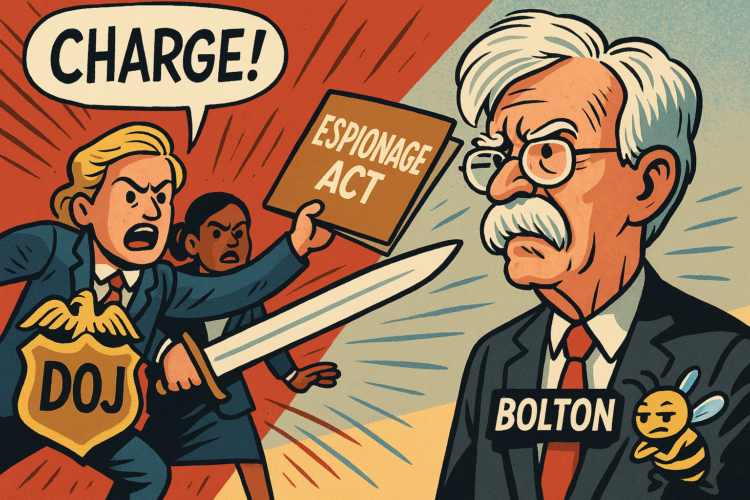
On the heels of a government shutdown, a stock market trembling under tariff scares, and a political climate so charged it could detonate, comes news that seems tailor-made for the age of rival prosecutions: former National Security Adviser John Bolton is expected to be indicted as early as next week. FBI agents searched his Maryland home and Washington, D.C. office in late summer. A Maryland grand jury has heard weeks of testimony about alleged mishandling or transmission of classified materials. Inside DOJ, the debate is already furious: whether to push an Espionage Act case or throttle the charges to something narrower.
Bolton—represented by Abbe Lowell and others—denies any wrongdoing, saying the documents in question stem from prior government service long ago, with proper review. But the context is unavoidable: a Trump administration, an FBI now under Kash Patel, and a Justice Department led by Pam Bondi, accused repeatedly of targeting critics. If the indictment lands, it will test whether this is a narrow document case—or a showcase of justice as spectacle.
The Backstage: Searches, Grand Jury, and DOJ Tug-of-War
The outline of the investigation is already familiar in political Washington:
- In August 2025, FBI agents executed searches on Bolton’s Maryland residence and D.C. office, seizing electronics, documents, and other materials possibly bearing classification markings.
- Those searches recall earlier probes dating back to the publication of Bolton’s 2020 memoir, in which he disclosed internal White House deliberations—some with classified content—but were never fully prosecuted under the Biden administration.
- Now, the probe’s scope reportedly has broadened to alleged retention, transmission, or unauthorized exposure of documents beyond what his book included.
- Behind the scenes, according to insiders, the DOJ is divided: the Acting U.S. Attorney for Maryland is pressing the case forward, while national security and Main Justice attorneys debate the scope (Espionage Act vs. narrower statutes) and the venue (Maryland, D.C., or elsewhere).
- The next step is expected to be an appearance before a magistrate judge, filings over discovery protections and suppression, and motions to limit the case’s reach or disqualify politically tainted evidence.
If this becomes a full Espionage Act induction, the charges might well include unlawful retention of national defense information (Section 793), unauthorized disclosure, false statements, and related statutes. To get a conviction, prosecutors must establish that Bolton knowingly possessed classified material, willfully retained it without authorization, and that he knew or should have known its sensitivity. False statements could come in if he allegedly misled investigators about origins or control of documents.
But the defense has obvious counters: many documents could date from prior service—before Trump’s term—and Bolton may argue that prepublication review, classification architecture, or internal compliance steps mitigate any purported misconduct. He may move to suppress evidence seized in searches that lack proper warrant scope, or argue that the case is a selective prosecution.
In short: grand jury testimony sets the scaffolding; the real fight will be in the filings, the protective orders, and the pretrial phase.
The Political Sword Behind the Gavel
We are not in neutral territory. The political atmosphere is unstable, and the timing is anything but random. A few lines of context:
- Bolton long since evolved into one of Trump’s most vocal, consistent critics—attacking the former president’s foreign policy, praising bipartisan norms, and calling for restraint. That makes him a dangerous adversarial voice.
- Just days earlier, in similar fashion, DOJ indicted former FBI Director James Comey, also in Virginia—raising speculation of a coordinated campaign against Trump’s critics.
- At the same time, officials close to DOJ and the White House have been accused of pressuring local U.S. Attorneys to move faster on politically salient referrals. Some senior prosecutors reportedly pushed back, citing lack of evidence or concerns about venue.
- The optics are conspicuous: searches of critics, delayed prosecutions under previous administrations, sudden urgency when politics align. Business groups have already begun fretting about “credentialed observers becoming targets.”
If successful, the indictment would signal: no former official—even one with deep institutional ties—can speak with impunity. But if it collapses or is trimmed, it may reinforce suspicion that the prosecution was theater first, law second.
What the Public Record Suggests—and Doesn’t
What is known is fragile:
- The searches are confirmed. Federal agents in August entered Bolton’s properties under court-order warrants.
- Some seized materials reportedly included files marked “classified” or relating to strategy, foreign policy, or national defense.
- Bolton’s past: when he published The Room Where It Happened, the Trump DOJ sued to block publication, claiming classified content; a judge eventually permitted portions to proceed. But the earlier probe was dropped.
- Bolton has publicly claimed that many documents under scrutiny date back decades, from his stints under Republican administrations before Trump.
- His team insists that everything was subject to internal review and clearance procedures.
That is not nothing—but it is not clear proof. The public record does not yet show smoking-gun emails sketching policy leaks. The record does not yet show imminent danger caused by his documents. What is likely is that DOJ will claim urgency, citing “national defense sensitivity,” and seek to keep key evidence secret.
Legal Strategy & Defensive Arcs to Watch
When the indictment drops, these battlegrounds will define outcome:
- Protective orders and classification review: Bolton’s team will demand access to redacted versions of evidence, challenging overclassification and seeking narrowing of secrecy barriers.
- Suppression motions: challenges to the warrant itself—was it overly broad? Did it exceed probable cause? Did agents seize items beyond lawful scope?
- Venue objections: Bolton may argue that Maryland or D.C. are improper forums if acts occurred elsewhere, or that selective prosecution favors a different forum.
- Motion to dismiss or for bill of particulars: forcing the government to clarify exactly which documents and dates are at issue.
- Discovery disputes: demands for classification logs, chain-of-custody, internal deliberations, predecessors’ files.
- Selective or vindictive prosecution claims: Bolton could argue that, given his criticism of Trump, this is a politically motivated case—especially if other officials with similar document exposures go untouched.
Over the pretrial period, the pressure will mount: how many charges survive motions? How narrow or sweeping is the final indictment? Does it remain a documents case or become a prosecution of dissent?
What It Means—Beyond Bolton
If the case proceeds, its implications will echo:
- Precedent for criminalizing former officials: a narrow victory for DOJ could open new pathways to prosecute ex-officials for document retention or public statements.
- Chilling public criticism: national security and foreign policy voices may self-censor, fearful that internal files or notes could be retroactively weaponized.
- Department of Justice integrity: if this case is seen as politicized, DOJ will suffer credibility wounds.
- Secrecy vs. transparency: the balance between safeguarding classified material and protecting whistleblower or oversight speech will be tested.
- Justice as spectacle: if the indictment is broadcast, weaponized, and used as political theater, the image of courts as a safeguard will erode.
And for Bolton himself—if convicted or even charged—his capacity to speak, write, and influence will be crippled.
Closing: The Courtroom as Theater—and the Victim Called Truth
Some will say this is overdue. That Bolton sat on secrets too long and should answer for them. But we live in a time when the justice system is a stage where prosecutors, politicians, and presidents audition for the final act.
If Bolton’s indictment becomes a show trial, he will be remembered not for documents but for the regime that tried to punish him for speaking truth. If the case unravels, we will know it was never about secrecy, but about silencing dissent.
In either scenario, one thing is clear: the grand jury is not just charging Bolton—it’s auditioning for the next act of American power. And as the documents fly and the defense motions swirl, we must ask: do we seek justice, or performance?