In what can only be described as a collaboration between Law & Order: SVU and Real Housewives of Potomac, NBC News reports that Dr. Wendy Osefo and her husband, Edward, have been arrested in Maryland for allegedly staging a home burglary to collect a fat insurance payout.
Yes, you read that right. Another week, another Bravo star allegedly confusing “storyline” with “criminal enterprise.”
This time, though, the plot isn’t pandemic loans or Ponzi schemes. It’s designer handbags, fake break-ins, and an insurance claim so large it could have its own reunion special.
The Setup: When Crime Meets Confessional
According to police and court records, the couple told investigators that hundreds of thousands of dollars in designer goods had been stolen from their home—luxury handbags, jewelry, electronics, the kind of loot you’d expect Ocean’s Eleven to risk it all for.
But investigators, bless their forensic hearts, allegedly noticed a few inconsistencies. Like the fact that several of the “stolen” items appeared in recent social media posts after the supposed burglary.
You can picture it: Wendy on Instagram, holding a Louis Vuitton purse listed as “missing,” captioned “Blessed and booked.”
If irony had a perfume, this would be it.
The Westminster Police Department and the Carroll County Sheriff’s Office confirmed both Wendy and Eddie were arrested, booked, and released on bond. Their reps say they’re home and ready to “contest the allegations.” Which is Bravo code for: “We’ll film through this, and Andy Cohen will ask about it later.”
From Bravo to the Big House: The Franchise Curse Continues
At this point, Bravo should probably install a holding cell next to the greenroom. The network’s legal-to-entertainment ratio is approaching one-to-one.
Let’s review the Real Housewives crime syndicate timeline:
- Teresa and Joe Giudice – tax fraud and bankruptcy fraud (New Jersey).
- Jen Shah – telemarketing scam (Salt Lake City).
- Erika Jayne’s husband Tom Girardi – allegedly embezzled settlement funds (Beverly Hills).
- Elizabeth Vargas – hostage situation and illegal firearm arrest (Orange County).
- Now: Wendy and Eddie Osefo – alleged insurance fraud (Potomac).
Bravo’s tagline might as well be: “Some of them steal hearts. Some of them just steal.”
Designer Crime, Discount Strategy
According to prosecutors, the Osefos’ alleged scam was a “staged burglary”—a genre of fraud that could easily air on Dateline: Lifestyle Edition. The couple reportedly claimed hundreds of thousands in stolen luxury goods, including rare handbags, jewelry, and designer shoes.
Investigators, however, found what might be the most twenty-first-century trail of evidence imaginable: matching serial numbers on “missing” goods and photos of the same items posted after the supposed heist.
The result is a kind of Instagram Crimes Unit vibe, where detectives scroll through the grid with grim resignation:
“Detective, that’s the same Gucci clutch—note the monogram alignment.”
“Bag’s been tagged three times since the burglary. These people can’t even delete their receipts.”
It’s always amazing how the same people who can build a six-figure brand on Instagram somehow forget it’s also an archive of their crimes.
Reality TV as Exhibit A
Bravo hasn’t commented on whether the saga will make it into the next season, but let’s be honest: they’re already drafting the taglines.
Imagine Wendy’s opening confessional:
“They say life’s expensive—but honey, so is bail.”
This is the natural evolution of the franchise. The Real Housewives have always been part social experiment, part morality play, part evidence log.
And yet, we keep watching—not because we admire them, but because they dramatize America’s most cherished delusion: that wealth and virtue are the same thing.
When Influencer Culture Becomes an Alibi
The Osefo case is allegedly about fraud, but it’s also about performance.
To maintain the illusion of affluence, reality stars live inside a perpetual costume drama. Every dinner party requires a new dress. Every confessional demands a glam squad. And every Instagram post is a commercial for a life just slightly out of budget.
But when your brand is “luxury lifestyle,” and your bank account is screaming for mercy, fraud can start to feel like brand management.
If the allegations are true, Wendy and Eddie’s “burglary” was less Ocean’s Eleven and more Target Self-Checkout Gone Wrong. It’s the influencer economy’s most tragicomic contradiction: the more you perform success, the more desperate you become to maintain it.
The Legal Drama: Coming Soon to Bravo+
Prosecutors are pursuing multiple counts of fraud, potentially including false insurance claims, perjury, and conspiracy. Those charges come with real stakes—fines, restitution, and possible prison time.
But that’s not all. Legal analysts say insurance fraud cases at this scale often trigger parallel investigations: the insurance companies conduct their own reviews, civil suits pile up, and suddenly you’re juggling more depositions than confessionals.
That means the near-term drama includes:
- Discovery requests for communications with insurers.
- A preliminary hearing to determine probable cause.
- Negotiations that could determine whether this stays a local case or becomes a broader review of “financial representations made to insurers.”
Translation: they might have to explain every dollar they’ve ever declared—or pretended not to.
The Bravo Cycle of Consequence
Every time a Housewife faces legal trouble, the audience splits into two camps. One half treats it like justice porn. The other half insists it’s “unfair” or “fake news.”
But the truth is, Bravo fans are complicit in this madness. The network sells the illusion of power and status to women who often have neither, and we—the audience—reward it.
We don’t want to see humility. We want diamonds, conflict, and crimes that pair well with rosé.
In that sense, the Osefo saga isn’t a tragedy. It’s a business model.
America’s Obsession with Fraud Lite
There’s something very American about the entire thing. We’ve built a culture that idolizes the hustle, even when it drifts into the criminal. Fraud, in America, isn’t just a crime—it’s a genre.
From Elizabeth Holmes to George Santos, from crypto bros to Bravo stars, our national religion is pretending to be richer, smarter, and more successful than we are. The Osefos allegedly just added a security alarm and a fake police report to the liturgy.
Insurance Fraud: The Gateway Grift
Insurance fraud is like the minor leagues of white-collar crime. It’s the entry-level hustle for people who aren’t clever enough to start a crypto exchange or “consulting LLC.”
It always starts small: a little exaggeration here, a “lost” ring there. But once the first payout hits, you realize that crime, like Botox, is addictive.
And before you know it, you’re explaining to investigators why the same watch that was “stolen” appeared in last week’s Bravo promo shoot.
The Bravo Justice Universe
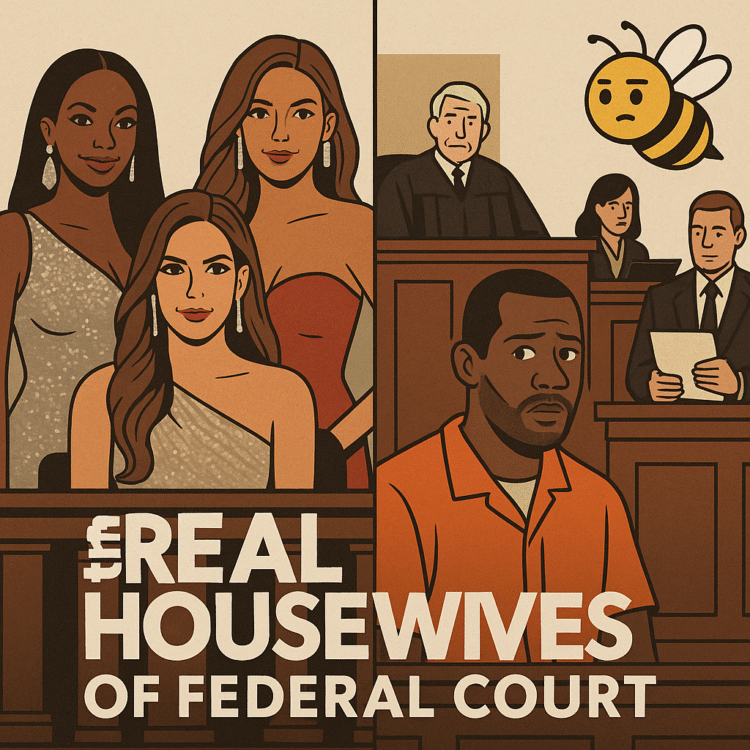
Bravo could easily lean into the meta-ness of all this. Imagine a crossover series called The Real Housewives of Federal Court.
Each episode:
- A cast member meets her lawyer (“He’s the best in white-collar defense, and he does house calls!”).
- A montage of courtroom glam prep.
- The slow-motion walk into the courthouse with hair catching the light of camera flashes.
- Andy Cohen narrating the indictment like a reunion monologue: “So, let’s talk about your alleged conspiracy…”
The finale? An emotional sentencing scene where the soundtrack swells with a remix of “Money Can’t Buy You Class.”
Bravo’s Ethical Gymnastics
Every time one of these scandals breaks, Bravo pretends to be shocked. But they’ve long traded in moral ambiguity. They don’t cast stability. They cast spectacle.
They want ambition that teeters on delusion. They want money that smells slightly fraudulent. They want women who will self-destruct beautifully on camera.
The irony is that the Osefo scandal, if true, isn’t even an outlier. It’s just the most recent chapter in a decade-long thesis: that reality TV has become a mirror for America’s collapse into image over integrity.
Why We Keep Watching
We tell ourselves we watch these shows for “escapism.” But that’s a lie. We watch because they’re us—exaggerated, accessorized, but fundamentally familiar.
The same way we post the good angles and crop out the debt, they stage the house, curate the outfit, and rehearse the lines.
The Osefos allegedly just took that illusion one step further: turning “fake it till you make it” into “stage it till you’re indicted.”
Closing Section: The House Always Wins
At the end of the day, this isn’t about handbags or home insurance—it’s about the American addiction to spectacle.
Fraud has become a lifestyle brand. Success isn’t about stability; it’s about visibility.
If the allegations against the Osefos are true, they didn’t just break the law—they broke character. They confused reality TV with reality, and in the process, reminded us that the line between the two has never been thinner.
Because in America, it’s not whether you’re guilty—it’s whether you can spin it into content before the next season.
And somewhere in a Bravo editing bay, a producer is already queuing up the transition shot: a slow zoom on a designer handbag, cut to black, title card reading “To Be Continued…”