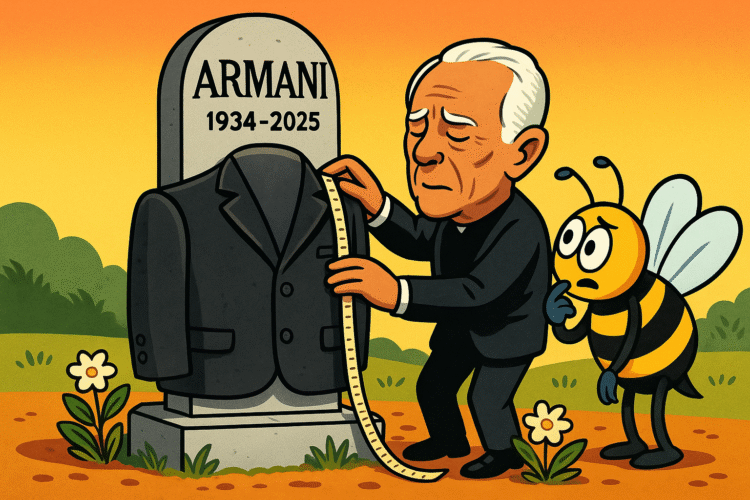
Giorgio Armani died on September 4, 2025, in Milan at the age of 91, closing a half-century reign that reshaped fashion by making power look soft. For most of his career, Armani lived as a contradiction: a designer who whispered while others shouted, a businessman who rejected takeover after takeover while building an empire so sprawling it included airport lounges. He taught the world that the most expensive thing in the room didn’t have to be the loudest.
And now, in the week of his death, the loudest thing about Armani is the chorus of obituaries marveling at how someone so dedicated to subtlety became a household name. “Re Giorgio,” the self-made king of quiet luxury, built his house in 1975 with Sergio Galeotti, turned Richard Gere’s American Gigolo wardrobe into global aspiration, and gave Miami Vice its pastel-shouldered swagger. He is remembered not just as a designer, but as an architect of desire—minimalist tailoring as cultural power move.
But like all things minimalist, the details reveal the contradictions.
The Soft Power of a Soft Jacket
Armani’s revolution was deceptively simple: strip the padding, soften the structure, let the jacket move with the body instead of against it. In the 1980s, that meant trading the banker’s armored silhouette for something that suggested you had power without needing to prove it.
The irony was immediate. A style that screamed “effortless” required obsessive tailoring, meticulous engineering, and the most expensive fabrics. Quiet luxury is never quiet for the people making it.
And yet it worked. Armani’s jacket became a uniform for men who wanted to appear approachable while staying untouchable, casual while being commanding. It was the corporate camouflage of a generation—soft shoulders masking hard ambition.
The Empire Beyond Suits
By the time Armani hit his stride, the brand had escaped the closet. Hotels, cafés, florists, chocolates, even those aforementioned airport lounges—Armani turned “lifestyle brand” into a business plan before marketing departments had even coined the term. The message was clear: why stop at dressing like Armani when you could live inside an Armani hotel, check into an Armani suite, spritz an Armani scent, and snack on Armani pralines before boarding your flight at the Armani terminal?
Minimalism metastasized into maximalism. Quiet luxury had franchising rights.
Independence at All Costs
Unlike many of his peers, Armani never sold out—literally. Fashion houses one by one were absorbed into luxury conglomerates like LVMH or Kering. Armani refused. He didn’t just reject offers; he designed a fortress. In 2016 he created the Giorgio Armani Foundation, meticulously engineered to safeguard the brand’s independence and values.
It was a bold move in an industry where “independence” usually means “for sale by next spring.” Armani meant it. Independence wasn’t just governance. It was legacy management. His empire would not be auctioned off to the highest bidder in a boardroom.
And yet, the satire remains: independence in fashion rarely means freedom. It means you are trapped by your own identity. Armani the man and Armani the brand became indistinguishable. For fifty years he lived inside his own myth, tailoring the world’s desire until it tailored him.
The Final Interview
Days before his death, Armani gave a final interview to the Financial Times. In it, he admitted his “only regret” was working too much and seeing loved ones too little. It was a rare human crack in a man defined by discipline.
The irony is heartbreaking. Armani spent his life teaching us that less is more, yet his own life was crowded by work. He built a brand on the idea of restraint, but couldn’t restrain himself from labor. His regret was not missing trends, not missing markets, but missing people. The man who dressed the world spent too little time undressed among friends.
Fashion as Whispered Wealth
Armani didn’t just clothe people. He created a lexicon of status. Quiet luxury—the idea that true wealth doesn’t shout but whispers—became cultural scripture. An Armani suit was never about flash. It was about the subtlety of expense. It told those who knew that you knew.
The satire, of course, is that whispering requires an audience fluent in the code. Quiet luxury is only powerful if others can recognize its silence. Otherwise, you’re just a rich man in a boring suit. Armani made sure the world spoke the dialect.
The Cultural Footprints
American Gigolo put Armani on the map, dressing Richard Gere in clothes that suggested seduction was a skill, not a transaction. Miami Vice plastered Armani pastel over television screens, teaching Americans that crime and couture could share a shoulder pad.
From there, Armani became red-carpet gospel. Actors, politicians, musicians—all discovered that Armani was not just about what you wore, but what you projected. Wearing Armani said: I am powerful enough not to perform power.
But as the years rolled on, Armani became less a revolutionary and more an institution. The quietest voice in the room eventually became the background hum, the hotel lobby Muzak of luxury.
Succession, Tailored
Unlike so many of his peers, Armani planned for the end. The 2016 Armani Foundation was not just a legal structure; it was a succession plan. His empire, worth billions, will be guarded against dismemberment. He engineered continuity the way he engineered jackets—soft on the surface, rigid underneath.
The brand will go on. Armani boutiques will stay open. Armani hotels will still check in guests. Armani suits will still whisper power. The man is gone, but the myth has been institutionalized.
This is the ultimate irony of fashion. A designer whose work was about impermanence—seasonal collections, shifting trends—dedicated his final years to permanence. Giorgio Armani will die again every season, every runway show, but his foundation ensures he will never truly disappear.
The Satirical Core
Armani’s death at 91 is not just the end of a life. It is a case study in how culture turns contradictions into empires.
- He preached simplicity, but built maximalist businesses.
- He sold independence, but lived in a gilded cage of his own brand.
- He promised quiet luxury, but depended on recognition to make it loud.
- He worked tirelessly to perfect minimalism, only to confess that work itself was his regret.
The satire isn’t that Armani lied. It’s that Armani revealed the paradox of aspiration. We want effortlessness, but only after exhausting effort. We want luxury, but only if others know we have it. We want independence, but only if it comes with an empire.
The Haunting Observation
On September 4, Giorgio Armani left Milan, the world, and the runway behind. His final regret was not seeing loved ones enough. That is the haunting echo in a life of whispers: a man who taught us how to dress for every occasion missed too many occasions himself.
The empire will continue. The foundation will safeguard governance. The boutiques will sell soft-shouldered jackets to new generations who want to look powerful without seeming it. Armani’s name will linger in airports and hotel lobbies, in perfumes and pralines.
But beneath the empire lies the quiet truth: Giorgio Armani spent fifty years tailoring power, desire, and wealth for others, only to discover that what couldn’t be tailored was time.
And no fabric, no foundation, no empire—not even Armani—can make up for that loss.