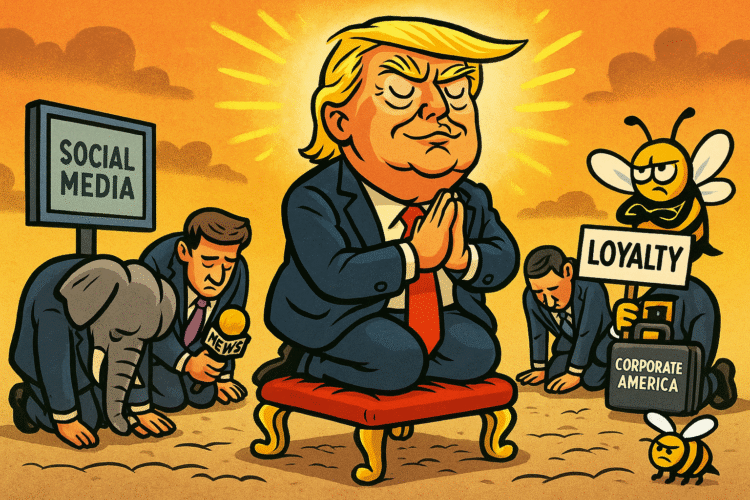
There’s a peculiar, humiliating ritual underway in Washington—and it’s not about crowns or scepters so much as knee-bends. The entire ecosystem of Republicans, big media empires, and corporations is tilting toward Donald Trump with a devotion that erases the very principles they once claimed as foundational. They weren’t just political allies—they were self-proclaimed guardians of federalism, checks and balances, free markets, free trade, limited government and journalistic autonomy. Now those tenets are being stowed in the closet so they can bow in the aisle of one overlord.
Think of it as ideological mis-appropriation: the party of constitutional restraint now praises executive emergency powers; champions of free markets cheer tariff taxes and industrial policy by tweet; free-speech evangelists welcome corporate blacklists they helped design. The ledger of transformation reads like this: Once: separation of powers; Now: executive fiat. Once: fiscal prudence; Now: ballooning deficits and mega-spending. Once: skepticism of adventurism; Now: performative “law and order” and cultural maximalism.
What we’re witnessing isn’t simply an alignment shift—it’s a genuflection economy, where the currency is loyalty and the product is silence.
Before and After: The Ideological Flipbook
Before: A constitutional-conservative GOP preached federalism, opposed centralized state power, insisted on oversight, sub-poena power, light-touch regulation.
After: They applaud administrative national emergencies, centralized enforcement, and executive unilateralism.
Before: Free trade, open markets, limited government.
After: Tariff taxes, industrial policy by decree, bailouts for firms aligned with the inner circle.
Before: Fiscal discipline; shrinking the deficit.
After: Deficits soar with tax cuts, military build-ups, and infrastructure bills tailored for political messaging.
Before: Human rights abroad, suspicion of authoritarian impulse.
After: Friendlier lines to strongmen, dismissal of treaty obligations, and “rough justice” as governance.
Before: Media as fourth estate; tech platforms as public square.
After: Media seeks access, platforms crave regulatory carve-outs and lobby quietly against free speech they once feigned to defend.
The transformation isn’t subtle—it’s a mural of collapse painted on collapse.
Tech Giants: “Free Speech” Hoodies Slip Off for Cash
Let’s parse the metamorphosis of tech: These companies once paraded “free expression,” “open platform,” “net neutrality” like winning slogans. Today? They whisper about “platform responsibility,” blacklists they drafted themselves, shadow-bans born from brand-risk fear-loops, lobbying deals to crawl behind towers of algorithmic access.
Imagine the boast: “We’re neutral platforms.” Then imagine the handshake in back rooms, the carve-out deals, regulatory safaris. The same companies that claimed “innovation happens without permission” now plead for “safe harbors,” “export controls,” and “favorable carve-outs.”
If platforms once claimed to be autonomous marketplaces of ideas, they now look more like rent-seeking landlords of speech—collecting tolls, shaping access, and bending to political winds disguised as “brand safety.”
Media: Access Junkies & Narrative Launderers
The legacy media industry has its own genuflection ledger. They once declared themselves adversaries to power, steady beats of accountability. Now many trade those vows for exclusive trips, access seats, high-ROI plane seats and “friendly coverage” spreadsheets.
What changed: Corporate budgets care less about public service journalism than EBITDA growth, click-flow and access to the executive carousel. Warning bells about authoritarian encroachment become “both-sides” segments, panels of pundits, euphemism leagues, and “critics say” hedges that soothe the audience into calm compliance.
Media houses now often serve as PR machines for power—not by design as much as incentives. Rewards: access, scoops, interviews. Risks: losing invites, losing exclusive footage. The result: critical coverage becomes a premium feature, not a baseline expectation.
The Money Trail & Incentives: Why Genuflection Pays
Here lies the economics behind the bowing. Corporations chase tariff shelters, deregulation breakthroughs, sweetheart contracts. Parties chase donors, bundlers, safe districts, sinecures. Newsrooms chase clicks, film seeds, ad deals. Tech firms chase regulatory exemptions, merger approvals, algorithmic privileges.
When loyalty becomes currency, principles become liabilities. If you stand firm on oversight, you may lose a contract. If you insist on free trade, you may face a tariff explosion. If you defend journalistic autonomy, you may be shut out of the conversation. The realpolitik: it’s cheaper to bend than to break.
The cost: rights chilled, oversight neutered, elections treated as vibes, not checks on power. The reward: tax breaks, access seats, settlement deals, branding opportunities. That’s the subsidy of obeisance.
Real-World Costs of Worship Economy
What are the actual casualties of this genuflecting ecosystem?
- When oversight fails, executive misuse grows—courts become sparsely armed, inspectors-general become sidelined, subpoenas become theater rather than tool.
- When speech platforms give in, dissent dwindles—not because voices vanish but because access hurts. Media freedom is stymied not by censorship but by collapse of independence.
- When elections are treated as infotainment, not defense of democracy, majoritarian norms erode. Warnings get broadcast as part of the show, not as risk to the republic.
- When trade policy becomes weaponized for loyalty, you reduce economics to patronage. The result: industries collapse, reciprocities fail, the vulnerable pay.
- When “strongman diplomacy” is normalized, you import authoritarian logic into democratic governance. The mutual antagonism of checks and balances gets replaced by top-down loyalty loops.
It’s not a theory. It’s your local law firm paying millions to avoid scrutiny. Your media outlet shelving criticism to keep access. Your tech platform scrubbing posts to meet brand guidelines. Your trade deal canceled at the airport for political flash. That’s the ledger being written.
Toward a Remedy: How to Get Some Spine Back
If we actually want a spine again, not a bowing economy, here are the prescriptions:
Re-weaponize oversight: Reinforce inspectors-general, protect congressional subpoenas so they bite, strengthen whistleblower channels. Make power fear investigation, not just media coverage.
Antitrust and transparency: Break attention monopolies, loosen tech’s grip on speech infrastructure. Make media platforms less gatekeepers and more conduits. Regulate mergers not as economics but democracy.
Journalism standards over “balance” cannibalism: Media must privilege truth, not “both-sides” equilibrium. If the loyalty oaths of the powerful aren’t challenged, they’re amplified. Standards must combat access-fetish narratives.
Tech rights over brand management: Protect speech and privacy instead of letting platforms dictate who gets amplified. Regulate shadow bans, algorithmic silence, secret policymaking. Platforms are the new forum—make them fair.
Civic muscle memory: Teach the Constitution not as a crown but as a leash on power. Reverence isn’t optional—it’s resistance. Citizens must understand that the republic isn’t about loyalty to a person, but institutional restraint on any person.
Final Reflection: From Genuflection to Governance
The great genuflection we’re observing isn’t just adulation—it’s abandonment of principle. The right that once opposed strongman rule now cheers executive fiat. The media that once monitored power now placates it. The tech platforms that once promised open forums now book-exit dissent.
When you bow before the very power you vowed to restrain, you become its echo, not its check. And when echo becomes louder than critique, governance yields to performance.
So yes, we might still have elections, courts, platforms—but if all of them genuflect before singular power, the act of genuflection becomes governance by proxy. The price paid isn’t just principle—it’s the republic.
And after all the bowing is done? We’ll remember not the speeches that justified it—but the silence that enabled it.