Let’s all take a deep breath and thank Generation Z.
No, not for their TikTok dances or the fact that they somehow revived low-rise jeans, but for refusing to play the rigged Monopoly game we keep handing them and asking, “Why don’t you just buy Boardwalk?”
They’re not buying Boardwalk. They’re moving back into Marvin Gardens with their mom.
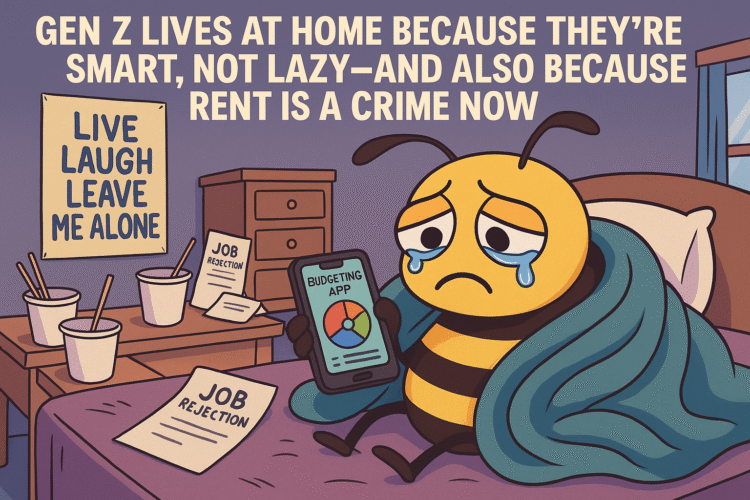
Because Generation Z—the generation born between approximately 1997 and 2012—isn’t lazy. They’re just the first cohort of Americans expected to do more with less while being mocked for trying. The average Gen Z adult is carrying $37,172 in student loan debt, paying nearly $2,000 a month in rent (median U.S. rental price: $1,964), and drowning in avocado toast discourse that implies everything would be fine if they just stopped spending money on joy.
And so they’re doing the unthinkable: they’re using their common sense.
Why pay $1,964 to live in a shoebox with roommates who steal your oat milk and trauma dump over passive-aggressive Venmo requests, when you could live at home, sleep on the mattress you had in middle school, and be guilt-tripped for free?
“Back in My Day…”
Boomers love to say Gen Z has it easy. That they’re entitled. That back in their day, you could buy a house, attend college, and feed a family of four on one income and a six-pack of Schlitz.
And they’re right. You could. Because back in their day, the average cost of college was $1,000 a year. A house cost $24,000. You could be a mediocre white man with a high school diploma and a dream, and some corporate ladder would materialize out of the fog like a golden escalator.
Now? Gen Z is taking out a loan the size of a Tesla just to major in Psychology and learn that all their attachment issues stem from growing up in a world actively collapsing.
Congratulations, You’re Broke and Educated
The student loan crisis isn’t a bubble. It’s a lead balloon tied to the ankle of every 23-year-old who dared to believe the myth of upward mobility. For the price of a diploma, they get crippling debt, a job market that wants five years of experience for an entry-level position, and a coworking space that charges $5 for a “productivity smoothie” made entirely of almond milk and gaslighting.
So yeah. They’re moving back in with their parents.
Not because they failed.
Because we did.
Rent: The Musical No One Can Afford
Let’s talk about housing. The American Dream used to be home ownership. Now it’s a sublet with natural light. Renting used to be a stepping stone. Now it’s a lifestyle sentence, with landlords charging $2,200 a month for a unit that smells like despair and has a mysterious stain shaped like Florida on the ceiling.
Buying a home is no longer a milestone—it’s a magic trick. Gen Z could save every penny for ten years and still be priced out of the market by some divorcee named Kevin who just flipped his fourth “investment property” and wants to turn your dream home into an Airbnb for bachelor parties and crystal retreats.
So Where’s This Inheritance You Keep Promising?
Ah yes—the great consolation prize. The Boomers will die someday, and Gen Z will inherit their wealth.
Except.
Except.
Half of that wealth is tied up in volatile markets, second homes, and collectibles that only increase in value on Pawn Stars. And the other half will likely be used to cover long-term care, medical bills, or the cost of living to 97 because modern medicine can keep the human body alive long after the will to live has expired.
So yes, Gen Z may eventually inherit some money. Right around the time their knees give out from working 60-hour weeks in a gig economy that refuses to offer benefits, stability, or PTO that isn’t just unpaid time off for mental breakdowns.
They’re Not Living With Their Parents. They’re Co-Investing in Survival.
Living with your parents is no longer a mark of failure. It’s a resistance strategy. It’s choosing to consolidate resources, preserve mental health, and cook dinner without Googling “how to sauté in poverty.”
Gen Z isn’t freeloading. They’re surviving a hostile economic climate with the grace of someone who had to watch a climate change PowerPoint in 6th grade and still got detention for crying about it.
They’re turning childhood bedrooms into command centers. They’re learning to stretch Trader Joe’s frozen dumplings into five meals and making Excel spreadsheets to track student loan interest like it’s a fantasy football league.
They’ve watched us burn the planet, tank the economy, and meme our way through every tragedy. And still—they are somehow kind. Queer. Empathetic. Organizing. Laughing. Dragging corporations on Twitter. Voting.
They are us at our most disillusioned. And our most stubbornly hopeful.
Final Thought:
If Gen Z is living at home, maybe we should ask what kind of world we built that made that the most rational option.
Because in a country where college costs a car, rent costs a kidney, and the job market is a Hunger Games arena with 1099s, living with your parents isn’t a failure.
It’s financial literacy with a side of emotional whiplash.
And frankly, if Boomers had the option to move back in with someone who made them chicken tenders and folded their laundry, they’d do it too.