The Grief Industry Goes Prime Time
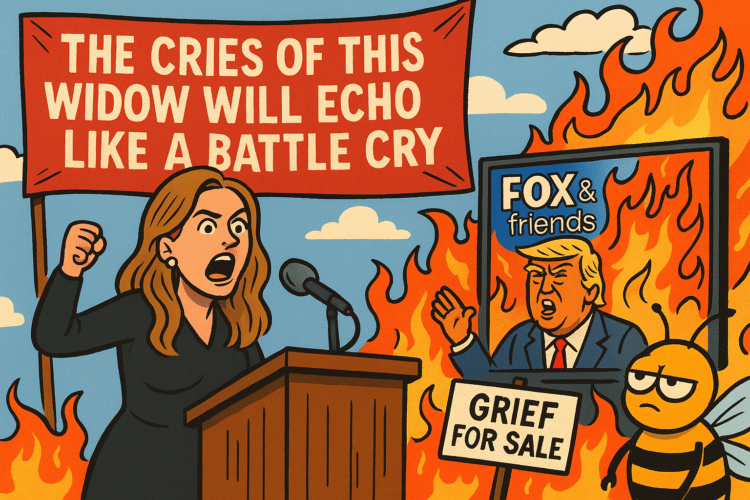
Charlie Kirk is dead, assassinated on September 10 in Utah. His young widow, Erika Frantzve Kirk, took to the microphone the next day, vowing that “the cries of this widow will echo around the world like a battle cry.”
It should have been a moment of mourning. It should have been quiet, fragile, human. Instead, it became an audition reel for turning grief into marketing collateral. Erika promised not reflection, not healing, but expansion. Turning Point USA, Charlie’s empire of grievance, will apparently not wither under loss but metastasize under tragedy.
On the same morning, Donald Trump appeared on Fox & Friends, blaming “the radical left.” Never mind that investigators had not established any motive, or that Tyler Robinson—the 22-year-old suspect later arrested after a 33-hour manhunt—was caught with a bolt-action rifle but without a discernible ideology. Never mind that fact-checkers were already swatting down viral conspiracies faster than mosquitoes at a Florida cookout.
What mattered wasn’t truth. What mattered was the narrative: grief as weapon, mourning as mobilization, tragedy as branding opportunity.
The Widow’s Cry as a Business Model
There is something obscene about how fast grief becomes theater in this country. Erika Kirk didn’t just promise to grieve. She promised to echo “like a battle cry.” There is no pause, no space between death and deployment. The coffin isn’t even lowered before the language of war takes over.
This isn’t unique to Erika. It’s systemic. We’ve built a culture where grief is immediately monetized, where the rawness of loss is polished into soundbites, where tragedy is a down payment on future influence. And if the widow refuses to weaponize her own grief, someone else will gladly do it for her.
Trump’s Fingerprints on the Ashes
Trump, naturally, wasted no time. His Fox & Friends appearance was less eulogy, more campaign ad. The left, he declared, was to blame. No evidence. No patience. No hesitation.
This is the same Trump who, on January 20, 2025, issued mass clemency for roughly 1,500 January 6 offenders. People convicted of storming the Capitol, attacking police, plotting to overthrow an election—he called them patriots. He rewarded violence with absolution, told the nation insurrection was justifiable, and then acted shocked when the cycle of menace spun again.
So when Trump says “radical left,” what he means is “a story I can sell.”
The Suspect They Didn’t Want
The arrest of Tyler Robinson complicated the narrative. A young man, a bolt-action rifle, shell casings, inflammatory etchings—but no clear political motive. The right had wanted a perfect villain: a radical leftist, a trans activist, someone who could be pinned to every Fox chyron for the next decade. Instead, investigators found… uncertainty.
That uncertainty is inconvenient. It can’t be weaponized as cleanly. So the strategy is simple: ignore it. Fill the vacuum with conspiracies, spread viral lies, blame Soros, blame Biden, blame anyone. If the facts don’t fit the story, amputate the facts.
Fact-Checking as Futility
By September 12, fact-checkers were already exhausted. Viral posts claimed Robinson was Antifa. Others said he was a Soros-funded agent. Others claimed he was a government plant, a false flag, an MK-Ultra zombie.
Every claim was debunked. None of it mattered. Because in the grief industry, facts are just speed bumps on the highway to outrage.
The tragedy wasn’t an opportunity for unity; it was an opportunity for distribution. Who cares what’s true when you can weaponize what’s useful?
The Widow as Mascot
It’s hard not to feel sympathy for Erika. She is, after all, grieving. She lost her husband, the father of her children. But the transformation of her grief into spectacle is unmistakable. The vow to let her cries echo “like a battle cry” wasn’t just mourning—it was branding.
This is the playbook: the widow becomes the mascot, the grief becomes the justification, the expansion becomes the proof that death is never just personal. It’s political.
We’ve seen this before. Gold Star families turned into props. School shooting survivors demonized or canonized depending on which party benefits. Grief never stands alone. It’s always a prelude to mobilization.
Escalation as Ritual
What this moment proves is that America has no brakes. Each tragedy becomes not a moment to slow down but to speed up. To escalate. To scream louder. To point fingers faster.
Trump’s January 6 pardons were gasoline. His rhetoric afterward was the match. Erika’s vow, though born of pain, became another accelerant. The entire political machine feeds on tragedy, converts it into energy, and then insists the fire is someone else’s fault.
This isn’t politics as usual. It’s arson disguised as leadership.
The Performance of Unity (Canceled Again)
Calls for unity? Forget it. Unity doesn’t sell merch. Unity doesn’t boost engagement. Unity doesn’t win primaries. Division does. Outrage does. Weaponized grief does.
So while investigators quietly said the motive remained unclear, Trump loudly declared it didn’t matter. The script was already written: blame the left, mobilize the base, feed the cycle.
This is why every tragedy now feels like déjà vu. We’ve seen the same performance before: accusations without evidence, unity denied, escalation guaranteed.
Mourning in America
The most tragic part isn’t that leaders weaponize grief. It’s that the public is conditioned to accept it. We expect the widow’s cry to become a slogan. We expect Trump to blame Soros. We expect falsehoods to flood our feeds.
We’ve normalized the abnormal. Death is no longer an interruption. It’s just another content cycle.
The Long Arc of Menace
The Kirk assassination didn’t happen in a vacuum. It followed years of normalized menace. January 6. Trump’s pardons. The Whitmer kidnapping plot. Each moment eroded the line between politics and violence. Each moment made the next tragedy more thinkable.
And yet, when the violence happens, leaders act shocked. They call for investigations, they shake their heads, they send thoughts and prayers. And then, without fail, they weaponize it.
The arc isn’t bending toward justice. It’s bending toward escalation.
The Widow’s Cry in Context
Erika’s vow will echo, but not as she intended. Not as the pure sound of grief. It will echo as part of the cycle. Her cry will be used as proof of righteousness, as justification for punishment-first politics, as a battle cry not against violence itself but against whatever political enemy is most useful.
And when the next tragedy comes—and it will—it will be folded into the same ritual. Grief weaponized. Unity canceled. Fire fed.
Summary: Grief as Gasoline
The assassination of Charlie Kirk was a tragedy that should have prompted reflection, restraint, and unity. Instead, it became another chapter in America’s grief industry. His widow, Erika Frantzve Kirk, vowed to make her cries a “battle cry,” promising to expand Turning Point USA. Donald Trump, appearing on Fox & Friends, blamed “the radical left” before investigators had established any motive, ignoring that the suspect, Tyler Robinson, was arrested with no confirmed political affiliations. Fact-checkers debunked waves of viral lies, but the damage was done. The darkness here isn’t a family’s grief—it’s the instinct to weaponize it, to pour gasoline on a fire and then claim mourning while holding the match. When leaders choose punishment-first narratives over unity, tragedy stops being a brake on politics and becomes its fuel.