📘 Get the book here
📚 Explore more books on my Amazon Author Page
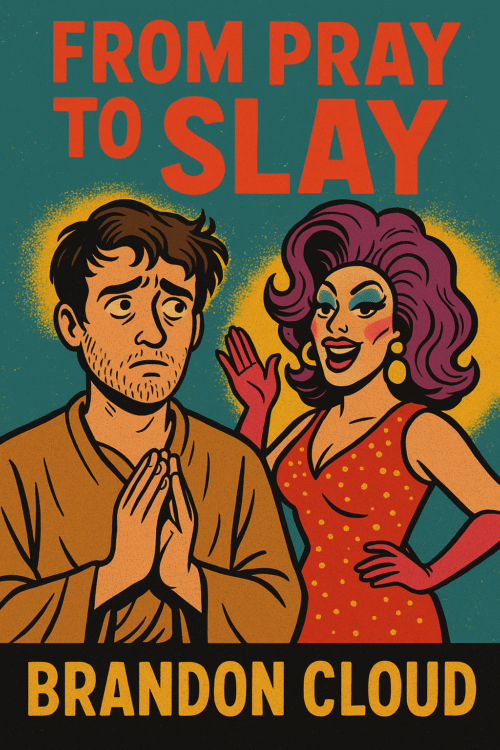
I didn’t write From Pray to Slay because I thought the world needed another “queer trauma” novel.
I wrote it because I needed something messier than healing and more honest than hope. I needed something that didn’t tie things up with a rainbow ribbon and call it growth. I needed to burn some shit down and laugh while I was doing it.
This book is not about rising above. It’s about crawling through, cussing the whole way, and maybe—maybe—stumbling into a version of yourself that feels a little more like home.

“Leaving the cult was easy. It’s what came after—the gaslight-colored Target aisles, the six-dollar iced coffees, the endless parade of hashtag inspiration—that made me wonder if salvation was just a rebrand.”
That line came from my own journal. Not a writing session. A breakdown. A real moment in the parking lot of a chain store, holding a Pride water bottle I didn’t ask for, wearing a smile I didn’t believe in. That’s where Malachi Frost was born—somewhere between religious disillusionment and capitalist fatigue.
Malachi is what happens when you take a boy out of a cult but leave the trauma simmering under his skin. He’s smart, impulsive, jaded, and still so full of aching, bright, unkillable light. He finds refuge in drag not because he wants to perform, but because it’s the first time his body has ever felt like his. It’s the first time he chooses who he gets to become.
“Faith, grief, glitter—it’s all the same thing if you press it hard enough into your skin.”
From Pray to Slay isn’t a conversion story. It’s a deconversion aftermath. It’s what happens when the hymns stop working and you don’t yet have words for the silence. It’s for the people who left a church, only to realize they walked straight into a different kind of sermon—this one selling productivity instead of salvation.
Malachi tries to survive on self-help quotes and low-paying retail shifts. He turns himself into a spectacle because being adored for something is better than being hated for everything. He becomes a local drag phenom, a queer glitter-saint with wounds he hasn’t even begun to clean.
“I used to think I was broken because I couldn’t pray anymore. Then I realized: maybe silence is its own kind of sacred.”
This book is for the loudmouth ex-youth group kids. The ones who got in trouble for asking the wrong questions. It’s for the queer survivors who aren’t ready to forgive yet. It’s for anyone who left somewhere toxic and woke up realizing their nervous system still hadn’t caught up.
It’s for the girls who wore purity rings and now wear nipple clamps. For the boys who never saw themselves at the pulpit but owned every damn inch of the stage. For the nonbinary babes who knew their soul before anyone let them name it.
“There is holiness in choosing yourself. There is sacredness in glitter. And there is something divine about surviving long enough to laugh at what once held you captive.”
I wrote From Pray to Slay because I wanted a book that didn’t sanitize queer resilience. I wanted readers to feel like they were dropped into the chaos of survival with no exit sign, no script—just guts, humor, heartbreak, and a hint of eyeliner.
Malachi is selfish, brilliant, scared, brave, and endlessly trying. Just like me. Just like most of us.
This isn’t a book where the queer kid gets killed. Or saved. He gets messy. And then messier. And then, somehow, a little bit whole.
So if you’ve ever:
- Smiled through a sermon that made your stomach churn
- Felt more at home under stage lights than stained glass
- Rebuilt your soul with glitter, grief, and found family
- Realized that healing isn’t linear, but it is fierce
Then this book is for you.
📘 Grab From Pray to Slay here
📚 See more of my books here
And if you love it—or even just needed it—leave a review. Tell a friend. Pass it to that one cousin who thinks healing means “acting normal.” We’re not doing normal anymore. We’re doing real.
This is for the queers who found their voice after faith tried to mute them.
This is for the ones still bleeding glitter.
This is for you.