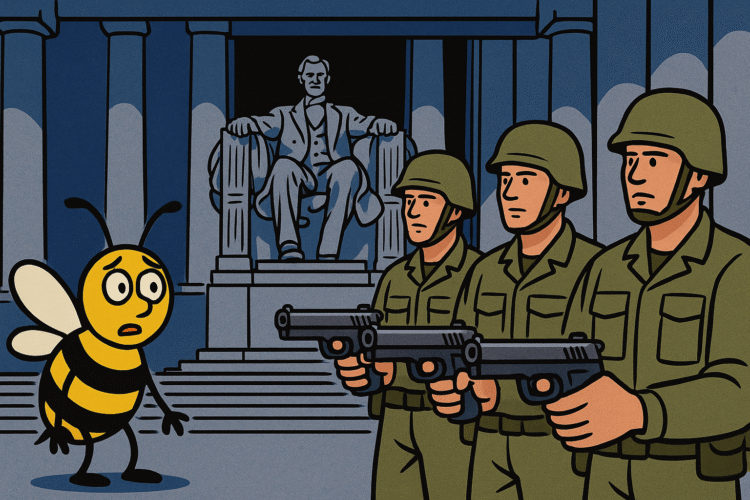
It started with photo ops: troops in clean fatigues, standing at the Lincoln Memorial like living postcards. But now, as of August 22, the experiment in “presence patrols” has escalated. Defense Secretary Pete Hegseth signed off on arming the National Guard with M17 pistols, placing nearly 2,300 troops into the capital’s streets with the legal finesse of a tax loophole and the optics of a state parade.
Welcome to Washington, D.C., 2025—where violent crime is at a thirty-year low, but the National Guard is apparently the new Uber of policing.
The Armed Souvenir Stand
The Pentagon insists the pistols are “for personal protection.” This is the same rationale one uses to justify carrying pepper spray in the suburbs: you don’t expect to use it, but you want the comfort of the bulge in your purse. Except these bulges are federally funded, semi-automatic, and worn on the hips of Guardsmen flown in from Tennessee, Louisiana, Mississippi, South Carolina, and Ohio.
The government has effectively merged public safety with costume drama. Guardsmen once posed as background actors in the administration’s law-and-order photo shoots. Now, they’re armed extras in the longest-running series of American governance: Democracy on the Verge of Martial Law.
The Loophole That Roared
The legal mechanism is Title 32. In plain terms: troops remain under governors’ control but are federally funded. Which means Trump gets his security spectacle while technically sidestepping Posse Comitatus—the federal law barring the military from domestic policing. This is legal alchemy, turning soldiers into cops with a bureaucratic wave.
Experts warn it’s a loophole. But America is a nation of loopholes. Tax shelters, campaign finance rules, the electoral college—it’s loopholes all the way down. Why should domestic militarization be any different?
The City That Didn’t Ask
Mayor Muriel Bowser called it what it looks like: an “armed militia” in the capital. She has data on her side. Metropolitan Police Department statistics show violent crime is down 26% from last year. This is the safest D.C. has been in three decades. Statistically, this is not an emergency. Symbolically, it’s the performance of one.
The mayor says no thank you. The White House says here are 2,282 troops and six months of housing per diems. Guess who wins.
Crime Theater at Thirty-Year Lows
If this were about crime, the deployment would be shrinking. If this were about safety, the Guard would be winding down. But this isn’t about safety. It’s about choreography.
Crime is down, but panic is profitable. The administration needs the story of a capital teetering on collapse, redeemed by the iron will of troops on patrol. Every pistol holstered on the Mall tells that story. Every “suspicious” pedestrian frisked near a Smithsonian exhibit affirms the plotline.
You can’t sell “I alone can fix it” if nothing looks broken.
Tourists, Please Remove Your Shoes and Enjoy the Bayonet
The ironies stack high enough to block the Washington Monument. Tourists arrive to see museums and cherry blossoms. They’re greeted by M17s and joint task force checkpoints. Washington always sells patriotism as spectacle—flags, parades, monuments to glory. Now it sells militarized irony: a democratic capital patrolled by soldiers as if it were Fallujah.
The official line? “Fix up the city’s appearance.” Which is how you describe landscaping, not law enforcement. The goal isn’t security; it’s staging. Make D.C. look orderly for the cameras. Swap the trash bags and graffiti with camo uniforms and sidearms. Nothing says “renaissance” like the scent of gun oil in the August humidity.
The Guardsman as Barista
This new mission was pitched as “presence.” Guardsmen once stood near monuments, unarmed, offering the visual comfort of muscle without menace. They were mall cops with pensions. Now they’ve been upgraded—Starbucks baristas one week, pistoleers the next.
Training is promised. But no amount of training erases the absurdity of a Louisiana Guardsman with an M17 patrolling Dupont Circle while crime numbers are already plummeting. It’s cosplay with consequences.
The Mayor’s Data vs. The President’s Drama
Bowser points to data: 26% down, thirty-year low. Trump points to drama: “Your city is going to hell, and we have to stop it.” One is arithmetic, the other is apocalypse. Apocalypse wins ratings. Apocalypse keeps troops deployed. Apocalypse demands pistols.
And here lies the rub: governance by apocalypse has no exit strategy. The troops are told they might be here for six months. Or longer. Because no performance ends while it’s still drawing crowds.
National Guard as Branding Exercise
This is less about security and more about branding. The Guard is no longer just a reserve force for emergencies—it’s a brand extension of the Trump presidency. Troops aren’t patrolling for crime; they’re patrolling for optics. The pistols aren’t protection; they’re props.
Every M17 is an exclamation point on a speech about toughness. Every armed patrol is a living press release. The Guard has become a 2,300-person billboard in fatigues, federally funded for the purpose of making the president look strong.
The Unspoken Contract
Washingtonians didn’t ask for this. But they didn’t get a vote. That’s the irony of D.C.—taxation without representation dressed up in camo. The unspoken contract of democracy is that power flows upward from people. The reality in 2025 is that power flows downward through loopholes, pistols, and task forces.
The Guard doesn’t answer to the city. It answers to governors who answer to a White House that answers only to itself. It’s a chain of command that loops like a Möbius strip, beginning and ending with optics.
The Bee’s Stinger
The irony isn’t subtle. Crime is down, yet soldiers march. Safety is up, yet pistols gleam. Reality improves, and the story gets darker. This is governance as a funhouse mirror: invert the truth, magnify the fear, and frame it in red, white, and blue.
What should alarm us isn’t the sidearm on a Guardsman’s hip—it’s the normalization of military presence where statistics show it isn’t needed. It’s the reframing of loopholes as leadership, performance as policy.
The Final Scene
The National Guard was once a symbol of last resort—floods, hurricanes, riots. Now it’s a first resort, padding press conferences and patrolling sidewalks while crime recedes.
The capital doesn’t need soldiers with pistols. What it needs is leaders who recognize that data is truth, not obstacle. Instead, Washington gets pistols for protection against a crime wave that doesn’t exist, and tourists get selfies with soldiers instead of cherry blossoms.
The haunting truth? In 2025, safety isn’t the goal. The goal is the spectacle of safety. And when spectacle becomes policy, every pistol holstered on the Mall is another reminder: democracy is safest when it looks like anything but.