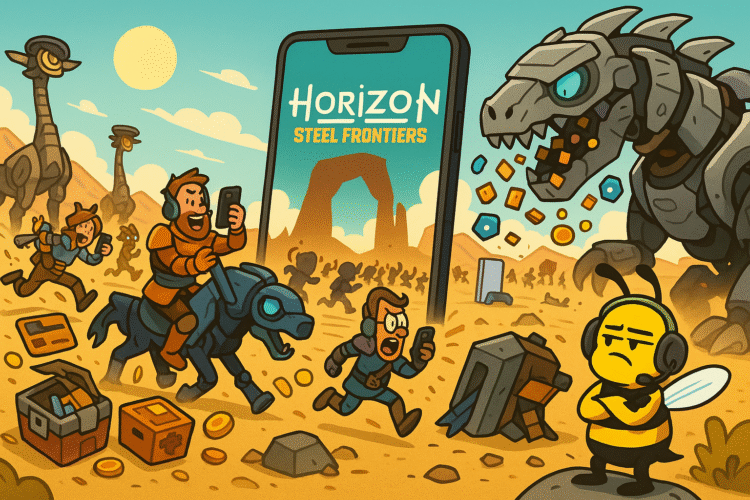
I have a confession to make: I love MMOs. Give me the dark parking lot of EverQuest, the regimented raiding towers of World of Warcraft, the sprawling social village of Final Fantasy XIV—I’ve sat through login queues, ignored dinner invites, and hasta-la-vida’d sleep for one last respawn. So when Sony Interactive Entertainment and NCSOFT revealed that their next act in the celebrated single-player franchise Horizon Zero Dawn / Horizonsomething is morphing into a full MMORPG, I felt a familiar tingle. This is the moment when prestige narrative meets the gacha gladiator pit, when Aloy’s quiet revolution gets repackaged into live-service carnage. Buckle up; the machines aren’t the only ones charging.
Here are the verified details. NCSOFT announced at its recent G Star adjacent event that “Horizon Steel Frontiers” (final name TBD) will be a full MMORPG. Built primarily for mobile, with cross-play to PC via NCSOFT’s PURPLE platform, it abandons Aloy as the sole protagonist, opens deep character customization, and drops players into a new region called the Deathlands—heavily inspired by the decimate-the-environment aesthetics of Arizona and New Mexico. Thousands of players will share that region, unscripted co-op and PvP over scarce resources, colossal machine hunts with new mechanics such as looted machine parts and mount-hauling rewards. The trailer blended cinematic spectacle with pre-alpha gameplay, but no concrete release date beyond “as soon as possible.” And curiously, no mention of PS5 or console in the core pitch. Yep. Mobile-first, phone in hand, raiding the wilds of America’s West while the living room gathers dust.
The timeline is telling. Years of leaks under the codename Project Skyline floated rumors of Sony’s internal struggle between narrative purity and profit potential. Then this week G Star opened with the reveal, The Verge ran a full write-up, players and investors alike blinked. Guerrilla Games’ mainline single-player story looked on from the sidelines as Horizon pivoted to mobile live service. The prestige badge slips, the throttle opens, and the question becomes less “Where will we roam?” and more “What are we paying?”
Which brings us to business stakes, where the excitement turns to caution. Sony’s record with live-service single-player offshoots is mixed. And NCSOFT, despite global hits, needs a breakout Western success—mobile revenue is seductive, global reach obvious, but mobile first means monetization pulling levers: gacha, loot boxes, micro-transactions, battle passes. In one hand is the aesthetic of machines stalking the desert. In the other is the casino chic of mobile commerce. Mechanics like looting parts and mounts scream “pay up quicker,” while killing machines as raid bosses scream “subscribe eternally.” Meanwhile the mainline Horizon story—Aloy, the machine gods, the narrative arc—now competes for attention with whale hunters raiding Thunderjaws on their phones. What happens to narrative prestige when your plot is overtaken by loot-drip schedules and monetization timers? What happens to the player who bought the single-player trilogy for storytelling and ends up in a cross-platform resource-grind micro-economy?
The asymmetry is stark. The winners here: upstream suppliers, live-service platforms, mobile infrastructure vendors. Sony and NCSOFT count on global reach and recurring revenue. The losers: console purists, narrative-first players, creative workers whose value gets reduced to “skins and emotes,” mid-sized dev teams squeezed between launch and live-ops, and communities who once believed the story mattered. Monetization is the new raid. Water-cooler story beats get less space than battle-pass tiers. Family budgets might shift as “free to play” becomes “free to pay if you want to win.” The public, the players themselves, will pick up higher utility bills for cloud play, data-use twists, and in-app purchase pressure. The economy of consumption gets richer; the economy of creation gets weaker.
In household math terms: you bought a console version and paid full price for story. Now you’re asked to download the mobile MMO for free but “invest” in bundles to keep the mount that helps you haul looted machine parts. You wait for the cross-play patch that syncs your PC account. You rent a server room you’ll never own. You pay attention to the live-service schedule more than the narrative. It’s the same environment Giants like Walt Disney said they would never reduce their art to. Yet here we are.
Now for near-term checkpoints: will Sony clarify platforms and monetization model? Is PS5 still a target or merely billboard support? Will a playable build appear at G Star or comparable show, and will dev-blogs explain servers, combat roles, anti-cheat measures, resource persistence? Will console-players revolt or sign up anyway? Will the studios deliver transparency on live-ops economy rather than drip-tease whales? Will games media say plainly that Horizon’s next big bet is a phone-forward MMO hunting whales and Thunderjaws at the same time? Or will the narrative remain “Horizon returns” while the subtext reads “pay to haul machines on a phone.”
Because let’s be honest: this pivot isn’t purely creative. It is strategic. The prestige IP becomes a funnel for live-service revenue. Aloy becomes brand collateral while your phone becomes the battlefield. The mobile ecosystem is meat-grinder optimized for engagement and spending. The MMORPG label is the sugar. The gacha mechanics the pill. And while thousands of players may roam the Deathlands and mount-haul loot, millions more will pour coins into the slot machine of live-ops. The shift from narrative adventure to economic loop is subtle but sharp.
It is also cultural. The MMO community has long resisted mobile-first raids because of control, latency, monetization edge. Now one of the marquee single-player franchises says “we will live here” on your phone. That’s akin to a rock-band announcing its next album will only stream behind a pay wall in micro-transactions. Some will pay. Many will watch reluctantly. The question: is the story worth it?
Consider the timeline again. Project Skyline leaks scratch the itch for expansion in 2022. In early 2024, rumors of cross-platform Horizon MMO surface in Korean dev circles. At G Star 2025 the reveal drops: MMO, mobile first, PC cross-play, Deathlands region, unscripted co-op and PvP, loot mechanics, mount-hauling, no PS5 named. The crowd applauds. Investors nod. Hardcore fans cough coffee. The risk category updates.
From a business lens: NCSOFT hopes for global hit, Sony hopes to bolster live-ops pipeline, mobile devs hope to make money off your phone. The platform costs: servers, cross play integration, anti-cheat, live-ops content cadence, global marketing. The risks: failing console prestige community, alienating single-player base, regulatory scrutiny over loot systems, mobile monetization fatigue. The narrative cost: the story gets outrun by the economic model.
It also raises creative questions. Guerrilla Games once prided itself on the story of machines and humans. Now those machines become raid bosses. The “machine gods” get repackaged into monetized events. The narrative milieu becomes a stage for resource contests rather than introspective arcs. Character arcs may vanish. Player investment shifts from “I must save the world” to “I must buy the next mount.” Co-op becomes coordination for micro-payments. Gacha becomes impetus for play.
The future is not predetermined but heavily weighted. If Sony publishes platforms + monetization up front, shows a demo filled with gameplay not just pre-alpha rhetoric, and commits to narrative depth alongside live-ops, the pivot might succeed. If they shutter console support, hide monetization behind surprise micro-transactions, and treat single-player fans like betas for mobile whales, we’ll call it what it is: franchise deep-dive into mobile gold-rush at the expense of story.
In the next few weeks we’ll see the skeletons. Sony will need to answer: is PS5 supported at launch? Will you need to pay monthly or just via micro-transactions? NCSoft will need to publish dev-blogs on combat roles, server governance, anti-cheat for cross-play. The team must address data-centres, connection lag, mount-hauling persistence. The players must decide: pay to roam the Deathlands now or wait for the console story that may never come. And the media must finally write plainly: this is not just “Horizon expands.” This is Horizon becoming a live-service mobile MMO built to monetize your phone time and resource grind, with story as backdrop, not centerpiece.
So yes, I am excited. I love MMOs. But I also know what happens when an IP jumps platforms and monetization models change. Sometimes the spirit stays. Often it doesn’t. Sometimes the loot-drip economy becomes the master instead of the story. And sometimes the hero ends up mount-hauling instead of world-saving. Horizon Steel Frontiers might soar. Or it might sink under the weight of its own promise.
The machines will still be cool. The desert skies will still clatter with Thunderjaws. But the real question: will you still feel like you’re part of a story—or just part of a spending loop? Because if you aren’t sure, the next patch will tell you. The next live-ops expansion will tell you. And the next billing notification will tell you.
Let’s hope the story matters. Because if it doesn’t, then what we’re playing is not a vision of the future—it’s a marketing plan for your wallet. And I’ve played enough MMOs to know when you’re just grinding credits instead of experiencing something. Here’s to hoping this one hits differently. Let’s mount-haul some machines and choose wisely.