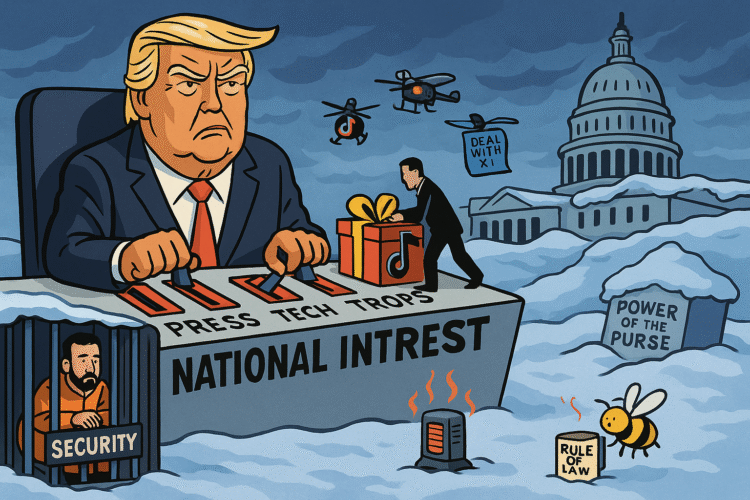
There are weeks in American politics that feel like historical footnotes, and there are weeks that feel like the Constitution was left in a microwave. This one was the latter. By midweek, the Trump administration managed to detain a journalist, nationalize TikTok through a handshake with Xi, pay the military during a government shutdown, and inspire a thousand think pieces about whether “discipline” is the new euphemism for “authoritarian chic.”
It began, as so many democratic comas do, with a visa cancellation. British journalist Sami Hamdi, a political commentator known for his critiques of U.S. and Israeli policy, was detained by Immigration and Customs Enforcement after finishing a U.S. speaking tour. DHS confirmed that his visa had been revoked “for national security reasons,” a phrase so elastic it could stretch from espionage to eye contact. Hamdi was placed in ICE custody pending removal. The Council on American-Islamic Relations (CAIR) called it what it was: “a blatant affront to free speech.” DHS, meanwhile, insisted the move was “consistent with national interest,” which in Trump-era translation means “we didn’t like what he said on television.”
That alone would have been enough to dominate a normal news cycle. But in 2025, normal is retro.
The Visa That Melted the First Amendment
Hamdi’s detention hit every alarm bell that still works in Washington’s broken firehouse. The journalist had been scheduled to speak in Washington, New York, and Chicago about media narratives around Gaza and the new “security realignment” in the Middle East. He entered legally, under a valid visa. Then, as if by magic—or memo—his legal status evaporated mid-tour.
When reporters pressed for details, DHS press aide Marjorie Sloane called it “a national security matter,” declining to elaborate. Translation: it’s probably legal in a parallel universe but not this one.
Civil liberties lawyers immediately cited the First Amendment and due process violations, noting that revoking a visa for speech critical of an ally is “the definition of viewpoint discrimination.” One former DOJ official put it less delicately: “If the administration thinks deporting journalists is patriotic, they might want to reread the part of the Constitution they keep quoting at rallies.”
The case will likely hinge on whether the government can articulate a non-political rationale under the Administrative Procedure Act—a tall order when the only visible threat is a journalist with a British passport and a working microphone.
Press freedom groups from Reporters Without Borders to PEN America issued statements that read like déjà vu. “The United States cannot claim global leadership on free expression while jailing foreign journalists for speech,” one read. The White House replied by quoting a favorite Trump mantra: “Free speech doesn’t mean free from consequences.” Which, in this context, means “the consequence is deportation.”
The TikTok Tango: CFIUS by Photo Op
Just hours after the Hamdi story broke, Treasury Secretary Scott Bessent went on Face the Nation to announce that a “final deal” for the forced sale of TikTok’s U.S. operations to American investors would be “consummated” at a Trump-Xi summit later this week.
In theory, the deal solves a two-year standoff over the app’s data security and Chinese ownership. In practice, it’s a masterpiece of contradictions: a forced divestiture negotiated by the same man who once called Xi “a great friend” and now alternates between tariffs and flattery like a mood ring.
The “American investors” reportedly include several firms with longstanding Trumpworld connections, and the proposed structure would place the U.S. operations under a domestic holding company governed by a consent decree on data access. The decree would allow limited Chinese oversight “for technical continuity”—Washington’s favorite euphemism for “we couldn’t cut the cord, so we’re pretending we did.”
Regulators under CFIUS (the Committee on Foreign Investment in the United States) have raised concerns that the arrangement could violate antitrust or APA guardrails. One former FTC lawyer quipped, “It’s like selling your surveillance camera to your neighbor and then asking him to guard your privacy.”
Yet for the administration, the optics are golden: Trump gets to claim victory over China, punish Big Tech for platforming critics, and collect praise from a business class allergic to subtlety.
The Shutdown Sleight of Hand
As if to prove multitasking is possible even during constitutional breakdowns, the administration also signed an executive order directing the Pentagon to continue paying troops during the ongoing government shutdown. On its face, it sounded noble—no soldier should miss a paycheck because Congress can’t count votes.
But constitutional scholars immediately noted the fine print: by bypassing Congress’s power of the purse, the order effectively shifts fiscal control from the legislative branch to the executive. “It’s an audacious expansion,” said one budget analyst, “a friendly coup by payroll.”
The White House defended the move as “protecting national readiness,” another phrase that means “we’ll worry about separation of powers later.”
Veterans of the Office of Management and Budget called it “a soft precedent with hard consequences.” The last time a president claimed authority to pay without appropriation, it was wartime—and even then, Congress balked. But in the new moral economy, the executive is the nation’s allowance manager.
Jonathan Karl’s Retribution: Pence’s Notes from the Abyss
As if fate wanted to remind everyone how we got here, Jonathan Karl’s new book, Retribution, hit shelves the same week. Using Mike Pence’s contemporaneous notes, Karl confirms that Trump told his vice president in January 2021: “You’ll go down as a wimp if you certify the election.”
The quote, while not new, now reads like prophecy. Pence went down as the wimp who obeyed the law, while the man who bullied him into sedition now governs like the Constitution is optional software. The irony is biblical: the rule-follower was vilified; the rule-breaker was reinstated.
Karl’s book became an instant bestseller, especially among people who still think the phrase “peaceful transfer of power” refers to rebooting your Wi-Fi.
Reactions: From Outrage to Applause
The reactions came in predictable flavors.
Press freedom groups condemned Hamdi’s detention as “retaliation by another name.” CAIR, the Committee to Protect Journalists, and Amnesty International filed joint amicus briefs urging immediate release. Former DOJ officials called it a “clear chilling effect” and warned that even the perception of speech-based retaliation could violate international human rights norms.
National security hawks, however, praised the administration’s “discipline.” Senator Tom Cotton called the move “a reminder that freedom isn’t a suicide pact.” The line was quickly adopted as a hashtag by pro-administration influencers who appear to think the Bill of Rights has an expiration date.
On the Hill, House Democrats demanded hearings, while Senate Republicans lauded the administration’s “firm hand.” The split wasn’t ideological—it was generational. Older lawmakers still remember Watergate; younger ones remember cable news.
Legal Crossroads and Constitutional Friction
The road ahead now splits into several legal and political fault lines:
- The Hamdi Case: Expect emergency filings in federal district court, possibly invoking Kleindienst v. Mandel (1972), the case that gave presidents wide discretion on visas but not when it’s overtly punitive. Hamdi’s lawyers will argue viewpoint discrimination and violation of due process; DOJ will cite national security and plenary power. If history holds, it’ll end up at the D.C. Circuit, where precedent and politics perform an awkward waltz.
- TikTok’s Forced Marriage: CFIUS will likely impose conditions under the International Emergency Economic Powers Act (IEEPA) to formalize the transfer. Antitrust lawyers already see red flags around data sharing and board composition. Expect a court challenge by ByteDance or U.S. investors who suddenly discover that “America First” doesn’t always mean “profit first.”
- Troop Pay and Power of the Purse: Congress’s power to fund—or defund—the government is not a suggestion. If the courts treat the executive order as lawful, it will effectively rewrite the separation of powers, cementing the president as budget czar during shutdowns. Expect constitutional litigation from watchdog groups and, quietly, anxiety from appropriations staffers now realizing their job descriptions may no longer exist.
- Weaponization Oversight: The combined optics—detaining a journalist, punishing tech companies, sidestepping Congress—could trigger a new Inspector General review into DHS and DOJ “political influence operations.” The last time an IG used that phrase, it involved Richard Nixon.
Power as Performance Art
What ties all these threads together isn’t policy—it’s performance. Every action this week was calibrated for symbolic resonance. Detain a journalist, and you project strength. Force a foreign sale, and you look like a dealmaker. Pay troops without Congress, and you play the benevolent dictator.
It’s governing as prestige television, complete with villains, plot twists, and cliffhangers. And like all serialized dramas, it demands suspension of disbelief. You must accept that deporting a journalist is about “security,” that restructuring TikTok is about “freedom,” and that executive overreach is about “discipline.”
The supporting cast obliges. Administration spokespeople call these moves “measured.” Loyalists call them “necessary.” Pundits call them “authoritarian adjacent.” The rest of us call them what they are: precedent-setting rehearsal for how democracies die in polite company.
Euphemisms Are the Enemy
The final insult is linguistic. Each controversy arrives wrapped in bureaucratic silk: “national interest,” “technical divestiture,” “readiness assurance.” The press repeats the terms like ventriloquists, afraid to use the plain language that might get them banned from the next White House pool rotation.
We say “visa revocation,” not “journalist detention.”
We say “divestiture,” not “forced sale.”
We say “continuity of operations,” not “executive encroachment.”
The euphemisms aren’t accidental—they’re anesthetic. They dull the pain of comprehension.
The test for American journalism now is whether any major outlet will abandon the thesaurus of timidity and print the words the story actually deserves: retaliation, coercion, censorship.
Near-Term Checkpoints
The week ahead promises to stretch this constitutional fever into a full-blown epidemic:
- Hamdi’s attorneys will file for emergency relief in federal court, demanding access and due process.
- TikTok’s transfer will be announced at the Trump–Xi summit, complete with photo ops and fine print that will take months to decode.
- Congressional committees will issue subpoenas for DHS and Treasury documents, most of which will arrive redacted beyond recognition.
- Inspector General offices at both DHS and DOJ will quietly open “preliminary inquiries.”
- And somewhere in a newsroom, a headline writer will wrestle with whether “crackdown” is too strong a word for a crackdown.
The Rule of Law: A Space Heater in a Blizzard
If there’s a metaphor for this moment, it’s the image of the rule of law shivering under fluorescent lights while the machinery of power hums in the background. Hamdi’s detention, TikTok’s forced sale, the shutdown pay order—each is a strand in the same tapestry of controlled chaos.
This is what happens when legality becomes a costume. The forms remain—the court orders, the briefings, the press releases—but the substance curdles. “Process” becomes permission. “Accountability” becomes a tagline. “Discipline” becomes domination by another name.
The administration insists it’s restoring order. But order without justice is just choreography.
And so the week ends as it began: with America pretending it’s still a republic while the executive branch auditions for something colder. Somewhere in an ICE cell, a journalist waits. Somewhere in Beijing, a data executive smiles. Somewhere in the Pentagon, payroll runs without Congress. And somewhere in Washington, a flickering little space heater labeled Rule of Law hums on, trying to survive the frost.