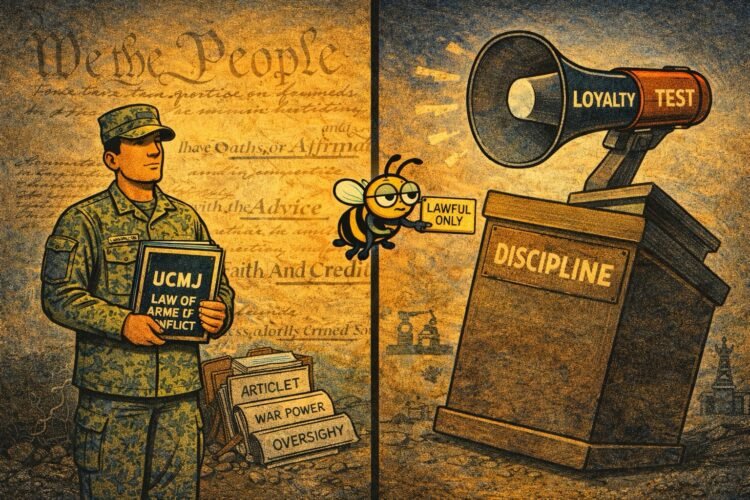
When loyalty tests replace doctrine and truth gets charged with misconduct.
The Pentagon announced that Secretary of Defense Pete Hegseth is seeking administrative punishment against Senator Mark Kelly for saying something that should have been so boring it barely registered as a headline. Kelly said service members should not follow unlawful orders. That’s it. No flourish. No manifesto. Just the sentence every recruit learns before they learn how to march.
Somehow, that sentence has been rebranded as seditious.
The move would be funny if it weren’t so dangerous. It would be satire if it weren’t happening inside the institution that controls the most lethal force on the planet. Instead, it’s a loyalty test masquerading as discipline, an inversion of accountability that treats constitutional guardrails as mutiny and turns the law itself into a suspect.
To understand how upside down this is, you have to start with what the law actually says, not what partisan theater needs it to say.
The Constitution is not ambiguous about the relationship between orders and legality. Civilian control of the military is paired with a system that demands obedience to lawful authority, not blind obedience to any authority that happens to be loud. That distinction is not a footnote. It is the spine of American military ethics.
The Law of Armed Conflict makes this explicit. So does the Uniform Code of Military Justice. Service members are obligated to obey lawful orders. They are equally obligated to refuse unlawful ones. This is not a loophole. It is the lesson the world wrote in blood after Nuremberg, when “I was just following orders” stopped being a defense and became a warning.
Modern doctrine drills this into troops precisely because war is chaotic and power is dangerous. Unlawful orders are not hypothetical. They are the predictable byproduct of stress, ideology, fear, and authority colliding. The duty to refuse is what keeps a professional military from becoming a criminal one.
Mark Kelly said nothing more radical than that.
He did not call for insubordination. He did not urge troops to decide policy. He did not encourage defiance of civilian leadership. He reminded them of their obligation under the very code that governs their service. In any sane system, that would earn a nod and a move on.
Instead, it earned an investigation.
The Pentagon’s response has leaned on strained legal contortions that read like a law school exam written by someone who skipped class on precedent. Officials have floated the idea that Kelly’s statement constitutes conduct unbecoming under Article 133 or a catchall offense under Article 134 of the UCMJ, despite the fact that Kelly is a retired officer and a sitting United States senator engaged in protected political speech.
Articles 133 and 134 are not magic words that transform discomfort into illegality. They are narrowly construed provisions meant to preserve discipline and good order within the ranks, not to police the speech of retirees or punish reminders that the law exists. Stretching them this far does not protect discipline. It advertises insecurity.
Then there is the threat to use a retirement grade review under 10 U.S.C. § 1370(f), a process designed to assess whether an officer served satisfactorily at their highest grade, not to retroactively discipline speech that embarrasses current leadership. Weaponizing that mechanism as political punishment turns an administrative safeguard into a cudgel. It tells every officer watching that your career can be re-litigated if you tell an inconvenient truth.
This is not how a confident institution behaves.
It is worth pausing on who Mark Kelly is, because the charge that he is undermining discipline collapses under the weight of his actual life.
Kelly is a retired Navy captain. A combat veteran. A test pilot. A NASA astronaut who flew multiple missions into space, a job that requires an almost pathological respect for procedure, safety, and chain of command. His career is a long record of following lawful orders and understanding exactly why the unlawful ones must be refused.
His moral authority does not come from slogans. It comes from experience.
It also comes from a trauma that rewired his life and the country’s conscience. Kelly’s wife, former Representative Gabby Giffords, was shot in the head during a mass shooting while serving in Congress. She survived, but with lasting injuries that reshaped both of their lives. The violence was political. The consequences were permanent. Together, they turned that horror into advocacy against political violence and for the rule of law, not as abstraction, but as survival.
To accuse Kelly of undermining discipline is obscene in that context. He has lived what happens when rhetoric escalates into action and when unlawful violence is normalized. He understands the cost of treating law as optional. If anyone has earned the right to remind the country that legality matters, it is someone who watched his spouse bleed on a sidewalk because someone decided rules did not apply.
That history stands in sharp contrast to the man now seeking to punish him.
Pete Hegseth did not rise through the military justice system. He rose through partisan media, where certainty is currency and outrage is a business model. His elevation to Secretary of Defense represents a broader shift in which performative loyalty is valued over institutional humility and televised conviction is mistaken for command experience.
This matters because the episode with Kelly is not about discipline. It is about obedience to a narrative.
The narrative says that questioning unlawful orders is disloyal. The narrative says that reminding troops of their duty to the Constitution is subversive. The narrative says that the chain of command flows in one direction and the law is a suggestion.
That narrative is incompatible with a professional military.
Civilian control of the armed forces does not mean civilian infallibility. It means elected leaders set policy within the bounds of law, and the military executes that policy lawfully. When civilians demand illegal action, the system is designed to resist, not comply. That resistance is not mutiny. It is fidelity.
By reframing that fidelity as sedition, the Pentagon risks teaching troops the worst possible lesson. That legality is negotiable. That ethics are partisan. That obedience is owed to personalities rather than principles.
This is how militaries rot.
The chilling effect is not theoretical. Officers and enlisted personnel are watching this unfold. They are absorbing the signal that even stating black letter law can invite retaliation if it conflicts with political goals. They are learning that retirement does not mean safety from retribution. They are learning that the institution may not have their backs if the law puts them in tension with power.
That kind of lesson does not produce discipline. It produces silence.
The legal foundation for Kelly’s statement is not obscure. It is taught. It is codified. It is reinforced through training precisely because unlawful orders place service members at risk of prosecution, moral injury, and lifelong consequences. The duty to refuse is not a loophole to be exploited. It is a shield.
Calling that shield seditious flips the moral axis. It tells troops that their safest course is obedience even when the law says stop. That is a recipe for war crimes, not readiness.
There is also a constitutional problem hiding in plain sight. Punishing a senator for protected speech under the guise of military discipline raises separation of powers concerns that should make every lawyer sweat. The legislative branch does not answer to the Pentagon. Senators do not lose their First Amendment rights because they once wore a uniform. Using administrative military processes to target an elected official for speech is not discipline. It is intimidation.
And intimidation is contagious.
The broader implication is that the Pentagon is being asked to serve presidential will rather than constitutional order. That is not a small shift. It is the line between a republic and something darker. When loyalty to a leader eclipses loyalty to the law, the uniform becomes a costume and the oath becomes decorative.
This episode is being defended as necessary to preserve good order. But good order does not require erasing doctrine. It requires reinforcing it. If leadership truly cared about discipline, it would be thanking Kelly for reminding the public what service members are taught from day one. It would be clarifying that unlawful orders must be refused. It would be reassuring troops that the institution will protect them when they do the right thing.
Instead, it is signaling the opposite.
There is a reason this feels like a loyalty test. Loyalty tests demand that you affirm something you know to be false to prove belonging. In this case, the falsehood is that obedience is absolute and the law is secondary. Those who refuse to affirm it are marked as disloyal.
History is unkind to militaries that adopt that logic.
The irony is that Kelly’s statement is the most pro-military position available. It protects troops from being used as tools for illegal action. It protects the institution from scandal and prosecution. It protects civilian leaders from the consequences of their own worst impulses. It preserves the moral contract that makes service honorable rather than coercive.
Punishing that position is not strength. It is fragility.
If the Pentagon proceeds, it will set a precedent that will outlast the current players. Future leaders will point to this moment as permission to police truth. Future officers will hesitate when they should refuse. Future soldiers will wonder whether the oath means what it says.
That is the real danger.
This is not about Mark Kelly alone. It is about whether the United States still believes that the law governs power, or whether power governs the law. It is about whether the armed forces are guardians of constitutional order or instruments of personal loyalty. It is about whether saying the obvious is now a punishable offense.
Telling soldiers to obey the law is not sedition. It is the bare minimum.
If that truth now requires courage to speak, the problem is not the speaker. It is the system trying to silence him.