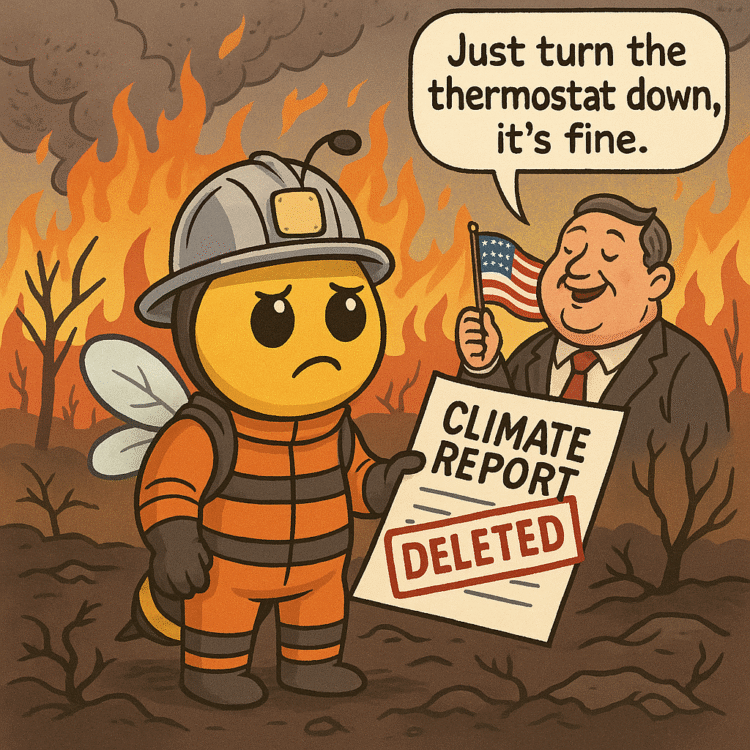
Once upon a timeline glitch, somewhere between the invention of Aqua Net and the third indictment, the Trump administration decided the best way to tackle climate change was… to pretend it didn’t exist.
And by “tackle,” we mean delete, obscure, and casually yeet any congressionally mandated climate report off government websites like a shady teen clearing their browser history before a parent logs on.
Because if the oceans rise and no one’s allowed to read about it, did it really happen?
The Great Climate Cover-Down
Climate reports—those pesky, data-backed killjoys filled with charts, projections, and reality—have long been the party poopers of American politics. Especially for an administration that believed “climate” was just another word for “weather, but liberal.”
So, what’s a freedom-loving, regulation-hating government to do when confronted with grim environmental science?
Easy.
Scrub it. Hide it. Pretend it’s a gender studies elective at Berkeley and send it to the cornfield.
Instead of preparing coastal cities for rising sea levels or assessing wildfire impact, the Trump administration allegedly played hide-and-delete with congressionally mandated reports, making them harder to find than Melania’s last three Christmas statements.
It’s not censorship if you do it patriotically, right?
Ignorance Isn’t Just Bliss—It’s Policy
You have to admire the commitment. Most politicians dodge accountability. The Trump-era EPA simply deleted the to-do list.
Don’t like what the science says? Reassign the scientists. Don’t like the graphs? Remove the pages. Don’t like the heat waves, flooding, and droughts? Call them “weather anomalies” and build a golf course.
In 2020, while actual climate events were busy turning California into a charcoal sketch and Louisiana into a sea-salt Jacuzzi, the administration’s energy policy was still “burn first, ask questions never.”
And all the while, the official websites were quietly sterilized. Because nothing screams “stable genius” like treating climate data like a bad Yelp review.
Congress: “You Can’t Just DELETE Reports”
Trump Team: “Bet.”
It wasn’t just an oversight—it was a strategy. Reports mandated by Congress weren’t “overlooked.” They were ignored, hidden, and in some cases, removed altogether.
Why? Because planning for climate impacts would’ve required doing something. Like funding adaptation plans. Or telling voters their beachfront property might someday house a coral reef.
Instead, we got fossil-fueled optimism and a press secretary who said the climate models were “inconclusive,” as if the Arctic wasn’t actively melting like a Popsicle in a tanning bed.
Meanwhile, the Planet Was Notified
Unfortunately for the administration, the climate did not get the memo. Or maybe it did, and just decided to speed things up out of spite.
- Wildfires became annual arson festivals.
- Hurricanes lined up like concertgoers outside a Taylor Swift stadium.
- Texas froze. Then it boiled. Then it deregulated again for good measure.
And all the while, those reports—those tidy little bundles of inconvenient truth—were being wiped like a hard drive in a panic room.
Rebranding the Apocalypse
Let’s be honest: Trumpism didn’t kill climate science. It just tried to rebrand it.
Why say “climate crisis” when you can say “unseasonably balmy opportunity”? Why mention melting glaciers when you can call it “new waterfront development potential”?
It’s not a wildfire—it’s a freedom blaze.
It’s not a drought—it’s a low-humidity tax break.
It’s not a deleted report—it’s streamlined patriotism.
If You’re Tired of Scrolling Past Disaster… Read Something Better
If the thought of your grandkids paddle-boarding through the ruins of D.C. makes you want to scream into a recyclable cup, maybe it’s time to escape. Not with Netflix reruns or doomscrolling, but with something queer, honest, and actually well-written.
✨ Read my books for free with Kindle Unlimited
📚 amazon.com/author/theclobra
If the planet’s going down, you might as well go down in style. Preferably while reading a queer romcom about emotional collapse and second chances, not a federal climate memo that was memory-holed in 2019.