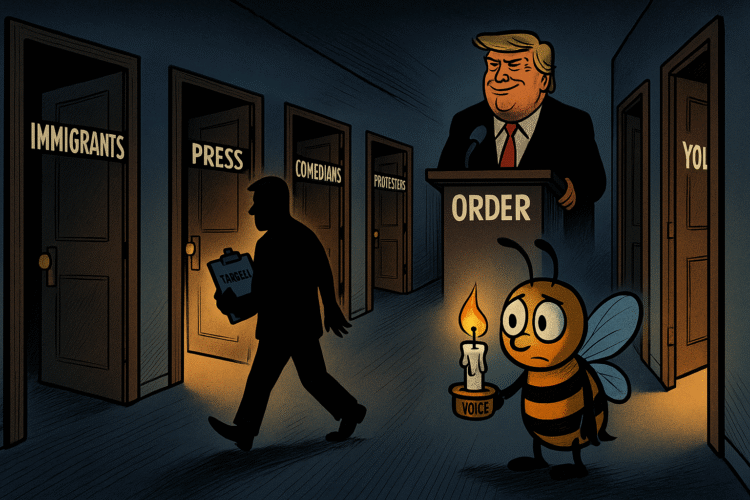
Pastor Martin Niemöller’s famous warning, “First they came for the Communists, and I did not speak out…” has been printed on everything from posters to classroom walls to dorm room tapestries. It has become a kind of moral shorthand for complicity, a poem that whispers to history students, “Don’t wait until it’s your turn.”
And yet, here we are again, watching the rerun in high definition. Different decade, same script. The state flexes its power against the vulnerable, the loud, and the inconvenient, and half the country yawns because it’s happening to someone they already didn’t like. The other half tweets the quote, gets 200 likes, and moves on to a video of a raccoon washing grapes.
The moral of Niemöller’s poem wasn’t just “speak up.” It was “you are not exempt.” But in Trump’s second term, exemption has become the new American dream. We are a nation of people praying that when the knock comes, it’s for somebody else.
The Updated Verse
Let’s modernize Niemöller’s warning, shall we?
First they came for the immigrants,
and I did not speak out,
because I had convinced myself that “illegal” was a personality type.Then they came for the journalists,
and I did not speak out,
because I get my news from memes anyway.Then they came for the comedians,
and I did not speak out,
because I only laugh at people I already hate.Then they came for the civil servants,
and I did not speak out,
because “draining the swamp” sounded like a cleaning service.Then they came for me,
and I tried to livestream it,
but the Wi-Fi was down because the First Amendment doesn’t cover routers.
We’re living through a remix of the poem, only this time the background track is nationalism, algorithmic propaganda, and the sound of your neighbor saying, “Well, if they didn’t do anything wrong, they have nothing to worry about.”
ICE, ICE, Baby
Niemöller’s Germany had the Gestapo. We have ICE, an agency whose budget grows faster than anyone’s conscience. They come at dawn in unmarked vans, detain parents outside schools, and separate families with bureaucratic efficiency that would make Kafka take notes.
It’s easy to dismiss ICE as someone else’s problem if your name doesn’t sound like it could trigger a database flag. The cruelty, we’re told, is the point. But it’s also the warning. Once a state starts dividing who counts as “real citizens,” it never stops at the border.
Today it’s the undocumented nanny or the asylum seeker. Tomorrow it’s the protester blocking a highway, the journalist asking the wrong question, or the comedian making the wrong joke. Power doesn’t need reasons. It just needs practice.
The Weaponization of “Justice”
Back when Pastor Niemöller spoke out, the machinery of persecution came dressed in uniforms and decrees. Now it wears suits and press briefings. The Department of Justice, that quaint institution once tasked with upholding laws, has become an instrument for enforcing loyalty.
Investigations are for enemies. Immunity is for friends.
We’ve seen the new model. Prosecutors are purged, whistleblowers are criminalized, and inspectors general are quietly retired like unwanted pets. The message is clear. Justice isn’t blind, it’s just been told where to look.
And while that happens, Trump smiles at rallies, reading the names of critics like a shopping list. Merrick Garland, Jack Smith, Letitia James. All reduced to punchlines for the crowd to boo, proof that in this administration, the only crime is defiance.
The Soldiers Came Too
Pastor Niemöller didn’t have to worry about the Pentagon deploying troops on domestic soil to patrol protests. We do. Trump calls it “peacekeeping.” Governors call it “overreach.” The Founders would have called it what it is, occupation in a flag disguise.
Troops line city streets “for order,” though somehow that order always seems to coincide with silencing dissent. Civilian oversight becomes optional when uniforms take orders from ideology. The Insurrection Act, designed for extraordinary emergencies, is now just another item on the campaign to-do list.
The crowd cheers because they think the soldiers are there to protect them. But in every historical rerun of this story, the troops eventually point inward.
The Press as Public Enemy
In Niemöller’s day, propaganda required printing presses and censorship offices. Ours runs on Twitter accounts, anonymous posts, and talking heads yelling “fake news” at every uncomfortable fact.
The American press, once labeled the Fourth Estate, is now treated like a hostile foreign power. Trump has branded reporters as “traitors,” “scum,” and “enemies of the people,” phrases borrowed directly from regimes whose historical Yelp reviews include “dictatorship, would not recommend.”
The chilling effect isn’t hypothetical. Journalists get doxxed. Newsrooms lose funding. Photojournalists covering protests are arrested under “suspicious activity” statutes. A free press doesn’t need to be banned. It just needs to be exhausted.
And the public cheers, because the algorithm told them every journalist is lying except the ones who flatter their worldview.
The Comedians
Every totalitarian impulse starts by silencing laughter. Humor is dissent’s gateway drug. It exposes absurdity faster than a policy brief.
That’s why authoritarian leaders hate comedians. The more fragile the ego, the thinner the skin.
When stand-up comics joke about the administration, the response isn’t critique, it’s investigation. The DOJ probes “incitement.” ICE checks work visas. Late-night hosts are labeled “un-American.”
Remember when presidents used to roast themselves at White House Correspondents’ Dinners? Now the only acceptable punchline is applause.
It’s not about comedy, it’s about control. Because if people can still laugh at power, they haven’t surrendered to it.
The Citizens’ Quiet Accomplice: Comfort
Niemöller’s poem reminds us that silence was less about fear than comfort. The average German didn’t protest not because they didn’t know, but because speaking up meant losing something. A job. A reputation. A sense of safety.
Sound familiar?
Americans, by and large, aren’t cheering the crackdowns. They’re scrolling past them. They see the footage of ICE raids, DOJ purges, and press arrests, and say, “That’s awful,” before returning to Zillow listings. Outrage fatigue has become the new sedation.
We are a nation sedated by convenience, pacified by DoorDash and plausible deniability. If tyranny ever comes fully dressed, it won’t need to knock. It’ll just text you a coupon.
The Luxury of Not Caring
It’s easy to moralize about Niemöller’s generation, to shake our heads and say, “I would have spoken up.” But history’s test is never dramatic at first. It starts as a whisper, a headline, a neighbor’s absence. It asks small questions: Would you notice? Would you care? Would you still care next week?
Right now, millions are failing that test in real time. The targets are always “other people.” Immigrants. Journalists. Activists. Drag queens. Librarians. Once you’ve learned to tolerate cruelty in doses, the dosage increases without you noticing.
The Trump Doctrine of Persecution
The Trump movement isn’t subtle. It doesn’t have to be. The point isn’t ideology, it’s hierarchy. Who gets to belong, who gets to stay, who gets to speak.
ICE raids keep the fear local. DOJ prosecutions keep the fear institutional. Troop deployments keep the fear visible. Together, they form a symphony of intimidation that hums in the background of daily life, normalized by repetition.
And every time someone says, “It’s not me, so it’s fine,” the chorus grows louder.
The Algorithmic Silence
In Niemöller’s time, silence meant looking away. In ours, it means getting distracted.
The platforms that shape our discourse are designed for amnesia. Outrage trends for 48 hours, then vanishes beneath celebrity scandals and viral pranks. Attention spans are harvested like data crops, and moral memory is just another app notification.
Dictators don’t need censorship when they have autoplay.
When the Knock Comes
Niemöller ended his poem with the final, devastating line: “Then they came for me, and there was no one left to speak out for me.”
It’s not just a warning, it’s a prophecy. In every society that tolerates persecution, the circle of “them” shrinks until it includes you. The trick is that you never realize you’ve run out of “thems” until the knock echoes in your hallway.
When ICE expands its definition of “unauthorized.” When the DOJ expands “seditious activity.” When satire becomes “hate speech” because it embarrasses the wrong official. The categories blur until law itself becomes a weapon instead of a shield.
And by then, the press is gone, the comedians are gone, the unions are gone, and the public’s moral reflex is gone too.
America’s Modern Pastor Niemöllers
There are people speaking out—immigration lawyers, journalists, organizers, comedians still doing jokes that might get them audited. But their numbers shrink with every chilling effect, every arrest, every headline that turns resistance into clickbait.
Each new crackdown finds fewer defenders, because the risk increases while the empathy decreases. History doesn’t repeat itself exactly. It just modernizes its software.
The Real Enemy Isn’t Trump
Trump is a symptom, not a cause. The real disease is the infrastructure of apathy that lets leaders like him thrive. Every authoritarian movement feeds on permission, on the quiet majority who confuse detachment for neutrality.
Silence doesn’t keep you safe. It just reserves your place in line.
Closing Section: The Comfort of Complicity
We like to believe we’d be the heroes in Niemöller’s story. But odds are, we’d be the audience, watching, rationalizing, changing the channel.
Every nation that slides into repression starts with the same bargain: tolerate cruelty toward someone else, and you won’t have to face it yourself. That’s the comfort of complicity. It works right up until it doesn’t.
So when the state comes for immigrants under the banner of “security,” for journalists under “stability,” for comedians under “decency,” for protesters under “order,” remember: this is how freedom dies, through paperwork, press releases, and polite indifference.
Niemöller didn’t write his poem to be quoted. He wrote it to be interrupted.
And if we don’t start interrupting now, if we don’t speak before the next knock, then when they come for the rest of us, the only sound left will be the echo of our own silence.