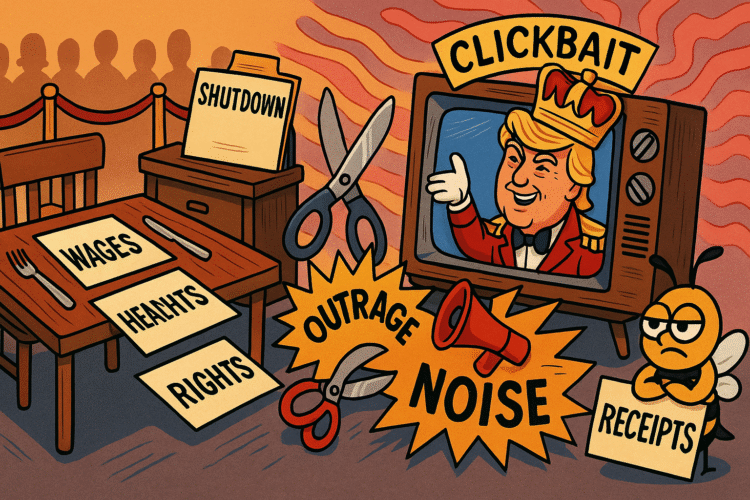
From immigration panics to crime bait, the outrage machine drowns out the boring policies that actually save you money.
A love letter to boring policies in a country addicted to feelings
“Kitchen table issues” sounds like a placemat you forgot to rinse. It lands in the brain like a PSA about flossing. Everyone nods at it, then reaches for a brighter channel because attention prefers glitter to groceries and conflict to coupons.
Democracy, bless it, has the same marketing problem. It is sturdy instead of sparkly, process instead of spectacle, receipts instead of riffs. The hard part is that you can only notice democracy when it is failing, which means the brand is invisible when the product is working.
Meanwhile the narrative moves like a magician’s scarf. You think you are watching a policy debate and then the scarf becomes a rabbit and the rabbit becomes a fire alarm and the fire alarm becomes a fundraising link. Trump is master carpenter of that stage. He changes the headline mid-sentence, declares victory before the game starts, and dares you to chase him across the room as he replaces the furniture with fog.
Every day becomes a scavenger hunt for the outrage of record. Yesterday’s clip is already vintage by lunch. Norms are not so much broken as turned into confetti, thrown in the air to see which piece the camera will follow. It is hard to sell a voting-rights fix when your audience is busy arguing over the latest costume change.
And still, the only things that actually move votes live very close to the sink. Health care that does not bankrupt you for catching a cold. Wages that are more than a compliment. Schools that teach your kid to read while keeping the ceiling intact. You can call these “kitchen table issues,” but the phrase is oatmeal in a world that wants a flaming dessert.
Democrats, for all their flaws and internal migraines, keep writing the better technical manuals. Medicare exists because of them. Social Security exists because of them. Minimum wages rise when they have a pen and a caucus, unions find air, regulators remember how to check the math, and whole regions breathe easier. The problem is not the spreadsheet. The problem is the soundtrack.
Policy is not exciting in the way a cliffhanger is exciting. It is a safety net that does not photograph well. It saves you from falling, and human beings are bad at celebrating gravity when it behaves. Feelings outrun facts because feelings hum while you cook, and facts sit on the counter like a pamphlet looking for a magnet.
People know billionaires do not care if your rent eats your groceries. They know this the way they know rain is wet. What they do not always know is that the boring programs they ignore are the reason the roof did not leak as badly last year. A tax credit does not smile on television. A regulation does not wink. A union contract looks like furniture until a storm hits.
The billionaire Republican class has an answer for that optics problem. Do not talk about the plumbing. Paint the walls and sell the color as destiny. If a pipe bursts, blame woke paint for being the wrong shade. Keep the conversation on immigration, drag shows, books in libraries, crime in abstract, anything with enough heat to fog the lens and enough symbolism to feel like a tattoo.
It is a cunning approach because feelings are easier to program than budgets. Fear is a helpful employee, always on time, never takes weekends. Outrage writes itself. Nostalgia is a memory foam that fits any grievance. You can make voters feel like heroes for scolding a librarian while a corporation changes the terms of their retirement behind a curtain.
The hypocrisy is not an accident. It is a strategy that makes the shameless immune to shame. Cry about border security at sunrise and hire undocumented labor at noon. Shout “family values” and ghost your child support, then book a primetime slot arguing that the real problem is pronouns. Call crime a plague, then bask in the immunity of wealth that never meets a courtroom unless it buys it.
We live in a country where a convicted felon can cosplay as law and order and be believed because belief is a vibe, not a logic tree. We also live in a country where that same felon married an immigrant who collected an Einstein visa, which is either a punchline or a commentary on national standards depending on your tolerance for irony. The show is not coherence. The show is dominance. Dominance sells. Dominance does not apologize for typos.
If it sounds like I am scolding, I am not. I am confessing. It is hard for me to care about policy white papers on a Tuesday evening when my brain is tired and the algorithm is serving me twelve tiny moral emergencies that all feel urgent. My feelings want the dopamine of a clapback. My future wants a rulebook. Every citizen is a tug-of-war between the two.
There is a double edge here. To get noticed you have to catch the narrative mid-flight. If you do not respond to the story shapeshift, the headline moves without you. But if you spend all your time chasing the costume changes, you forget to point at the trapdoor under the stage. Trump knows this intuitively. He will keep you arguing about the hat while he alters the hiring rules for the people who count votes.
Destroy a norm today, the cameras run. Erode a clause tomorrow, no one sees it until the clause becomes a club. Denigrate the press until the press has to cover the attack on itself, then describe the coverage as proof that the press is self-involved. Argue that prosecutors are political while turning prosecution into a weapon, then claim every indictment is a poem about victimhood. It is attention judo, and most of us are not trained for it.
So the question becomes, how do you make kitchen table issues trend without turning them into circus acts. How do you honor boredom without losing the room. How do you sell stability in a marketplace that rewards panic, spectacle, and the infinite dopamine scroll.
Start by telling the truth about feelings. People do not vote against their interests. They vote for the stories that explain their days. If the only storytellers they hear are selling grievance and glamour, they will buy those stories because empty calories are still calories. If the storytellers of policy speak like instruction manuals, the audience will wander off.
Make the invisible visible. Show the bill that did not arrive because a regulation did its job. Show the drug price that fell because a negotiation office remembered who it works for. Show the child care slot that exists because a budget cut did not happen. Do not give me a number on a chart. Give me the afternoon it returned to a parent who can now breathe.
Make the boring heroic. Union organizers are not mascots for nostalgia. They are the reason a warehouse worker can kneel without a surgery bill. Regulators are not hall monitors. They are the reason your water and your mortgage are not the same color. Court clerks with tired eyes are the reason your vote survives a busy Tuesday. These are heroes with clipboards. The cape is not required.
Make the stakes specific. Democracy is not a poem. It is the permission structure for your paycheck, your prescription, your kid’s school, your ability to be loud on a sidewalk without meeting a baton. When democracy thins, the price of insulin goes up more easily. When democracy thins, a governor can convert your city into a prop. When democracy thins, the line between public safety and personal militia starts to blur on purpose.
Name the scam. The billionaire Republican class would prefer you spend your energy on cultural cosplay because the money moves quietly while the costume drama eats your battery. They want you fighting over pronouns while they rewrite liability rules. They want you panicking over caravans while they carve new holes in the tax code. They want your blood pressure and your distraction. They do not want your spreadsheet.
Refuse the hypocrisy bargain. If a party sells family values, ask about their families. If a politician screams crime, ask about their indictments and their hush money and their loss of paperwork that always seems to happen around subpoena season. If someone says the border is a crisis, ask where the visas are for the industries that rely on the labor they pretend to despise. If someone says woke, ask them to define it without using a synonym for empathy.
But we cannot shame our way to better politics. We have to build a different kind of attention. Attention that rewards answers, not just adrenaline. Attention that gives a politician more points for funding a bus route than for feeding a TV hit with new synonyms for apocalypse. Attention that makes boring a compliment again.
It will require new rituals. Weekly receipts instead of weekly outrage. Neighborhood assemblies that are not cosplay. Rotating living room caucuses where people bring one policy they actually felt this month, not a talking point they saw at midnight. A shared language for “this changed my bill” and “this kept my kid safe” and “this job exists because we decided to fund a thing instead of a throne.”
It will require translation. Not dumbing down. Translating up. Turn “anti-trust enforcement” into “somebody finally told your internet company no, and your bill listened.” Turn “minimum wage indexation” into “your paycheck got a raise while you were sleeping, and it was not because your boss had a vision board.” Turn “regulatory capture” into “the referee was living with the home team, and we evicted him.”
It will require laughing at the right things. Laugh at the cosplay monarchy. Laugh at the gold trim. Laugh at the tweet that pretends a court is a fan club. But do not laugh at the people who fell for the performance. Invite them into a story that feels better than grievance. Offer them a seat at the boring miracle.
We also need to be honest about our side’s temptations. Democrats can get high on the supply of being right. It is a dizzying feeling. It does not pay rent. You can be correct and lose the room. You can have the better policy and the worse story. You can write a brilliant bill that dies because you forgot to sell the feeling of being seen by it.
Feelings are not the enemy. They are the interface. Policy should aim for relief you can taste. Relief is a feeling. Safety is a feeling. Dignity is a feeling. Respect is a feeling that can be measured in dollars when a nurse’s schedule does not break her back.
There is a reason Trump’s chaos strategy continues to find purchase. Chaos makes competence look small. It also makes cruelty feel like humor. The only counterprogramming that works is reliable care at scale, wrapped in a story that feels like a hand on your shoulder, not a finger in your face. That is not softness. That is power saying I see you without asking for a worship service.
If the norm-breaking continues, and it will, we cannot normalize our reaction. We need an escalation plan for boredom. When a norm is shredded on Monday, we do not chase. We tabulate. We explain the consequence in ten plain words. Then we pivot back to the block and the bill and the bus. We punish the smash-and-grab with consequences, and we starve it of airtime.
Yes, we have a felon auditioning for monarch, a man married to an immigrant whose celebrated genius visa reads like satire next to his own vocabulary. It is tempting to live in the snark. It is cathartic. It is also a trap. The more time we spend narrating his contradictions, the less time we spend narrating the contract we owe each other.
Kitchen tables do not trend because they do not ask for applause. They hold elbows, spill soup, get nicked, survive. The country we keep saying we want looks like that. It is scratched. It is solid. It is made of choices that are not exciting until the day they save your life. We can upgrade the phrase if we need to. Call them paycheck issues. Call them bedtime issues. Call them “the part where your future eats tonight.”
Whatever we call them, we have to put them back at the center of a story that feels like a life, not a fight club. A story where Medicare is a promise, Social Security is a shared memory, minimum wages rise because we decided not to be cheap with each other, unions are how people protect their time, and regulation is how we keep rich strangers from moving into our lungs.
Democracy is not a vibe. It is a work schedule. It is a rotating crew of neighbors choosing fairness over flare every boring Tuesday. It is your vote plus your voice plus your patience plus your refusal to be dazzled by a man who thinks a crown would finally make him whole. It is the documents that keep saying no to people who cannot hear the word no any other way.
So here is my pitch. Let the other side keep the circus. We will keep the kitchen. We will cook the food that keeps a country standing. We will brag about the recipes when they save a bill. We will celebrate the line cooks who keep the burners safe. And when the ringmaster starts juggling fire, we will hand each other plates and say dinner is at six, the kids need their medicine, the bus comes at seven, the lights work, the water runs, the rent is due, and the Constitution, that square little booklet with no selfies, still fits in a pocket next to your grocery list.
That is not catchy. It is durable. It is not viral. It is valuable. It is not a hook. It is a home. And if we do it long enough and loud enough, feelings will remember what they are for, not just to be fed by a screen, but to be filled by a life that makes sense.