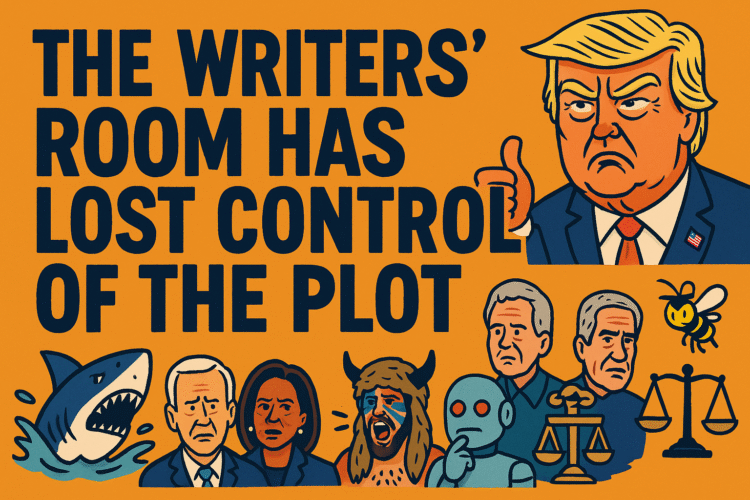
If the last decade were a TV series, even the interns would be begging the showrunners for a hard reboot before cancellation.
There comes a time in every long running series when the writers lose all sense of proportion. When the storylines pile up like abandoned shopping carts, when characters behave like they have been bodysnatched by new actors, and when the season arcs become so chaotic that the audience stops asking questions and simply holds on for dear life. That time, for us, arrived somewhere between 2016 and now, and it has not let up since. We are living inside a narrative that feels less like a coherent plot and more like a group of exhausted scribes being forced at knife point to keep improvising story beats because the network executives discovered that chaos tests well with younger viewers.
If you pitched the last decade as fiction, you would be escorted from the building. Not because the story is bad, but because it is too unbelievable for even the least discerning streaming platform. Netflix would call it unrealistic. Amazon would call it overwrought. HBO would call the narrative arcs unfocused. Even CW executives would say the character motivations lack continuity. Yet here we are, trapped in a cosmic series that no one greenlit but everyone is forced to watch, complete with plot twists that would get any actual TV show cancelled mid season.
Take the premise. A reality TV host becomes president. Not as a gag, not as a cameo, not as a dream sequence, but as the central protagonist. Already we have deviated so far from reasonable storytelling rules that it is difficult to remember what political television used to look like. Yet the writers leaned in, making each season more intense, more unhinged, more implausible than the last. It was as if the universe hired a writing staff composed entirely of interns who think subtext is something you order off DoorDash.
Let us catalogue the elements that would get any real show shut down. A pandemic arrives, killing millions, paralyzing daily life, and spawning arguments about whether masks work, as if scientists had not spent a century studying respiratory illness. Bleach becomes part of the cultural dialogue. Conspiracy theories spread faster than the virus itself. Lawmakers go on television to debate whether the disease is real. The president claims victory over it multiple times like a child declaring they have slain a dragon in the backyard.
Meanwhile the supporting cast becomes a revolving door of people who would normally be background extras, suddenly elevated to speaking roles and then killed off by scandal, indictment, or resignation. Whole seasons pass where Cabinet members exit faster than horror victims in a slasher film. Press secretaries come and go like guest stars on a sitcom who storm off after one night because the script smelled like battery acid.
Then, as if the writers had grown bored of pandemics, they introduced a coup plot. Not a subtle coup. Not a shadowy thriller style coup. A coup written by interns who have only seen heist movies on airplanes. Costumes included Viking horns, tactical cosplay, zip ties, riot shields, makeshift gallows, and confused boomers wandering through the Capitol building taking selfies. The protagonist at the center incites a mob, tells them he loves them, then watches the chaos from a private room like a man enjoying a bonus episode of his own show.
Any sensible fictional world would follow this with a scene where the character is recast, written out, or imprisoned. Instead, our show’s writers kept him in the cast. Then, in a twist so deranged it feels deliberate, they wrote a future season in which the country reelected the man who staged the coup. Not begrudgingly. Not as a plot twist forced by ratings. But openly, proudly, as if no one had watched the last season finale.
And once reelected, the protagonist wasted no time turning the entire narrative into a redemption arc written by a villain. He pardoned every January sixth rioter, granting amnesty to the people who attacked the Capitol in service of his delusions. He pardoned his friends, his cronies, his loyalists, and anyone who had ever uttered a flattering sentence about him on cable television. It was a mass absolution scene so campy that if it aired on prestige TV, critics would declare the show had lost the plot. But real life kept going.
Then came the most absurd storyline of all: the hiding of the Epstein files. These are the same files the protagonist demanded be released when he was in the opposition storyline. Full transparency, he declared. Sunlight. Drain the swamp. But when the new batch of Epstein emails emerged, including the ones referencing him directly, the writers reintroduced a classic hypocritical twist. He dismissed the files as fake. Then said they were true. Then said the parts implicating him were lies. Then said the parts implicating Democrats were gospel. Then buried the files behind layers of executive privilege and choreographed chaos. It was the narrative equivalent of throwing plot pages in a blender and hoping the audience cannot tell where the ink smudges came from.
This would already be enough to get a television series cancelled.
Yet the writers escalated. They always escalate.
They added Russia. And not subtly. Not as a Cold War subplot or a thriller arc. They dropped Russia into the main storyline like a crossover event. Suddenly there were secret meetings, back channel communications, kompromat rumors, sanctions, indictments, and investigations. The Mueller inquiry became its own spinoff, complete with guest stars, redacted dialogue, surprise cameos from oligarchs, and a finale so anticlimactic it felt like the writers ran out of caffeine halfway through the script.
But even that was not enough.
They introduced a scene where the protagonist’s personal attorney became Attorney General. Imagine the White House counsel in a political drama stepping into the role of chief law enforcement officer and immediately using the office to prosecute the president’s political foes, intervene in cases involving allies, misrepresent federal findings, and behave like a Fixer in Chief. Fiction would never dare. Reality did it on a Wednesday.
And because the writers apparently decided that subtlety had died in 2015, they then promoted a primetime Fox News host into the head of the Department of Defense, repackaged as the Department of War in everything but legal name. In any other show, this would read like a parody of propaganda, the kind of storyline a satirist uses to warn about creeping authoritarianism. Yet here it was, fully realized, complete with monologues about enemies, immigrants, and internal traitors. The national security apparatus became a live action cartoon narrated by a man whose previous job was scaring retirees before commercial breaks.
Then the writers layered in the creepiest connective tissue of all: the protagonist’s repeated proximity to alleged and confirmed sexual predators. Not one. Not two. Entire clusters of them. Matt Gaetz, under investigation for sex trafficking. Sean Combs, accused of assault and exploitation. Prince Andrew, disgraced by his involvement with Epstein. Epstein himself, the billionaire pedophile with whom the protagonist shared parties, connections, photos, and convenient denials. It was a pattern so blatant that any fiction editor would have rejected it as heavy handed. But reality let it play on repeat.
Now layer all that onto the preexisting madness: the overturning of Roe v. Wade, transforming bodily autonomy into a state by state roulette wheel; the rise of AI systems that talk, argue, flirt, and occasionally threaten humanity; billionaires launching themselves into orbit while workers skip meals; wildfires rendering cities uninhabitable; schoolchildren practicing active shooter drills as casually as fire alarms; cryptocurrency tomfoolery that swallowed billions; deepfakes blurring truth until nothing feels real; supply chain collapses causing toilet paper wars; and, more recently, political operatives insisting that rising food prices are imaginary even as Americans stand in grocery aisles comparing apples like distressed economists.
If this were fiction, test audiences would riot. Writers would be fired. Actors would refuse the scripts. Streaming platforms would walk away. Yet real life keeps turning out new episodes.
And then came the latest seasons.
A sitting president stepping down mid reelection campaign like a cast member walking off set over contract disputes. Two highly qualified women offered as successors. The chance to finally write a compelling, morally coherent arc. And audiences choosing instead to regain the protagonist who incited a coup, fled responsibility, racked up indictments, praised dictators, pardoned extremists, hid evidence, and demanded absolute loyalty.
This is not plot. This is narrative malpractice.
And the writers know it. They lean into it. They savor the chaos the way showrunners savor scandal when ratings dip. Each new episode arrives more confusing than the last. Each arc becomes more tangled. Each storyline feels like a prank pulled by a writer who has stopped sleeping and now composes scenes based on fever dreams.
Let us revisit the full catalogue of storylines that would have destroyed a fictional series:
A reality star president.
A Russian election interference arc.
A multi year investigation into conspiracy and obstruction.
A global pandemic.
A bleach cure suggestion.
A toilet paper shortage arc.
Baby cages.
Wildfires visible from space.
Mass protests.
A coup attempt.
A QAnon shaman.
A president impeached twice.
A president indicted multiple times.
A president reelected despite staging a coup.
A mass pardon sequence for insurrectionists.
A personal attorney becoming the nation’s top law enforcement official.
A cable news host running military policy.
An Epstein scandal that refuses to die.
Multiple connections to alleged predators.
Overturning of Roe v. Wade.
Book bans.
AI hysteria.
Deepfake chaos.
Crypto meltdowns.
Billionaires competing for influence like cartoon villains.
A sitting president stepping aside mid campaign.
Voters choosing a felon over qualified women.
And the protagonist hiding the very documents he once demanded be released.
This is not a series. This is a multi platform collapse of storytelling norms.
People keep wishing they could wake up from the dream sequence. They want the series to return to its original tone, the procedural with predictable arcs and adult leadership. They want consistency. They want relief. They want coherence. They want a world where the political plotlines feel grounded rather than psychotropic.
They want the writers’ room to take a break.
They want the showrunner replaced.
They want the narrative reset to factory settings.
They want the algorithm unplugged.
They want the world to stop experimenting with genre blending.
Because right now we are living in a political show that has combined psychological horror, absurdist comedy, tragic melodrama, sci fi panic, legal thriller, erotic scandal, crime procedural, dystopian satire, and slapstick farce. No series can support this many genres at once.
And yet our world keeps trying.
The Summary the Writers Forgot To Write
The past decade has broken every storytelling rule in the book. No plotline is too absurd. No twist too unbelievable. No character arc too inconsistent. If this were fiction, it would be rejected outright for being incoherent. But this is not fiction. It is the world we live in, powered by chaos, written by madmen, and desperately in need of a reset. The audience is exhausted. The cast is confused. The writers are unhinged. And the story cannot continue like this forever. Eventually, someone will have to reboot the series. The only question left is whether that reboot comes gracefully or after the final episode implodes on itself in a spectacle no one can walk away from.