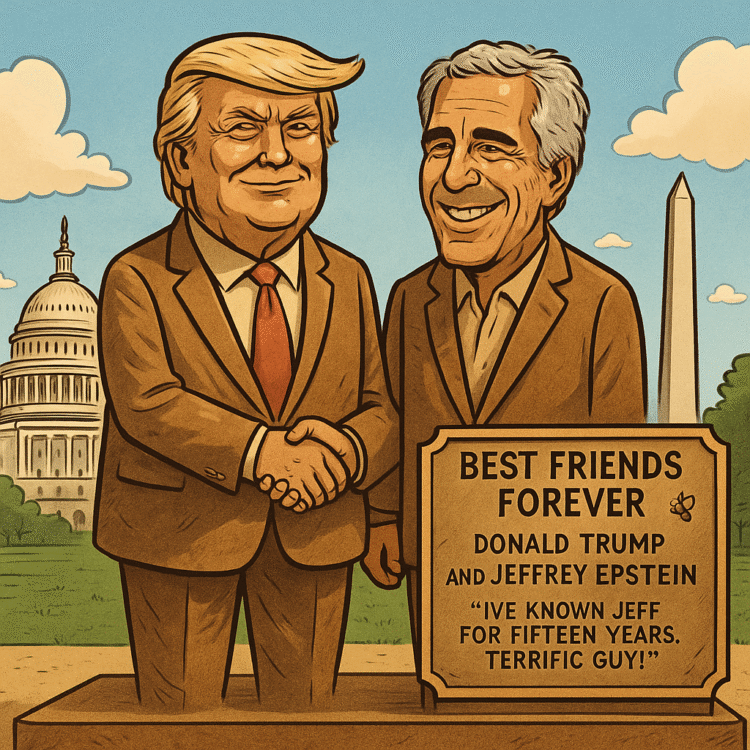
If Washington, D.C. is America’s front lawn, then the National Mall is the part where we put out our most awkward lawn ornaments. Statues to presidents, monuments to wars, the occasional scaffolding around the Capitol—these are the ornaments meant to convey gravitas. So when a 12-foot bronze-finished sculpture depicting Donald Trump and Jeffrey Epstein holding hands suddenly appeared near the Capitol, courtesy of an anonymous activist collective, the ornamentation turned into something else entirely: a blistering reminder that public art can be sharper than any editorial, and far more durable than a news cycle built on 280-character outrage.
The Scene
The sculpture, cheekily titled Best Friends Forever, was reported as wood, foam, and resin dressed up in bronze to mimic permanence. It rose twelve feet high, right across from the Capitol dome, placing Trump and Epstein in the same heroic scale usually reserved for Founding Fathers or generals. Plaques at the base referenced Trump’s past social ties to Epstein—yes, including a birthday-book note—and forced viewers to reckon with memories many would rather see edited out of history.
The National Park Service, apparently unbothered by the irony, issued a permit allowing the piece to remain until Sunday at 8 p.m. This was not a guerrilla drop-and-run stunt; it was a state-sanctioned installation of satire. And because the artists remain anonymous, the focus stays squarely on the subject rather than the creators’ résumés.
The Pushback
The White House wasted no time in distancing Trump from Epstein, reminding reporters that Trump had cut ties with the convicted sex offender years before Epstein’s arrest and death. Press aides insisted this sculpture was a “bad-faith attempt to smear by association.” Which is to say: the sculpture worked. Public art is successful precisely when it forces institutions to say things they’d prefer never to have to repeat out loud.
The Tradition of Protest Art on the Mall
The Mall has a long history of temporary installations that double as political arguments. From AIDS Quilt panels to climate-change ice blocks, activists know that nothing cuts through C-SPAN static like a striking image staged against America’s most symbolic backdrop. The trick is always the same: place something absurd, provocative, or heartbreakingly human next to the solemn marble. The contrast does the rest.
Best Friends Forever follows in that lineage. It is less about sculptural technique than about visual shorthand. A single image: two men holding hands. It collapses years of headlines, depositions, and disavowals into one frozen tableau.
The Stakes
Why does a temporary statue matter? Because the National Park Service permit system is essentially America’s cultural megaphone. Getting a permit means the federal government, however reluctantly, has agreed to host your political art on its lawn. Even if it’s for a weekend, even if the material is foam and resin painted to look like bronze, the effect is real: the image is legitimized by proximity to the Capitol.
That proximity forces a reckoning. Tourists stumble onto it. News crews can’t ignore it. Lawmakers walk past it and squirm. The Mall becomes a stage, and the whole country becomes the audience.
Public Memory, Weaponized
Statues are not neutral. They are arguments about who deserves honor and how we remember. For decades, defenders of Confederate monuments insisted those hunks of bronze were “just history.” Activists toppled them precisely because they weren’t. Best Friends Forever flips that logic, forcing viewers to confront not just what Trump has said about Epstein, but what power does with memory.
The White House can insist Trump long ago distanced himself. The activist collective insists the opposite: that power tries to erase embarrassing ties, and that public art can restore them to visibility.
The Mechanics of Permitting
Normally, the NPS permit process is about porta-potties and sound systems for protests. But once in a while, the bureaucracy greenlights art that detonates into national headlines. This was one of those moments. Approving Best Friends Forever meant approving a week of viral photos, op-eds, and press briefings. It meant that, for seven days, the most iconic lawn in America would host a visual argument no politician wanted to debate.
That is the brilliance of protest art: it hijacks the bureaucracy’s neutrality. A permit isn’t an endorsement, but it is an allowance—and allowances become power.
Why Anonymous Matters
The anonymity of the artists is part of the work. We live in an age when creators are instantly profiled, canceled, elevated, or co-opted. By staying anonymous, the collective ensures that attention stays fixed on the subject: Trump and Epstein, hand in hand. The anonymity also underscores the universality of the message: anyone could have made this. It could be you, your neighbor, your coworker. Accountability is everyone’s job.
The White House Response, Translated
When officials say Trump distanced himself years ago, they are right in the narrowest sense and wrong in the broader one. Trump did cut ties. He also attended parties. He also made public comments. He also knew Epstein. That ambiguity is the soil from which satire grows. By insisting on black-and-white, the White House invites reminders of the gray.
In the political economy of scandal, denial is free, but memory is stubborn. A 12-foot sculpture ensures memory gets a better platform than denial.
Why This Works as Satire
The power of Best Friends Forever is not in realism. It is in absurdity. Trump and Epstein, cast in bronze, towering like saints or generals: it is the inversion of honor into indictment. The absurdity forces a double take, and the double take becomes a conversation.
Satire at its best is not about accuracy. It is about exaggeration that exposes a truth everyone prefers to whisper. The sculpture exaggerates the relationship into eternal friendship. The truth is murkier, but the point is simple: these are associations worth remembering, not burying.
The Stakes for Free Expression
This installation is also a stress test for public art as political speech. If a collective can get a permit to display Best Friends Forever for a week, it sets a precedent. If future collectives can’t, it exposes selective enforcement. Either way, the sculpture doesn’t just indict Trump; it pressures the Park Service, Congress, and the White House to clarify where the line is between protest and propriety.
The stakes are not just aesthetic. They are constitutional. Political art on federal land tests whether dissent is tolerated in its most visible form.
The Week’s News Cycle
A temporary statue can hijack a week’s headlines. Photos of bronze Trump and bronze Epstein holding hands will circulate long after the foam and resin are hauled away. The image will outlive the installation because images are sticky, especially when staged against the Capitol dome.
The White House can issue statements. Republicans can roll their eyes. Democrats can politely look away. But none of that erases the photo op now embedded in the country’s memory.
The Absurdity of Accountability
There is something fitting about accountability arriving not in hearings, indictments, or official histories, but in a foam-and-resin satire dressed up as bronze. It says something about our political culture that art on a permit outperforms Congress in delivering consequences.
It also says something about the hunger for spectacle: we remember images more than policy votes. We forget cloture counts but remember statues. We forget CR deadlines but remember viral photos.
Summary: Bronze for a Weekend, Memory Forever
An anonymous collective installed Best Friends Forever on the National Mall, depicting Trump and Epstein hand in hand. The materials may be foam and resin, but the finish is bronze, and the permit grants legitimacy until Sunday at 8 p.m. The White House insists Trump distanced himself from Epstein years ago, but the sculpture inserts memory back into the landscape of power.
Placed in the lineage of Mall protest art, this temporary statue shows how public art can shape political speech, force uncomfortable reckonings, and dominate a week’s news cycle. It demonstrates that the battlefield of accountability is no longer just the courts or Congress—it is the nation’s most symbolic lawn, where satire cast in fake bronze can remind us that memory is stubborn, power is fragile, and art still knows how to sting.