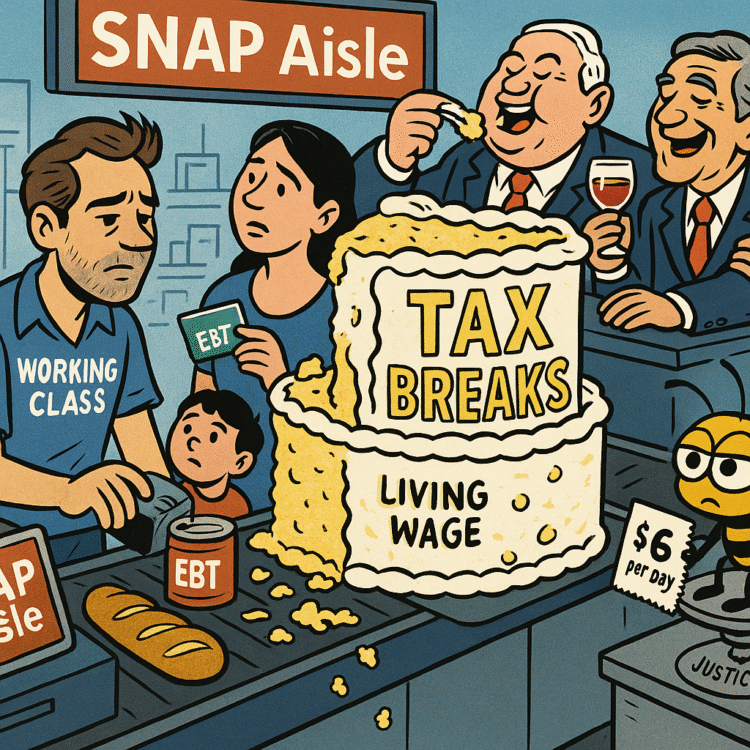
America has a long, proud tradition of punching down. We could have been the country that invented bullet trains or universal childcare, but instead we perfected the art of yelling “Get a job!” at someone carrying a bag of store-brand cereal and a SNAP card. Forty-two million people are on the Supplemental Nutrition Assistance Program, and the national conversation about it sounds like a talk radio caller who just discovered empathy is taxed at 37 percent.
Every few years, a viral post or congressional hearing reminds us that “millions of freeloaders” are buying apples instead of working three jobs like “real Americans.” The talking points write themselves: These people are lazy. They’re gaming the system. They should just budget better. And yet, statistically, most people on SNAP already have jobs. They just don’t pay enough to survive in a country where an apartment costs the same as a used Honda every month.
The myth of the freeloading SNAP recipient is one of the most efficient pieces of propaganda the American right ever produced. It’s how billionaires who pay less in taxes than their gardeners convince the public that the true drain on society is a single mom buying peanut butter.
The Freeloading Worker: America’s Favorite Contradiction
Here’s the cognitive dissonance: most of the 42 million people on SNAP are working adults. They’re stocking your shelves, serving your food, cleaning your offices, and driving your delivery packages. But since the federal minimum wage hasn’t budged since 2009, they qualify for food assistance despite spending forty-plus hours a week being “productive.”
That’s not freeloading. That’s wage subsidizing. Every time you roll your eyes at a “welfare queen,” what you’re really sneering at is corporate welfare—because programs like SNAP effectively let companies like Walmart and McDonald’s keep wages low while taxpayers pick up the grocery tab.
In other words, the real freeloaders are the ones who hold shareholder meetings in the Hamptons while their employees have to apply for EBT cards. But that’s not a compelling Fox News chyron. “CEO Receives Record Bonus, Blames Cashier for Needing Lunch” doesn’t exactly rile the base.
The Disability Loophole (Otherwise Known as Surviving in a Body)
Roughly one in five adults on SNAP is disabled, but you won’t hear that mentioned between congressional hearings about “fraud.” Disability is a dirty word in a culture that worships productivity as moral worth. You can lose a leg, a lung, and your health insurance in this country, and someone will still tell you to “stop being lazy.”
The moral calculus is simple and cruel: if you can’t produce profit for someone richer than you, you’re a burden. You can’t pay rent with your spine? Must be a character flaw. Never mind that Social Security Disability Insurance is a bureaucratic marathon, or that many people waiting for approval die before they’re approved.
SNAP doesn’t just feed the lazy, it feeds the forgotten. The elderly widow who spends $4 on bread and $300 on insulin. The man with a spinal cord injury who needs ten forms to prove he can’t stand at a fryer. But why humanize that when you can show a blurry photo of someone buying ice cream and call it investigative journalism?
The Children Are Freeloading Too
Of the 42 million SNAP recipients, nearly half are children. Half. But even that fact doesn’t break through the national psychosis that equates poverty with moral failure. Apparently, the eight-year-old eating lunch at school should have “picked a better career path.”
You’ll hear a lot of righteous outrage about “the next generation being soft,” often from people whose grandkids rely on free school meals to meet daily calorie requirements. America’s relationship with children is transactional: we love them as embryos, ignore them as students, and shame them as adults for growing up poor.
And so, when conservatives rail against “dependency,” they’re really talking about kids—kids whose parents work two jobs, whose schools run food drives, whose meals depend on a card with a government logo that right-wing pundits treat like a scarlet letter.
“Get a Job, Fatass”
There’s always a layer of contempt disguised as moral advice. “Get a job” is the most common, usually shouted by someone who’s never checked what qualifies for SNAP. The majority of working-age adults who can work, do. They’re in food service, home care, warehouses, and farms—industries that define “essential” when convenient and “unskilled” when not.
“Fatass” is the other half of the insult, because this country loves to moralize hunger and body size in the same breath. It’s how we can starve kids through budget cuts and still shame them for being “unhealthy.” America has weaponized fatphobia into a bipartisan sport: conservatives call it laziness, liberals call it “personal responsibility.” Either way, poor people’s bodies become proof of their moral defect.
And when the inevitable photos circulate of a heavyset person using an EBT card, the comment sections erupt with the same gleeful cruelty: Look at them. Eating our tax dollars. As if metabolic health and poverty weren’t statistically entangled, as if malnutrition, stress, and processed food deserts weren’t policy choices baked into zip codes.
We don’t have a hunger crisis. We have a shame crisis—engineered by politicians who would rather moralize than legislate.
The Real Math
Let’s talk numbers, since empathy apparently needs data to survive.
- The average SNAP benefit is about $6 per day per person. That’s two coffees and a muffin at an airport.
- The program costs roughly 1.6 percent of the federal budget, or about what we spend on military contractors’ “miscellaneous expenses.”
- About 70 percent of recipients are families with children.
- Another 20 percent are seniors or people with disabilities.
- The “fraud rate” hovers around 1 percent. For comparison, corporate tax evasion costs hundreds of billions annually.
So yes, there’s freeloading—but not where you think. The real grift is the lobbying that keeps wages low while shifting the cost of survival to public programs. SNAP is the Band-Aid on a system that prefers bleeding to reform.
The Cottage Industry of Poverty Porn
Every administration trots out its own spin on who “deserves” help. The right paints the poor as lazy. The center-left paints them as pitiable. Both depoliticize the problem by turning hunger into an individual morality play.
Meanwhile, news outlets send cameras to grocery stores to film “luxury SNAP purchases” like shrimp or soda, as if a family celebrating a birthday with real protein were an act of economic treason. The same networks that glorify billionaires buying $200 steaks will run exposés about whether the poor are buying “too much cheese.”
We live in a media ecosystem that treats poverty like a crime scene and billionaires like deities. The system doesn’t need to hide inequality—it monetizes it. Every headline about “welfare fraud” is free PR for the myth that scarcity is self-inflicted.
The Corporate Subsidy Nobody Talks About
The cruel joke is that SNAP doesn’t just serve the poor—it props up the companies that keep them that way. When workers at major retailers or fast-food chains qualify for benefits, it’s a hidden subsidy to their employers. Taxpayers foot the bill so shareholders don’t have to.
It’s a seamless ecosystem: corporations pay starvation wages, politicians slash taxes, and the public covers the difference. Then, the same politicians hold hearings about “waste” and “dependency” while posing in front of campaign banners that read Hard Work Pays Off.
It does—just not for the people doing it.
The Protestant Work Ethic, Now With Bonus Cruelty
At its core, the hostility toward SNAP recipients is theological. America’s moral compass was forged in the flames of the Protestant work ethic, which treats success as proof of divine favor and poverty as evidence of sin. If you’re struggling, you must be lazy, immoral, or both.
It’s why so many conservatives think starvation is an incentive, not a tragedy. “They’ll work harder if they’re hungry,” they say, mistaking Dickensian cruelty for economic policy. It’s the same thinking that defends unpaid internships, at-will employment, and billionaire tax cuts as somehow character-building.
In reality, hunger doesn’t motivate. It debilitates. Try holding down two jobs while rationing insulin or skipping meals so your kid can eat. But that story doesn’t fit the American gospel of bootstrap morality, so we call it “dependency” instead of survival.
The Moral Olympics of Poverty
To be poor in America is to audition for empathy. Every purchase, every calorie, every possession is cross-examined for evidence of virtue. A poor person with a phone is “irresponsible.” A poor person with no phone is “unreachable.” You can’t win, because the game is rigged.
SNAP recipients are expected to navigate a bureaucratic labyrinth, re-certify their poverty every few months, and smile while doing it. Meanwhile, the corporations that benefit from their underpaid labor face fewer audits than a single mother buying cereal.
We don’t test billionaires for drug use before approving tax cuts. We don’t ask defense contractors to prove “need.” But if you want to feed your family, the state will make you jump through hoops just to prove you’re worthy of calories.
The National Hobby of Cruelty
It’s not just policy—it’s culture. Americans have been conditioned to conflate cruelty with fairness. If someone’s getting help, we demand to know why we aren’t. The logic goes like this: If I suffered, you should too.
That’s not morality. That’s trauma bonding.
Every “freeloader” narrative is a confession of national insecurity. We can’t face the fact that the richest country in human history still pays people so little they need food aid, so we invent villains in grocery aisles. It’s easier to blame the poor than the powerful, because the poor can’t sue you for defamation.
The Real Question
The next time someone snarls, “Why are 42 million people on SNAP?” the answer isn’t complicated. They’re on SNAP because America runs on poverty. Because we built an economy where full-time work can’t buy groceries. Because we decided that billionaires deserved tax breaks more than children deserved lunch.
They’re not freeloaders. They’re the labor force that keeps the lights on while billionaires turn the thermostat to 72. They’re nurses, janitors, delivery drivers, caretakers, veterans, grandmothers, and kids. They’re everyone who believed the promise that hard work would pay off, only to find out the fine print was written by lobbyists.
If there’s freeloading happening, it’s at the top. The yachts have kitchens big enough to feed small towns. The private jets get subsidized fuel. The “job creators” get their losses socialized and their profits privatized. And then they go on television to tell you that feeding children is “fiscally irresponsible.”
Closing Section: The Hunger Games Economy
There’s a reason the cruelty feels deliberate—it is. Keeping people desperate makes them compliant. Keeping them divided makes them forget who’s hoarding the feast. SNAP isn’t the scandal. The scandal is that forty-two million people need it in the first place.
We could fix this tomorrow. Raise wages. Tax windfalls. Guarantee healthcare so disability isn’t a life sentence of poverty. Feed kids without attaching moral lectures to lunch trays. But we won’t, because the narrative of “lazy freeloaders” is too profitable.
So we’ll keep circling the grocery aisles of outrage, scolding the poor for buying the wrong kind of food, while the real freeloaders dine in silence behind tinted glass.
And the next time you hear someone sneer, “Get a job, fatass,” remember: they’re not defending fairness. They’re defending a system that needs people to go hungry so it can keep pretending to be free.