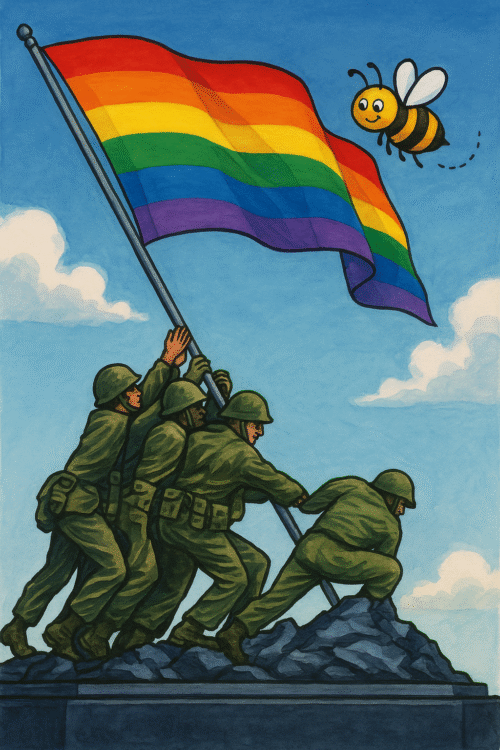
Ah yes. Don’t Ask, Don’t Tell—that beloved Clinton-era gem of half-measure equality. The 1993 military policy that essentially told queer Americans, “You can serve your country, but could you please do it invisibly?” Because nothing says “thank you for your service” like “now lie about who you are, suppress your identity, and don’t you dare hold anyone’s hand.”
The Pentagon’s logic was airtight: openly gay service members might compromise unit cohesion—a phrase that roughly translates to “Chad from Kentucky is too emotionally fragile to hear that his foxhole buddy has a boyfriend.” So, to protect Chad’s delicate masculinity, tens of thousands of Americans were told to zip it, smile, and pretend to be into NASCAR and Hooters while secretly listening to Alanis Morissette in their bunk after lights out.
But sure. Freedom.
The Pitch: Gay Soldiers Welcome (Just Leave Your Identity at the Door)
Let’s be clear: Don’t Ask, Don’t Tell wasn’t progressive. It was an erasure with better PR. It allowed gay, lesbian, and bisexual people to serve—as long as they remained closeted, celibate, and emotionally constipated. A policy so hypocritical it may as well have been co-authored by a televangelist and an ex-boyfriend with commitment issues.
And the military loved it. Because what better way to maintain discipline than to threaten people with discharge if they loved too openly or made eye contact during Fleet Week?
Want to get promoted? Keep your sexuality as hidden as your browser history in middle school.
The Fallout Nobody Talks About
Since its repeal in 2011, the U.S. has been real quiet about the policy’s aftershocks—like a military family ignoring the gay cousin who moved to Portland. But here’s what still lingers in the air like leftover toxic masculinity:
1. Thousands Were Kicked Out—and Still Aren’t Made Whole
Over 13,000 service members were forcibly discharged under DADT, losing pensions, benefits, careers, and dignity—not because they failed in battle, but because they succeeded in being themselves.
Many received dishonorable discharges—a permanent black mark that affects everything from civilian employment to VA health care. Some have never had their status restored, because paperwork is hard and shame, apparently, is easier to ignore than apologize for.
2. PTSD, But Make It Internalized
Serving under DADT meant your biggest threat wasn’t always insurgents or IEDs—it was your own mouth. One slip at the wrong time, and your career exploded faster than the coffee machine in the break room.
Imagine being deployed overseas, dodging bullets, only to be sent home early because someone saw you holding hands with your boyfriend at an Applebee’s during leave. Yes, Applebee’s. That was the line.
Now imagine trying to recover from war while also unlearning the belief that love is dangerous. Because that’s what this policy did—it taught queer service members that honesty equals destruction.
3. The Culture Never Actually Left
Even post-repeal, DADT is still spiritually alive in military culture. Whispers. Eye-rolls. Side-glances in the barracks. Open queerness might be allowed now, but it’s not always welcomed. There are still gay troops who downplay who they are, not because they have to, but because they know better.
Some commanders still “joke” about gay soldiers in the mess hall. Some troops still get reassigned or mysteriously fail evaluations after coming out. Repeal doesn’t erase behavior—it just buries it deeper under plausible deniability and Army-branded Diversity & Inclusion pamphlets.
DADT Wasn’t About Safety—It Was About Straight Fragility
The original rationale for DADT was that open service would harm morale. You know, because straight men might feel weird showering next to a gay guy, which would somehow ruin national security.
You know what really hurts morale? Watching your friend get discharged for kissing someone, while another soldier with multiple DUIs gets promoted because his girlfriend is “technically still 17, but it’s legal in Alabama.”
Also: let’s not pretend straight soldiers don’t spend half their deployment dry-humping each other in group chats or trying to have sex with local civilians. But sure—two men holding hands is the threat.
Susan Collins Syndrome: “I Was Always Supportive, Privately, in My Heart, With My Eyes Closed”
Plenty of lawmakers now say they always had concerns about DADT. Which is adorable. Susan Collins, for instance, would like you to know she was “troubled” by the policy while continuing to vote for every GOP initiative that reinforced it. Kind of like being “troubled” by a house fire while pouring gasoline on it in pearls.
And Joe Biden? God love him, but even he didn’t speak up loudly until it was politically safe. You know who did speak up early? The service members who lost everything. The ones who came out and paid the price so future queer kids could wear the uniform without a secret.
“But It Was a Different Time…”
Oh, was it? You mean the time where Ellen came out, Will & Grace was on network TV, and your grandma had already seen Brokeback Mountain? Cool cool cool. Let’s stop pretending 1993 was the Stone Age and start admitting the policy was never about timing—it was about cowardice, political pandering, and pretending compromise is progress.
Final Salute (To Reality)
Don’t Ask, Don’t Tell didn’t just damage careers. It damaged psyches. It told a generation of queer Americans that they were conditionally American. Useful in war. Disposable in peace.
Even today, many veterans still haven’t received apologies or corrections. Many are still afraid to tell their full stories. And far too many civilians think, “Well, that’s over, so it’s fine now.”
But queer troops still carry that legacy. And they don’t need your rainbow flag in June if they can’t get their discharge upgraded in July.
So if you’re tempted to bring up how the military “isn’t the place for politics,” remember this: forcing people to lie about who they are was politics. And calling that “neutral” was the biggest lie of all.
In memory of every soldier who served under silence.
May we never again confuse tolerance with dignity.
And may we never again write policies with our eyes closed.