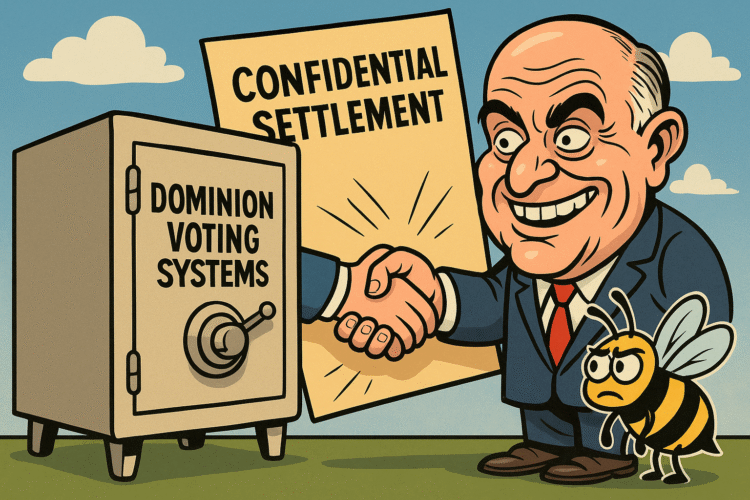
There’s a peculiar magic trick the powerful love: make a noise so loud it draws attention, then vanish the outcome so no one can reverse-engineer the fraud. Yesterday, a mammoth defamation case—one purporting to demand $1.3 billion from a man who spent years amplifying election falsehoods—ended not in a verdict or a sensation, but in a sealed settlement. No admission of guilt. No public record of payment. A federal judge dismissed the case, and the silence left the court dockets echoing with questions.
Once, that magnitude of lawsuit would plant flags: depositions sworn, emails spilled, witnesses kneecapped in the glare of scrutiny. But now? Curtains closed. The hush is the point. We are meant to take away only one thing: power can lie loud and pay light.
The Vanishing Act
You watched for months—or years—as the case wound its way through discovery, motions, subpoenas, fighting over internal documents, swirling accusations of evidence suppression. You saw reporters poring over pleadings, commentary dissecting how a media personality could be sued for defaming a voting-machine vendor.
Then, in a single announcement, both sides claimed “mutual resolution.” Dismissal with prejudice. Terms sealed. No one would say whether money changed hands. No promises disclosed about future behavior or rejections of past claims. You are left with a court order without explanation—like ejecting from a plane without seeing the parachute open.
That’s how you lose—in the absence of public justification.
A Continuum of Concealed Accountability
This silent settlement is not an isolated drama. There is a pattern. Take the giant network that settled for $787.5 million—its name known and settlement terms public. That settlement forced a shift in how mainstream media handles defamation claims, though it didn’t rewire the underlying incentives. Then one of its smaller siblings paid $67 million in a more modest defamation deal. The documents there were partly disclosed, so the public could see what “defamation” costs in reality, not in rumor.
Contrast that with the man now shielded by the hush: a figure whose narrative engineering helped reshape how election lies infect public memory. He’s already walking under the weight of a $148 million judgment elsewhere—one tied to attacks on election workers—and surviving corporate bankruptcy. So why this hush deal now? Because silence scales better.
In the earlier settlements, the public got receipts. Here, all we get is a closing line with no credits.
The Invisible Contract
What might be inside a sealed settlement? Retractions? Or stronger: prohibitions on future claims? Gag clauses? Confidential payments in installments? Somehow, it probably doesn’t read like “I admit I lied.” That’s the secret: the lie remains in the marketplace. Instead, the penalties stay behind legal iron curtains.
You don’t sue a man whose audience you fear. You settle quietly—and you shift damage from public accountability to private ledger. That is disinformation capitalism in full bloom: lie widely, litigate quietly, profit on the silence.
What the Public Never Sees
The documents, internal emails, and negotiations all vanish—no future scholars can unpick the chain. Occasionally a sworn witness leaks under oath, but sealed suits guard the most dangerous internal logic. That means future courts will not view this as precedent. They won’t be able to cite Judge So-and-So’s 150-page denial or reasoning. Instead they’ll face fresh versions of the same claim, with no guidance from this staggering case.
Meanwhile, the people who were threatened, whose reputations were gaslit, whose lives were rolled into the narrative: they’re left with no lecture, no vindication, just the knowledge that the theater stopped and the stagehands took the contract out.
The Business of Lies
We pretend that lies are moral failings. But in the 2020s, lies have become assets. A person amplifies conspiracies, builds audiences, sells books or subscriptions. If someone sues, pay a settlement behind closed doors. The market shows no disincentive. The message is: if you’re loud enough, you can buy erasure.
That economy is dangerous. If settlements become the cost of lying, truth becomes the risk. Speak it, and you may get sued. Lie it widely, and you may pay quietly. That inversion is the engine of disinformation.
The Threat to Democracy Workers
Election officials, local auditors, mechanics who maintain voting machines—they live in the margins. When false narratives congeal around them, they get threats: doxxing, harassment, social media mobs, lawsuits. Their deterrent is institutional support and legal immunity. But when powerful liars can settle quietly, those institutions hesitate.
This hush deal sends a signal: the system may protect powerful amplifiers but not the people doing the work. The next local software verifier, the next election machine technician, sees that lawsuits may hit—but that the liar may vanish into confidentiality when it suits.
Press, Power, and Ethics
For media outlets, this is a test. In past settlements, the public saw the contract terms, the retractions, even editorial apologies. That’s a measure of accountability. But when the deal is secret, the media loses its chance to interrogate. Narrative control vanishes. The public cannot see what was promised or forced.
Some outlets will simply shrug: it’s legal, it’s private. Others will mourn that their profession is reduced to reporting what they can see—not what they must. In a world where courts silence outcomes, the press becomes a museum for truth, not its curator.
Do Settlements Change Behavior—or Just Settle Price?
In theory, large settlements deter future conduct. But only when they sting. When the public sees the damage, the terms, the admission, the behavior shifts. The Fox settlement, partly public, forced editorial caution. The Newsmax deal triggered real policy adjustments in commentary.
But in this sealed deal, the behavior likely doesn’t change. The liar learns: keep lying. If someone pushes it, pay quietly. No watermarks of shame. No altered brand. No court precedents. The risk remains manageable. The model remains profitable.
The Warning Shot to Courts
Lining up charges against a fiction-peddling former agency head has consequences. Courts watching see more than an indictment. They see what happens when the system dares to punish someone prominent. They see how terms vanish, how judgments vanish, how the institution holds no record champions. They observe that the power to indict may be the power to intimidate.
Then comes the frozen aid decision. Then the citizenship petition. Each move tightens the pressure. Judges who dissent may find themselves in future dramas. Judges who comply may find their reasoning unpublished or absorbed into silent precedent. The message is clear: the law is optional—and so is accountability.
The Stage Is Quiet, but the Orchestra Plays
The settlement silenced the case. But it did not silence its meaning. The quiet is itself a roar: you may never know who paid, what was promised, or what lies were granted immunity. That is the price of power in disinformation age.
The public, though, deserves something: not closure, but illumination. When lies are expensive and covenants are sealed, democracy’s ledger becomes encrypted. We end not with a judgment, but with a question: how many more lies will we finance silently?
The Silence That Settled It
A courtroom emptied, a lawsuit vanished, and the lie survives. In an era of disinformation, settlement is not defeat—it’s the comfortable turning of the page. The quiet is part of the story. And when accountability evaporates behind sealed doors, we are left with ghosts in the dockets and questions in the margins. Democracy demands more than quiet endings. It deserves public reckonings.