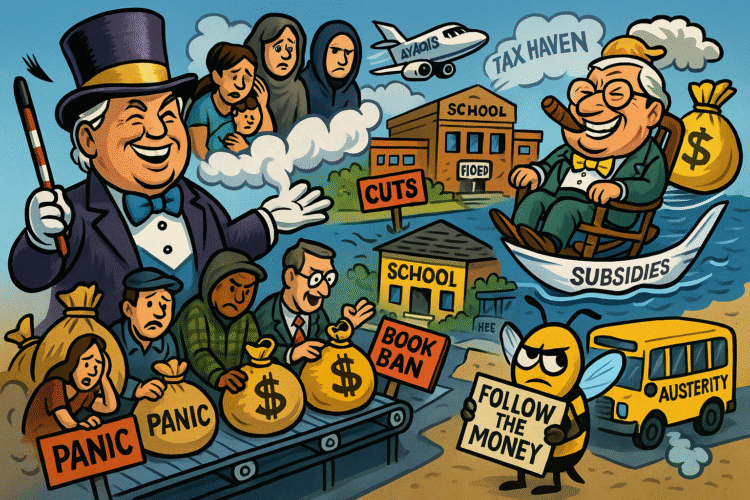
Culture-war noise keeps you busy while antitrust is gutted, noncompetes spread, and public money builds luxury towers.
The Hand in Your Pocket Is Wearing a Cufflink
The oldest magic trick in politics begins with a sigh and ends with your wallet. The sigh is theatrical, “What is happening to our great nation?”, and the wallet is yours. Between those two points, the billionaire and his right-wing courtiers perform a sequence so practiced it should qualify for historical landmark status. First they roll out scapegoats like an assembly line: the poor are lazy, the sick are faking it, immigrants are “pouring in,” queer kids are a menace to bathrooms they do not even use, “urban crime” is a civilization-ending wave that you must fear from the safety of a gated community, and the real problem with wages is that workers want them. Then, while you are busy arguing about book jackets and bathroom signs, they sail the yacht out of the harbor with the treasury lashed to the bow like a figurehead.
It is not even subtle. The trick requires outrage as a spotlight and confusion as a smoke machine. You will be told that a single mom with a SNAP card is the reason your eggs cost more, while the company that controls the shelf space quietly takes another price increase because every competitor agreed to “follow the market.” You will be warned about “welfare queens,” then asked to pick up the tab for a helicopter ride to the shareholders’ meeting. You will hear weeping, on camera, for small businesses, while a law firm is paid to write a bill that makes it illegal for small cities to raise their minimum wage. You will be told that asylum-seekers are picking your pocket, while the real pickpocket is wearing carried interest, capital gains alchemy, pass-through sorcery, depreciation schedules that function like a spa day for assets, and tax credits that reproduce with every stadium ribbon cutting.
The scaffolding is as old as money: divide, distract, deregulate, then disappear the receipts. The divide part you know by its stage names, “law and order,” “family values,” “real America,” “protect the children,” “the border is open,” “welfare reform,” “right to work.” The distract part arrives on time every election cycle, bathroom panics, syllabus panics, library panics, curriculum panics, statue panics, a full season of panic couture. The deregulate part wears a tie and a lapel pin, it says “unleash growth” while it unleashes price gouging, consolidates markets, and teaches executives to call cutting safety “innovation.” The disappear part, my favorite, happens inside offices with excellent coffee, an ad buy here, a think-tank brief there, and a “both-sides” panel that treats tax cuts as freedom and safety nets as addictive. By the time you notice that the numbers do not add up, a respectable person in a respectable suit has explained that arithmetic is socialism.
Scapegoat assembly line, model year forever
We have always had it. In the Gilded Age, the same financiers who stuffed railroads with debt and bribed legislatures hired Pinkertons to break strikes, then called the workers “mobs.” The Southern Strategy taught the modern party how to speak in tax codes and busing routes while everyone heard the siren they were meant to hear. The “welfare queen” was a lie that launched a policy regime, and “welfare reform” did not end hunger, it renamed it. “Urban crime” sells ratings and hires more police while wage theft, quiet and spreadsheet-shaped, exceeds shoplifting every year. Bathroom panics hand out school-board seats and donor reminder emails; they do not deliver a single raise, clinic, or bus line. The immigrant is always the thief in the story, and in the time it takes to argue about it, the monopoly down the road swallows another competitor and cuts shifts.
Meanwhile, the playbook
Fund culture-war outrage to keep wages low, that is step one. It works because people are exquisitely distractible when their dignity is on the table. Next, gerrymander and voter-suppress to keep accountability low. “Election integrity” is a lovely euphemism for picking your own voters. Then deregulate, union-bust, privatize, and financialize to keep profits high. You do not have to hate workers to slow-walk their schedules until they cannot hold a second job and must quit; you can simply buy software that calls it “optimization.” You do not have to hate democracy to redraw it into a puzzle that keeps the same hands on the budget. You do not have to hate the town library to starve it; you can pass property-tax caps and then make speeches about literacy while cutting the librarian’s hours. For finishing touches, launder everything through pay-as-you-go respectability: a white paper from a think tank with “freedom” in the name, an op-ed from a philanthropy that swears charity can handle what public budgets cannot, and a TV segment where a pundit calls a twenty-five dollar wage “radical” while calling a twenty-five billion dollar buyback “responsible capital allocation.”
Divide and conquer in practice
Redlining’s afterlife did not end when the maps went to archives; it migrated into credit scores, zoning, highway placement, and school district boundaries that do the same job with better table manners. Benefits used mostly by the working class, like Medicaid, the EITC, school meals, are recast as handouts to undeserving others, so the plumber and the childcare worker feel insulted by the very programs that stabilize their budgets. Homelessness is criminalized because it is cheaper to ticket the body than to fund the bed. Immigrant-baiting lands because it feels like someone finally named a culprit, and naming is intoxicating; meanwhile a monopsony labor market quietly tells you to take the shift at the wage on offer or go elsewhere where the same three companies set the same three prices. Price gouging is renamed “post-pandemic repricing.” Corporate-friendly antitrust “reform” says we must modernize the law for dynamic markets, and modernize here means watching your town turn into a company store with an app.
The fiscal shell game
Meet the regressive tax code dressed up as opportunity. Payroll taxes show up with perfect attendance; capital gains drift in when convenient. Carried interest, that elegant costume, lets income pretend to be investment so it can glide past the toll booth. Step-up in basis, the trust-fund amnesia cure, ensures that appreciation gets a baptism before it meets the tax man. Offshore havens do the rest, the profits take a vacation and forget to come home. Onshore, stock buybacks now outstrip R&D and wages because boosting the quarter is the only doctrine that still pays. Austerity for schools and clinics is paired with subsidy fountains for stadiums and luxury towers. A mayor who swears there is no money for bus routes somehow finds a nine-figure check for luxury boxes, because that money returns as campaign ads about “economic development” and a plaque with a donor’s name.
History provides the receipts. Gilded Age strike-breaking, where private armies and local sheriffs converted grievances into funerals. The Southern Strategy’s scapegoats recoded into policy. “Welfare reform,” marketed as tough love, which did not end hunger. The post-crisis bailout-to-bonus pipeline, where institutions saved by the public returned, unblushing, to distributing windfalls at the top. Today’s version is simpler: record corporate margins alongside food-bank lines, meritocracy speeches delivered from trust funds, zero-dollar tax bills for mega-firms while municipalities cut bus routes and ask teachers to buy their own crayons. If you feel like you are being asked to clap for your pickpocket, you are paying attention.
Social politics as smoke for class extraction
Book bans thrive while library budgets crater. “Family values” signs gleam while child poverty spikes the moment refundable tax credits lapse. “Law and order” ads flood the air while wage theft quietly takes more than all robberies combined. “Free speech” absolutism, in practice, means your boss can fire you for organizing, your city cannot pass a wage floor, and your protest requires a permit that never arrives. This is how you turn neighbors into antagonists: pit them against each other in moral panics while the top one-tenth of one percent attends a policy retreat where the dress code is “business casual, bring your legislator.”
Mechanisms of control, lovingly disguised as efficiency
Noncompetes that forbid you from using your own hands a mile down the road. Algorithmic scheduling that produces lives in fifteen-minute increments and calls them flexible. Union-busting consultants who train managers to say “we are a family,” then pull the fire alarm every time a union card appears. “Independent contractor” rebrands that convert payroll obligations into press releases. State preemption laws that block cities from protecting their own, no sick leave, no local wage floors, no rent stabilization, because someone’s statewide donor dislikes local democracy. Philanthropic “solutions” that privatize policy, a glossy collaboration to “reimagine” public safety without funding public housing, a challenge grant for “breakthrough education” that demands the district close libraries to match the gift. All of it paired with nondisclosure agreements, arbitration clauses, and a corporate culture that praises “grit” while designing turnover as a feature, not a bug.
Now the satire, because sometimes the only way to say it is to laugh before we stop.
Behold the billionaire who tells you to fear the asylum-seeker while his company pockets public subsidies, tax abatements, and discounted land deals that would fund a clinic on every corner. He warns that newcomers are a drain while his lobbyists hunt for more visa exemptions, more guest-worker programs, and more ways to price labor like a commodity on the dock. He funds a group that screams about “dependency,” while his firm stakes a stadium deal whose profits depend on municipal bonds and field trips canceled so the city can service debt.
Behold the pundit who calls a twenty-five dollar wage “radical,” then calls a twenty-five billion dollar buyback “normal.” Labor costs, she says, will trigger doom; capital returns, she says, prove health. She will ask whether the working poor truly “deserve” a living standard, then shrug as a chief executive collects a package large enough to buy the county fairgrounds. She is not confused. She is fluent in a dialect where “discipline” applies only downward.
Behold the governor who rails against “dependency,” never once pointing at crop insurance, defense contracts, mortgage interest deductions, accelerated depreciation, pass-through loopholes, or the disaster aid he requests with both hands the minute a hurricane walks onto his coastline. He flies to Washington to condemn Washington and leaves with earmarks in a carry-on. He is a subtle man, meaning he can hold two checks at once.
Behold the CEO who insists that “no one wants to work,” while posting record margins created by too few competitors and a price increase that every rival followed. He calls fraud on a cashier who takes home a stapler, then calls efficiency on a merger that lets him dictate the price of bread. He testifies that regulations are strangling his industry, then spends eight figures to purchase the rulebook.
Outrage is easy, which is why it is part of the trick. The antidote is not catharsis; the antidote is counter-infrastructure, the dull scaffolding that lets ordinary people bargain with real leverage and starves the trick of oxygen.
Worker power
Start with the obvious. Make it possible to form a union without a psychological warfare campaign against your coworkers. Card-check recognition ends the game where signatures mysteriously evaporate between HR and the counting room. Sectoral bargaining lets whole industries set floor standards so decent firms are not punished for paying decently. Ban captive-audience meetings. End the tax deductibility of union-busting consultants. Ban noncompetes that tell a dishwasher he owes fealty to the plate.
Pro-competition enforcement
We need antitrust with a memory, which is to say antitrust that remembers people. Stop mergers designed only to reduce headcount and raise prices. Break up gatekeepers that are vertically integrated enough to decide which supplier lives and which neighborhood gets stuck choosing between two monopolies. End no-poach arrangements in franchise systems that trap wages where they are. Treat algorithmic price-setting as cartel behavior when it walks and quacks like one; the math does not cleanse the collusion.
Progressive taxation tied to visible public goods
People will pay when they can see what they bought. Top marginal rates belong where they belong, above the level of “I own a small country.” Tax capital gains like labor. Close step-up in basis so inheritances stop evading history. End carried-interest cosplay. Then spend the money on things adults can point to, child care that lets people work, transit that gets them there without a car note shaped like a second rent, housing built in the price bands where humans live, school meals that turn children into students instead of blood-sugar experiments, clinics that make “preventive care” something other than a brochure. You want to fix the narrative about taxes, make the bus come every six minutes and the nurse practitioner’s line disappear.
Universal programs that defang stigma
When everyone gets it, no one is shamed for needing it. Medicare taught this lesson, public school did too. Cash supports for families, call them child allowances or refundable credits, drop child poverty like a rock because reality is not partisan. The second you condition help on moral purity, you hand the scapegoaters an anvil.
Democracy hygiene
Independent redistricting so politicians stop picking voters like fruit. Automatic registration so participation is not a bureaucratic obstacle course. Robust early voting and vote-by-mail so a sick day does not disenfranchise a shift worker. Bans on dark money so the public can see who bought the ads that explain there is no money for the thing the donor hates. Enforce anti-corruption rules with budgets that match the problem, not with auditors who bring a teaspoon to a flood. The goal is not sainthood. The goal is friction for the purchase of referees.
Re-public things that were never markets to begin with
Build public broadband where monopoly carriers refuse to build. Treat child care like the essential infrastructure it is. Fix zoning that became a velvet rope for the already-housed. Public options break the extortion loop. When you can get decent service without kneeling to the last firm standing, the last firm standing remembers how to compete.
This all sounds unsexy, which is a feature. The opposite of a culture war is a budget hearing that ends with buses that run, cases that close, kids who eat, and jobs that pay. You cannot meme your way to a clinic; you fund it. You cannot rant your way to a wage; you bargain it. You cannot ban your way to literate children; you hire librarians. The culture-war carnival only ends when the audience walks out to make dinner, and discovers that dinner is more affordable because someone, somewhere, chose to regulate, tax, and invest with a bias for the many.
Let us retire a few myths that keep the trick alive.
Myth one, the market will sort it out. The market is a marvelous allocator of sneakers. It is a terrifying allocator of insulin, child care, and elder care. When the inputs are human beings, markets do what they do best, they price scarcity, and the results are horrifying unless law insists on conditions, floors, ceilings, and exits. Unfettered “choice” in a monopoly is not freedom. It is cosplay in a company town.
Myth two, charity can replace government. Charity is beautiful; it is also seasonal, partial, and biased toward ribbon cuttings. It does not pave roads or insure risk across a lifetime. Philanthropy can complement public goods; it cannot substitute for them without privatizing the soul of policy, which is accountability. You cannot vote out a donor.
Myth three, growth first and fairness later. Later is a country you never reach. Growth without guardrails gives you bubbles, bailouts, and an economy that can brag about GDP while half its households cannot weather a four-hundred dollar emergency without crowdfunding. Workers are not cost centers, they are the economy. A raise is not a favor; it is the transaction working as advertised.
Here is the blunt thesis, unpopular in rooms with chandeliers, perfect for kitchen tables. A country that blames the powerless and worships the altar of greed gets exactly what the altar demands, harsher laws for the hungry, softer laws for the rich, and a politics that turns neighbors into enemies so nobody looks up at the penthouse. The joke lands only if we keep laughing. We should stop. Reframe “class warfare” as a ceasefire on the bottom and a long-overdue audit at the top. The shortest path from baffled to better is embarrassingly simple, follow the money, fund the commons, and stop mistaking the hand pointing at immigrants for the hand in your pocket.
If you want a mock-serious action plan to tape to the fridge, here is mine, shaped by optimism that has been scuffed by time.
One, every budget is a moral text. Read it out loud. Ask who pays, who benefits, and what each line item does in human lives. If “efficiency” means cutting the bus that gets the night shift home, the math is lying.
Two, count the theft you are trained not to see. Wage theft exceeds shoplifting by a canyon, but only one of those has screaming segments on cable news. Price fixing in boardrooms steals more than porch thieves. The cops with spreadsheets, the antitrust lawyers and wage-and-hour inspectors, deserve parades.
Three, insist on visibility. Universal school meals, posted wage floors, inspection scores on the door, Medicare prices on the website, and a public portal for subsidies so citizens can see the scale and demand the terms. Secrecy is not a market; it is an invitation.
Four, make it easy to say yes to decency. Automatic union elections when a threshold is crossed. Automatic voter registration at sixteen with activation at eighteen. Default savings with opt-out rather than opt-in. A guaranteed seat on the bus every ten minutes so choosing transit is not martyrdom.
Five, stop buying moral panics at retail. If a politician screams about a syllabus while voting against school lunches, you have identified smoke. If a donor funds a “parental rights” group while underwriting a lobbying campaign against paid leave, you have identified motive. If an anchor cannot say “wage theft” but can say “shoplifting” five times a minute, you have identified programming, not journalism.
The oldest magic trick only works because we keep looking where the magician points. The fix is embarrassingly adult. Look at the other hand. The one with the cufflink, the carried-interest carve-out, the deed to public subsidies, the noncompete clause, the memo to HR about “scheduling flexibility,” the speaking fee for a talk about “personal responsibility” delivered from a trust fund. Then do the things that hands hate, count, disclose, tax, bargain, and build.
I am not proposing a revolution, I am proposing a renovation, the kind where the building stays open during improvements and the tenants finally see their rent buy something other than leaks. Worker power is caulk, antitrust is a beam, progressive taxation is plumbing, universal benefits are insulation, democracy hygiene is the lock on the door. It is not glamorous. Neither is a roof that does not leak. Roofs keep you alive, and glamour is a terrible umbrella.
What would it feel like if we stopped letting them run the same play. Boring at first, then safer. A city where the bus is so reliable that the car becomes optional. A school where the librarian does not spend lunch writing grants for hand soap. A clinic where the nurse practitioner is not a rumor. A workplace where a raise does not require a viral video. A news diet where the segment on books is about stocking them, not banning them. A politics where “freedom” means the freedom to live a life not budgeted by a price-gouger and a slumlord.
The hand in your pocket has had a great run. It learned to point at people you could see and blame them for the ache you felt. It learned to make you choose between your dignity and your neighbor. It learned to call theft “discipline” and charity “solution.” It learned, above all, to call the oldest extraction in the world inevitable.
It is not. The counter-magic is older still. Put down the smoke, pick up the receipts, and follow them home. Then do the most subversive thing an electorate can do, fund the commons and starve the panic. The yacht will still sail. For once, the harbor will belong to the people who built it.