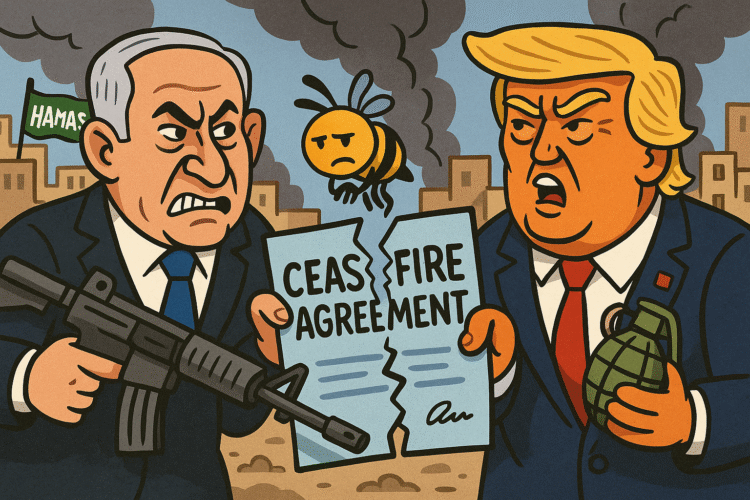
Welcome to “Peace as Spectacle, Round Two.” The ceasefire’s first act produced something concrete: all 20 living Israeli hostages were handed over, hundreds of Palestinian detainees released, IDF pullbacks commenced, and aid convoys began crossing. But now the sequel begins, with disclaimers: Netanyahu insists that Hamas must “give up its arms or all hell breaks loose.” Trump promises, “If they will not disarm voluntarily, we will disarm them.” A bold claim, delivered amid real progress—and dangerous fragility.
Because what matters next is not whether the ceasefire holds for a week, but whether it can survive the absence of miracles, the insistence of spoilers, and the slow work of governance. The real terrain lies in tunnels, verification, fuel, policing, and the trust that no one will use the lull to reload.
“Clear Conditions,” Blurry Realities
Netanyahu’s line—“the conditions are very clear”—sounds like the final stage direction in a tragedy. But the conditions slide like grease. What counts as “arms”? What counts as “disarmament”? If a tunnel system exists beneath Gaza like some subterranean subway, does that count as a weapon?
The Israeli demand is sweeping. Hamas must not only relinquish rockets, but surrender internal policing authority, rein in its fighters, and submit to third-party oversight. All while aid flows in, infrastructure begins repair, and destroyed districts brace for resettlement.
Meanwhile, Trump’s statement is theater masquerading as diplomacy: “We will disarm them.” The confidence is cinematic. But execution demands boots, reconnaissance, verification, funds, and someone credible to enforce it. In this moment, rhetoric now hinges on the credibility cliff edge.
The First Act: Hostages, Releases, Pullbacks
The first phase had its moments of genuine progress. Hostages handed over via the Red Cross. Detainees bussed back into Gaza and the West Bank. IDF forces withdrawing from urban zones. Aid convoys making routes.
That was the easy part—or the part visible under spotlight. The difficult, hidden work now begins: sequencing. Aid cannot arrive until checkpoints open. Pullbacks cannot proceed until certain zones are secured. Prisoner releases depend on verification.
The public sees buses, embraces, photos. The back rooms see smoke tests, legal drafts, secret corridor negotiations. The contrast between frontstage drama and backstage stress will define whether peace is novelty or narrative.
Hamas, Tunnels, and the Authority Vacuum
But Hamas leadership is already signaling resistance. Weapons aren’t symbolic; they’re existential to their standing. To relinquish arms is to risk being dominated, ousted, or carved up by rival factions.
Tunnel networks remain a central dilemma. Some serve smuggling, others harbor fighters. Israel insists that unless they’re neutralized, Hamas retains its deep-strike capacity. That’s not just a security ask—it’s a demand for structural surrender.
Meanwhile, Hamas will control streets, hospitals, reconstruction bodies, local police. If they cannot reconcile that authority with demilitarization, they risk internal revolt or irrevocable contradiction. The risk: they declare the ceasefire a courtesy, not a constraint.
Verification & Monitoring: The Hope and the Trap
Third-party monitors are the linchpin. They must inspect tunnels, count weapons, audit claims of withdrawal, oversee aid distribution, and adjudicate disputes. They are peace’s foot soldiers.
Yet monitoring is a monstrous task in a war zone. Who staffs these teams? Which nations become judges? What access rights do they have? What happens when one side accuses the monitors of bias or obstruction?
If monitors get blocked, delayed, or delegitimized, the ceasefire’s scaffolding collapses. Worse, every new accusation of violation becomes political theater, not proof. Peace doesn’t scale without credible third-party muscle—and muscle costs political credibility.
Aid, Infrastructure, and the Timing Gamble
Gaza is a ruin. To stabilize any peace, hospitals must reopen, power lines repaired, water systems restored, bridges rebuilt. The temptation is to promise too much, too early, and then break faith.
Aid agencies are already pressing for more crossings, fuel, and fewer checks. But each entry point becomes a security puzzle: who guards, who monitors, who taxes?
If fuel stalls or supplies slow, civilians starve. The vacuum fills with desperation—not just from conflict, but from absence of governance. When people see trucks full of medicine turn back, faith drains faster than infrastructure.
Policing, Governance, and the Postwar Authority Contest
Who polices Gaza during this lull? Not Israel. Not donors. Not even the U.N., at least not without local buy-in. That leaves Hamas, civic actors, and militant factions to negotiate control.
Salaries must be paid. Border control must be secured. Municipal services must work. If those fall apart, community leaders or militias fill the gap. That is how war returns by default.
The great irony: disarmament demands centralized authority—but centralized authority demands coercive capacity. The governance plan must thread that needle—or it ceases to be a plan at all.
Political Turbulence & Spoiler Incentives
In Jerusalem, Netanyahu’s coalition is fragile. Every delay or perceived softness invites rebuke from hawks. Cabinet ministers may press to re-militarize if the deal shows cracks.
Within Hamas, rival commanders and local factions eye gains. If the truce makes the leadership too dependent on oversight, the conservators inside Hamas might seek paths to rearm clandestinely.
Arab capitals, regional states, global powers—every actor watches to see whether the U.S. keeps funding, whether donor promises deliver, whether verification maps devolve into theater. If one country backs away, the pressure grows on all.
The Dilemma of the Sound Bite
Trump and Netanyahu will again view peace as a photo op. The temptation: declare “truce achieved” before the trenches are cleared. They will treat staging as substance, optics as outcome.
But the real test is not the words—they have used them before—but the work. Verification, policing, reconstruction, diplomacy: these demand staff, money, legal mandate, and international backing.
If their next press statement says “war is over” but every aid convoy stalls, every border checkpoint remains closed, and rockets resume, the peace will be exposed as branding, not basis.
Will Disarmament Be Enforced—or Evaded?
This is the ultimate question. Will Israel simply pause and wait? Will Hamas secretly retain hidden arms? Will verification be precise—or a paper exercise?
The danger: that both sides treat their duties as optional—Israel withholding further pullbacks, Hamas preserving hidden arsenals. In that scenario, the ceasefire becomes delay, not solution.
A war doesn’t resume with a bang; it often returns with whispers, missteps, deliberate ambiguity, and spoilers testing limits.
The Families, the Remains, the Unreturned
Amid glossy news photos, the families of those who died or remain unreturned await remains, breakable promises, unfinished mourning. The ceasefire treaties include language on return of remains and honoring final requests.
But remains take forensic work, identification, secure transfer. Any delay is agony. Any broken timeline is despair.
For those freed hostages, trauma, debriefing, rehabilitation, and justice demands more than spectator diplomacy. Their lives will pull the peace into human scale.
What We Watch—and What We Lose
In the coming weeks we will watch:
- Whether Israel honors aid, pullbacks, and corridor promises if disarmament stalls
- Whether Hamas begins consolidation, suppression of dissident factions, or clandestine rearming
- Whether European partners face credibility tests over inspectors, forensic authority, and funding
- Whether families of deceased hostages receive remains on schedule
- Whether Washington turns sound bites into rules, funding, oversight, and staffing
If verification lags or funding stalls, if spoilers rearm or optics supplant institutions—then the “war is over” narrative will droop under its own weight, and the region may tumble back into raids, reprisals, and ruin.
Conclusion: The Peace That Must Be Enforced
The first chapter of the Gaza ceasefire played like a political miracle: hostages freed, detainees released, aid convoys moving. But miracles don’t make peace. Peace demands sustained enforcement, humility, policing, oversight, and rebuilding.
Netanyahu’s “clear conditions” and Trump’s “we will disarm them” may rally headlines, but whether they become policies depends on invisible architecture: monitoring, sequencing, verification, accountability, and law.
If that architecture fails, the ceasefire will read not as a new era but as a pause—a breathing space for power to rearm or collapse.
In the end, peace is not the absence of war; it’s the presence of justice, administration, and trust. The israel-Hamas conflict will teach us whether a truce can mature into governance—or whether “peace achieved” was always the softest lie.