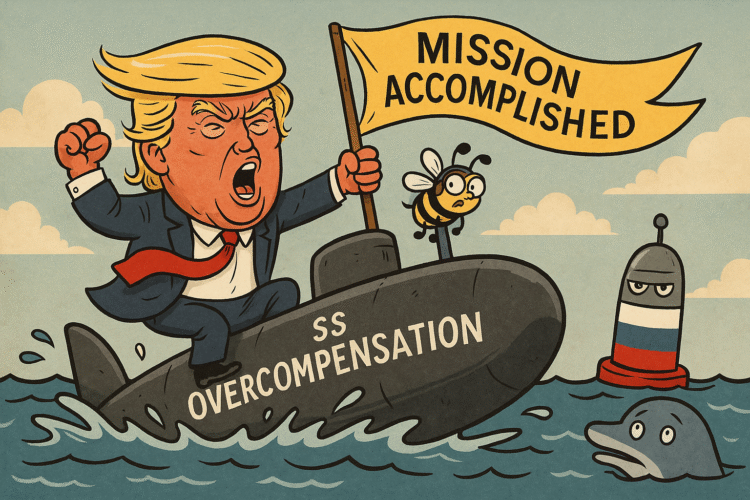
In a turn of events that could only be described as “textbook masculine fragility but with submarines,” former President Donald J. Trump has responded to a so-called “highly provocative” statement from Russia not with diplomacy, nor with tact, nor even with a sharply worded tweet—but with the deployment of two nuclear submarines.
Because nothing says “measured response” like hurling $6 billion worth of stealth warheads into the ocean because someone bruised your ego across a time zone.
Let’s back up. The provocation in question? A vaguely condescending remark made by a Russian defense spokesperson who reportedly described Trump’s previous comments on NATO as “erratic and historically inaccurate.” In diplomatic terms, that’s basically the equivalent of being called “unserious” in a group chat.
But to Trump, it was war. Or at least the theatrical suggestion of war—a posture of performative retaliation served lukewarm on a plate of delusion and national insecurity.
So, in the grand tradition of white men turning mild criticism into apocalyptic theater, he did what any twice-impeached reality star with nuclear access and a chip on his shoulder might do: He reached for the subs.
“We have sent two of our best submarines—very powerful, the best in the world, everyone says so—into strategic position,” Trump announced from a makeshift podium at Mar-a-Lago, flanked by gold drapes and an American flag that looked like it had been purchased at a Bass Pro Shops clearance sale. “They are beautiful, beautiful submarines. Russia will be thinking very carefully about what they say next.”
Yes. Submarines. Because when someone questions your foreign policy acumen, the correct response is to trigger a geopolitical pissing contest beneath 10,000 feet of saltwater.
According to administration insiders (which is now a phrase that mostly refers to whichever waiter is still under NDA at the Mar-a-Lago omelet bar), the decision was made after Trump misheard the term “nuclear option” during a Fox News segment and demanded to know where “our underwater nukes” were. When advisors tried to clarify, he reportedly asked, “Can we park them under Moscow or nah?”
To be fair, it’s hard to tell whether this move was meant to deter aggression or just distract from a bad news cycle. Earlier that same day, leaked audio captured Trump confusing the Geneva Conventions with the Michelin Guide and referring to Ukraine as “the country with all the blondes and the big problems.”
In other words: he needed a win. And nothing spells ‘victory’ to the MAGA base like ambiguous military flexing—especially if it happens underwater, where no one can check the math.
Of course, the Pentagon is scrambling. Privately, defense officials have described the order as “deeply unserious,” “logistically nonsensical,” and “yet another Thursday.” One unnamed official remarked, “The subs aren’t even fully staffed. We had to call in two guys from SeaWorld to round out the crew. One of them thought sonar was a cryptocurrency.”
Still, the subs have been deployed. Silent. Lurking. Possibly fueled by Red Bull and unresolved daddy issues. One assumes they’re circling somewhere between posture and parody, the way most Trump policies do.
And Russia? Predictably unmoved. Kremlin spokespeople issued a statement calling the deployment “predictable bluster” and “a waste of diesel.” In an unverified post on Telegram, one Russian official wrote, “It’s like being threatened by a man waving a Nerf gun and screaming about crowd size.”
Meanwhile, back in America, Trump’s base is ecstatic. “He’s showing strength!” declared one supporter outside a Cracker Barrel in Tallahassee. “Biden would’ve sent an email. Trump sends submarines.” Another chimed in, “I don’t know what a submarine is, but I like that it’s under things. Real American.”
This, in the end, is the secret sauce of Trump’s political theater: gesture over substance, spectacle over strategy. Where previous presidents measured their words to avoid escalation, Trump measures his ego—and acts accordingly. If a world leader calls him unstable, he shows them just how unstable he can be. It’s less diplomacy, more drunk text with a weapons budget.
And that’s the legacy he’s gunning for: not peace, not progress, but presence. Loud, shimmering, submersible presence. The message is simple and profoundly unhinged: If you say something mean, I will literally surface a war machine off your coast and call it patriotism.
It’s hard to tell whether history will see this moment as a joke, a warning, or the cold open of World War III. But if it’s the last one, rest assured it will begin not with a bang—but with a press conference held over shrimp cocktail and an upside-down American flag.
Final Thought:
The world may be teetering on the edge of crisis, but at least America is consistent. When given the choice between rational diplomacy and chest-puffed theater, we’ll always go with the man in the red tie, screaming into the sea.