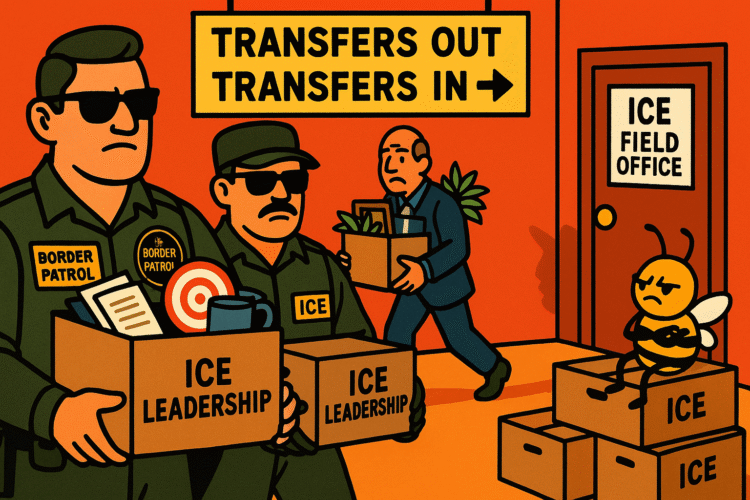
Every administration has its signature moment of bureaucratic chaos—the thing historians will point to and say, ah yes, that’s when the clown car caught fire. For Trump 2.0, that moment has arrived in the form of a mass decapitation inside ICE, where up to a dozen field office chiefs are reportedly being removed or reassigned in a nationwide purge so theatrical it might as well have a live studio audience.
The move, sources confirm, is being orchestrated by Corey Lewandowski—the eternal campaign aide who seems to function as Trump’s bad idea whisperer—and carried out by Border Patrol Commander Greg Bovino, a man whose tactical playbook reads like The Fast and the Furious rewritten by Joe Arpaio. The plan? Replace seasoned Immigration and Customs Enforcement officials with Border Patrol hardliners to “ramp up deportation numbers.” Because nothing says administrative reform like firing the managers and giving the security guards the keys to the prison.
The message is clear: efficiency is out, spectacle is in.
The Great Deportation Renaissance
Let’s begin with the premise of this shakeup: deportations, but faster, louder, and preferably in front of cameras. According to multiple DHS sources, the president’s inner circle believes ICE has gone soft. The agency, they complain, has spent too much time targeting “the worst of the worst”—violent offenders, fugitives, and people with final deportation orders—and not enough time scaring the living daylights out of everyone else.
Under the old model, ICE agents would spend weeks conducting surveillance, verifying addresses, identifying high-risk suspects, and planning safe arrests. It was clinical, methodical, and, in bureaucratic terms, boring. But under the new Border Patrol-inspired model, who needs preparation when you can stage roving patrols at Home Depot and call it counterintelligence?
Trump’s Border Czar Tom Homan and ICE Director Todd Lyons reportedly prefer the old approach—precision over chaos—but they’ve been sidelined by the Lewandowski-Bovino faction, which sees every immigrant as a headline waiting to happen. The result is a Department of Homeland Security at war with itself: the cops versus the cowboys, the spreadsheet class versus the selfie squad.
Corey’s Commandments
Every Trump-era crisis has its high priest, and in this one, it’s Corey Lewandowski. If there’s a man less qualified to manage immigration policy, he’s probably already been nominated to lead FEMA. Lewandowski, who has all the subtlety of a bullhorn at a funeral, has been pushing an agenda of “total enforcement”—a phrase that sounds less like public policy and more like a lost Schwarzenegger movie.
He’s reportedly working hand-in-glove with DHS Secretary Kristi Noem, whose political instincts can be summed up as “whatever polls well in Sioux Falls.” Together, they’ve greenlit a plan to merge ICE’s precision raids with Border Patrol’s shock-and-awe tactics, creating an agency hybrid that might as well be called ICE Patrol: Civil Rights Edition.
According to senior officials, Lewandowski’s directive is simple: “numbers over nuance.” Deportation statistics are to be treated like quarterly earnings, and anyone who can’t deliver gets replaced. It’s the Uberization of immigration enforcement—just with fewer background checks.
Meet the New ICE, Same as the Old Border Patrol
The names being floated to replace the ousted ICE field directors are pulled straight from Bovino’s own command roster: Border Patrol officers known for aggressive tactics, social media flair, and a mutual disregard for federal injunctions. Los Angeles, Phoenix, Philadelphia, Denver, El Paso, San Diego, Seattle, Portland, and New Orleans are all on the list.
This is not a game of musical chairs; it’s a full-on genre swap. ICE traditionally operates like a surgical team, guided by intelligence and paperwork. Border Patrol operates like an adrenaline sport. Handing over ICE field offices to Border Patrol veterans is like firing the accountants and putting the demolition crew in charge of payroll.
The results are already visible. Agents have been spotted conducting “roving patrols” at construction sites, car washes, and flea markets—operations so chaotic that federal judges have issued injunctions against them. The now-infamous Los Angeles Home Depot sting, where agents hid inside a rented Penske truck like some dystopian Trojan horse, was reportedly Bovino’s brainchild.
ICE officials hated it. The internet loved it. Bovino got promoted.
The Optics Olympics
It’s not that the administration doesn’t understand optics—it’s that they’ve decided optics are policy. In Trump’s America, perception is governance. Arrests are camera ops. Deportations are ratings boosters. Everything is branding.
ICE used to be the villain in activist circles but invisible to most Americans. Now, Border Patrol has stolen the spotlight by turning enforcement into performance. Videos of agents in tactical gear swarming parking lots are catnip for the president’s base, proof that the campaign promise of “mass deportations” isn’t just rhetoric—it’s reality TV.
Inside DHS, though, the mood is less celebratory. “We’ve lost our focus,” one official told a reporter on background. “It’s getting numbers, but at what cost?” The answer, of course, is legality, oversight, and the illusion of moral restraint.
Border Patrol agents, meanwhile, are unapologetic. “What did everyone think mass deportations meant?” one agent asked rhetorically. “Only the worst? Tom Homan said it himself—anyone here illegally is fair game.”
When enforcement becomes entertainment, fairness is the first casualty.
Bureaucracy as Blood Sport
The deeper irony is that both factions—ICE traditionalists and Border Patrol maximalists—want the same thing: more deportations. The difference lies in their methods. ICE prefers chess; Border Patrol prefers dodgeball with live rounds.
The friction isn’t ideological; it’s aesthetic. ICE sees itself as a law enforcement agency. Border Patrol sees itself as a movement. The former values due process. The latter values body counts. And under Trump 2.0, the movement always wins.
The current shakeup isn’t about competence; it’s about loyalty. In this administration, the surest way to get fired is to take your job description literally. The surest way to get promoted is to make chaos look patriotic.
When DHS insiders talk about “performance-based” reassignments, what they mean is: you didn’t break enough doors.
Greg Bovino: The Cowboy Bureaucrat
Commander Greg Bovino has become the cult hero of Trump’s immigration revival. To his supporters, he’s a maverick, unafraid to “take the gloves off.” To his detractors, he’s a lawsuit magnet in mirrored sunglasses. Either way, he’s now the de facto architect of American immigration policy.
Bovino’s signature tactic is the ambush raid: surprise sweeps at public gathering spots, “rolling” patrols that blur jurisdictional lines, and creative disguises like moving trucks. His defenders call it efficiency. His critics call it entrapment. Federal judges have called it unconstitutional.
But the president calls it “results.” And in Trumpworld, that’s the only credential that matters.
Bovino’s rise illustrates the administration’s core philosophy: if something looks tough on camera, it must be working. Forget oversight. Forget proportionality. Forget the Constitution. If it bleeds—or in this case, bleeds ratings—it leads.
The DHS Hunger Games
Inside the Department of Homeland Security, morale is reportedly “volatile.” ICE agents are watching their leadership disappear overnight. Border Patrol officers are suddenly their bosses. The rank and file are caught between career survival and moral exhaustion.
Tom Homan and Todd Lyons are trying to hold the line, insisting that ICE must remain “targeted” and “prioritized.” But the word “prioritized” is a death sentence in Trump’s Washington—it sounds too much like thought.
Kristi Noem and Corey Lewandowski, meanwhile, are pitching this as “streamlining.” It’s the kind of streamlining that replaces process with panic. In their view, ICE’s biggest problem isn’t legal risk—it’s insufficient enthusiasm.
Even the official statement to Fox News was a masterpiece of doublespeak: “While we have no personnel changes to announce at this time, the Trump Administration remains laser-focused on removing violent criminal illegal aliens.”
Translation: we’ve fired everyone and replaced them with a tank.
Lawsuits on the Horizon
The lawsuits are already piling up. Civil rights organizations are challenging the legality of roving patrols in cities that were never supposed to host them. Federal courts have repeatedly warned the administration about overreach, but injunctions mean little when enforcement becomes theater.
Border Patrol’s mandate has always been limited to border zones and checkpoints. Expanding its role into ICE’s interior enforcement turf isn’t just mission creep—it’s mission stampede. The American Civil Liberties Union has already signaled it will sue. So have state attorneys general. So have several cities.
But for this administration, litigation is part of the business model. Court losses double as campaign talking points. Each injunction is proof of persecution. Each settlement is rebranded as victory. They’re not governing—they’re live-streaming martyrdom.
The Shutdown Backdrop
This bureaucratic bloodbath is unfolding against the backdrop of a government shutdown nearing its fourth week. Hundreds of thousands of federal employees are furloughed or working without pay. Airports are understaffed. Food inspections are delayed. National parks are closed or vandalized.
And yet, the White House insists the chaos is productive. “We’re delivering results,” a spokesperson declared, as if unpaid TSA agents were a sign of progress. In a normal government, this would be considered crisis management. In this one, it’s branding.
To Trump’s team, the shutdown isn’t an embarrassment—it’s leverage. The country’s suffering is collateral damage in a hostage negotiation with itself. DHS is simply the latest theater of cruelty.
The Numbers Game
At the heart of this reorganization is a fetish for numbers. Deportation statistics have become the administration’s GDP, the single metric by which it measures its success. But not all numbers are created equal. ICE’s old metrics were based on case complexity, prioritization, and legal sustainability. Border Patrol’s new metrics are based on volume, optics, and adrenaline.
In a system like that, wrongful arrests aren’t bugs; they’re features. The more indiscriminate the sweeps, the higher the count. It’s not about who gets deported—it’s about how many.
The irony is that the more aggressive the tactics, the worse the long-term results. Courts overturn sloppy cases. Detainees disappear into a bureaucratic maze that drains resources. Public backlash builds. But those consequences happen later, off-camera. And in Trump’s America, the only sin is low engagement.
The Political Math
This is, ultimately, a political maneuver disguised as policy. With midterms looming, the administration wants to deliver a visual—a sea of uniforms, trucks, and “perp walks” to prove the promise of mass deportations wasn’t empty.
They don’t need the policy to work. They just need the footage to roll.
Republicans will call it strength. Democrats will call it cruelty. The White House will call it Wednesday. The country will call it what it is: governance by grievance.
The danger isn’t just moral. It’s structural. When political operatives can rewrite the chain of command inside law enforcement to chase optics, the republic isn’t being managed—it’s being marketed.
The Future of Fear
If you live in Los Angeles, Phoenix, or Philadelphia, the next few months are going to feel like an experiment in managed panic. Border Patrol will act with newfound jurisdiction. ICE will serve as the scapegoat. Local governments will scramble to interpret shifting boundaries. And somewhere in Washington, Corey Lewandowski will call it innovation.
The reassignments are just the beginning. The endgame is cultural: to erase the line between policing and politics, between law and theater. It’s a test of whether fear can govern more efficiently than law ever did.
Spoiler: it can’t. But it can sure trend on TikTok.
The Joke Without a Punchline
The administration’s official defense is that these changes will make immigration enforcement “more effective.” But effective at what? Deterring migration? Or distracting voters from a shutdown, a broken budget, and a presidency that’s permanently allergic to competence?
Trumpworld doesn’t do nuance. It does narrative. And in this narrative, ICE wasn’t failing because of bureaucracy—it was failing because it wasn’t dramatic enough.
It’s tempting to laugh, until you realize the joke’s on the country. A government that replaces strategy with spectacle doesn’t need to succeed; it only needs to perform.
SECTION TITLE: The Theater of Enforcement
In the end, this purge isn’t about law or order. It’s about mood. The government is no longer an institution—it’s a vibe. And the vibe right now is vengeance with a badge.
Trump doesn’t want a functional immigration system. He wants an applause line that arrests people. Lewandowski doesn’t want reform. He wants credit. Bovino doesn’t want oversight. He wants the rush.
The rest of us get to live in the aftermath, where legality is flexible, morality is negotiable, and cruelty is patriotic as long as it polls well in Ohio.
So yes, the purge of ICE is real. The Border Patrol is ascendant. And the DHS has officially joined the ranks of America’s most dangerous reality shows.
The only thing missing is a host with a perfect MRI.