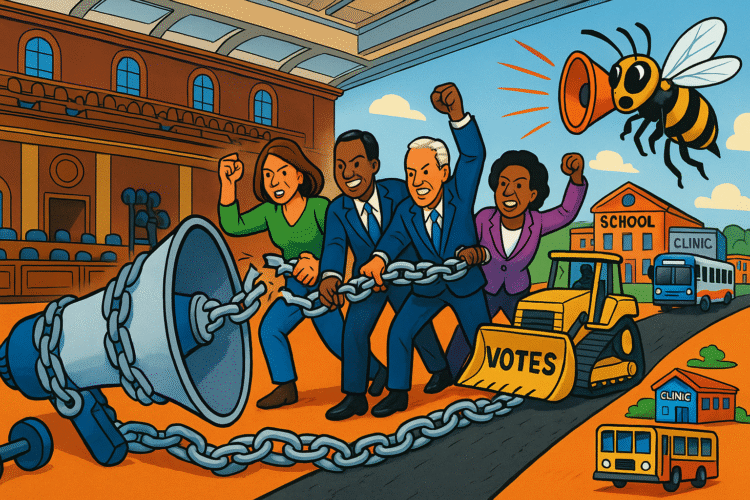
If Democrats want to govern, they have to stop apologizing for oxygen, pick fights they can win in public, scrap the procedural choke points on purpose, and brag until the story sticks.
There is a certain sound to a party that does not trust itself. It is crisp, consultative, and terrified of verbs. You can hear it in the way a press conference lands like a voicemail from a manager. You can hear it in the way the word affordability appears as if it were sacred text instead of a bill and a deadline. You can hear it in the way good people who know exactly what they want to fix keep trying to earn permission from a system that only hands out delays. This is the argument for a different sound. Loud, human, and unembarrassed. The pitch is simple. Be yourselves, be specific, stop waiting for etiquette to bless your convictions, and once the voters hand you keys, drive like you have somewhere to be.
The defensive crouch came from somewhere real. Every Democrat in public life can recite a story about a sentence turned into a cudgel, a vote framed as betrayal, a good faith compromise advertised as weakness. Entire careers have been spent learning how to avoid the next trap. What got lost in the safety drills was the reason anyone ran in the first place. People did not ask for caretakers of a delicate etiquette. They asked for custodians of public goods. They asked for health care that does not require a scavenger hunt, housing that is not a casino, schools that are not treated as warehouses for anxiety, and public transit that respects a worker’s time like it is money. None of that is radical. What feels radical is saying it in a voice that belongs to a person and then acting like the person who said it means it.
The script for the next cycle should be short enough to memorize and grounded enough to survive contact with a rent bill. Lead with what you love. Name what you will change. Explain how it touches a life. Then make it impossible to mistake your plan for a memoir. Talk like a neighbor who is done being polite about the leak in the ceiling and has the number for the plumber. It helps to remember that political speech is not literature. It is a tool for coordination. Clarity is not a risk when you are right. It is the only way anyone can join you in time.
The second part of the argument is about permission. Voters are not waiting for perfect copy. They want evidence that you know who gets hurt when the grown ups in the room confuse caution for responsibility. They want a sentence that sounds like a vow and a government that behaves like a promise kept in increments. The most honest way to deliver both is to quit behaving like process is an altar. Process is a tool. It can honor democracy or throttle it. If your plan is to make health care cheaper, protect the vote, regulate climate damage, and keep guns out of hands that want to turn a classroom into a crime scene, you do not need a seminar in sacred tradition. You need a majority that acts.
That is where the filibuster enters like a tired ghost. It has been sold as a guardian of deliberation. In practice, it is a choke collar that rewards the politician who prefers attention to results. The country lives in the consequence of that choice. If you finally win the right to legislate, do not hand your power to a parliamentary trick designed to make the public believe nothing can change. Scrap it. Pass what you promised. Take the heat. When the editorial page scolds you about norms, smile and point to the family that can pay rent, the clinic that can keep its lights on, the voting line that moves because the precinct finally has enough machines. Breaking a bad habit is not a scandal. It is a release.
Norms are not scripture. They are practices. Some protect the people from the powerful. Some protect the powerful from accountability. A mature party should be able to tell the difference without pretending to be shocked. Keep the norms that guard voting, transparency, independent courts, and a press that can ask hard questions without a permission slip. Retire the norms that let a minority veto the basic maintenance of a modern society. Build new ones where the old ones have become decorative. Protect whistleblowers like they are valves on a pressure system. Treat inspectors general like smoke alarms. Stop behaving like etiquette is a branch of constitutional law.
The third part is the one that consultants love and forget. Talk about real things like they are real things. There is a reason good policy gets rejected as message. It is written like it was designed to impress a grant committee, not a parent who is deciding between groceries and a co pay. Translate what you intend to do into the units people live in. Dollars on a bill. Minutes waiting for a bus. A school nurse who is either there or not. A landlord who either gets fined or gets away with it. The more specific you are, the less oxygen you leave for the pundit who swears your program is a mood. The more concrete you are, the easier it is for a voter to tell whether you delivered. If you are afraid of that test, you need a better plan.
It is not enough to speak clearly. You also have to pick your enemy. That does not mean you turn every sentence into an attack. It means you tell the truth about who profits from the status quo. You do not have to scream at a billionaire to be honest about the way concentrated wealth has turned public institutions into negotiating partners instead of referees. You do not have to demonize a cop to be honest about which calls never needed a gun and a badge. You do not have to sneer at a landlord to be honest about the way the law lets profit pretend it is a civic good while a kid learns what mold does to lungs. Politics is not a therapy session. It is a contest over material outcomes. Everyone knows someone is benefiting from the way things are. If you do not say who, your opponent will, and their list will be ugly.
Once you are elected, the argument gets simpler. Deliver. That is not a slogan. It is a work plan. Build a schedule of promises with deadlines and line items. Show your work weekly. When you miss, say so. When you change course, say why. Make sure that every agency head knows they will be judged by what a person can feel, not by a spreadsheet that balances in theory. Hire for competence and spine. Fire for indifference. Protect the public servants who are trying to turn vision into service, and confront the ones who have learned to hide inside a binder.
There is a school of thought that says governing is the art of managing expectations. That school teaches people to speak as if the point of politics is to avoid disappointment. It is not. The point is to aim ambition at the places where it can change the most lives and then fight like you mean it. That requires triage. Pick the first three fights that will move the needle on the cost of living, the dignity of work, and the fairness of the ballot. Finish them. Then move to the next three. Nothing destroys a narrative like visible execution.
Here is the part that will make the etiquette police faint. After you deliver, talk about it constantly. Not with a victory lap’s smugness. With the clarity of a builder who wants more hands on the site. There is a superstition among polite liberals that bragging is gauche. It is not bragging to tell someone what their government did for them. It is democratic hygiene. The other side has made a lifestyle out of advertising phantom victories and converting spite into brand loyalty. You are allowed to publicize actual successes. You are obligated to, because the press has a limit on how many times it will cover a ribbon cutting, and your opposition has an unlimited capacity for narrative sabotage.
If you are worried about backlash, good. It means you are alive. There will be days when a change you make offends someone you like. There will be days when a policy you love hurts in an unintended way. The answer is not to retreat into passive language and call it prudence. The answer is to show up, admit the trade, and make a fix you can measure. The country can forgive an error that comes from trying to deliver. It will not forgive a pattern of caution disguised as wisdom. Courage is not a tone. It is a habit.
There is a deeper moral claim at stake. Politics that avoids conflict is not neutral. It collaborates with the strongest interests in the room. In a society where wealth has managed to become a weather system, neutrality is a choice about who gets soaked. If you want to be the party of nurses, teachers, line cooks, home care workers, delivery drivers, renters, and small business owners who play by the rules, you have to show up for those people in conflicts that matter. That means rewriting procurement so the deal flow stops rewarding the donor class by default. It means enforcing wage theft like it is an actual crime. It means regulating pollution like a health intervention, not a legal puzzle. It means investing in mental health responders and violence interruption so that safety is a plan, not a posture. None of this requires a miracle. It requires using every legal tool you have and refusing to apologize for using it.
There is a myth that Democrats must choose between heart and competence. The strongest leaders do not pick. They tell you what breaks their heart and then they show you the invoice for the fix. They can cry without becoming sentimental, laugh without becoming flippant, and punch without becoming cruel. Voters can smell the difference. They do not always use the same words for it, but they know when someone is avoiding the real. They know when a candidate is trying to romance them with process because the plan is too small to feel. They know when a politician is pretending to be normal because normal is safer than honest. If you want people to show up for you, show up for them with sentences that contain a subject, a verb, and a promise that can be audited.
The press is part of this ecosystem. It contains both heroes and habits. It loves a conflict and forgets a spreadsheet. It will punish you for monotony and punish you for chaos. You cannot control it and you do not have to. You can feed it a storyline that is stubbornly boring in the right way. This week, this thing got cheaper, this many people felt it, here is the name of one. Repeat until it becomes wallpaper, then repaint the wall with the next chapter. The job is not to win the take economy. The job is to starve it until it learns to cover the impact economy again.
This is not a purity test. It is a performance standard for grownups. You can negotiate. You can compromise. You can be strategic about sequencing and timing. You cannot pretend that manners are a substitute for outcomes. You cannot promise a city that you will keep it livable and then accept that a minority of senators can block a floor vote because an old rule says they can. You cannot say you believe in voting rights and then treat a procedural relic like a sacred totem. You cannot insist that climate policy must pass and then soothe yourself with executive orders that will be erased by the next indifferent administrator. If you mean it, legislate it. If you legislate it, defend it. If you defend it, celebrate it.
So what does being yourselves actually look like. It looks like Kamala Harris refusing to evacuate her own moral clarity when she describes what a government owes a child or a patient. It looks like Pete Buttigieg explaining a supply chain in plain English on a loading dock at dawn, not in a studio that confuses poise with proof. It looks like Alexandria Ocasio Cortez taking a hearing and using it to make power visible to an audience that is never invited into the room. It looks like Elizabeth Warren building a whiteboard narrative that ends with a bill someone can hold. It looks like Bernie Sanders aiming his anger at a system instead of at the people trapped inside it. It looks like Gretchen Whitmer turning a plain sentence into a permission slip for a state that remembers what solidarity feels like. It looks like governors, mayors, and council members talking about rent, food, transit, and wages like they have walked the long way home.
The other team already plays by this logic. They do not apologize for wanting power. They do not hide their program. They attempt to break institutions that block them and call it courage. The difference is that their project often requires cruelty to maintain momentum. Yours does not. You can be as unembarrassed as they are without importing the rot. The way to prove it is to deliver improvements that land in a bank account or a body. People will forgive your lack of poetry if the money and the oxygen arrive on time.
There is a final fear that keeps good Democrats cautious. The fear that being unapologetic will be confused with arrogance. The cure for that fear is not silence. It is humility in execution. Make the promise. Do the work. Credit the people who made it possible. Share the microphone. Show your math. Admit the error. Fix it in public. None of that reads as arrogance. It reads as adult.
If you need a mantra for the next cycle, use three sentences and tattoo them on the schedule. Be yourselves. Break the vetoes that exist to make you fail. Tell the story of what you did until people are sick of hearing it, then tell it one more time for the person who just got off a double shift and missed the first three.
The truth underneath all of this is not philosophical. It is mechanical. The problems that most people experience are the result of deliberate choices that benefit someone who can pick up a phone. Undoing those choices requires a kind of political stubbornness that looks rude in the green room and feels like rescue at the bus stop. If you are tired of losing arguments you should be winning, change the venue. If you are tired of waiting on etiquette to bless the obvious, stop asking.
What The Cameras Did Not Show
The country is not allergic to Democratic policy. It is allergic to Democratic caution that masquerades as kindness while rent climbs and wages stall and the vote gets harder to use. The fix is not a better slogan. It is a better posture. Speak in the units that people live in. Name the actors who profit from delay. Win a majority and use it like it matters by scrapping procedural choke points that were designed to exhaust you. Pass what you promised, enforce what you passed, and turn your results into a drumbeat so steady that even your critics learn the tune against their will. If the etiquette police tut, let them. If your opponents howl, let them. The measure is whether the family with a sick kid gets care without a panic, whether the worker can afford a day off without catastrophe, whether the ballot is a right instead of a maze, and whether the planet your grandchild meets feels like a home instead of a dare. You already know how to talk about that. You already know how to fight for it. The last step is permission. Take it.